Fleet managers are no strangers to the pain of fuel logistics. Between tracking consumption across dozens of vehicles, coordinating dispatch, managing invoices, and reconciling data across systems, the operational overhead is enormous, and even a single wrong step can lead to costly downtime. The global mobile fuel delivery market is valued at $5.84 billion in 2025 and is projected to reach $11.93 billion by 2035 (Future Market Insights), growing at a CAGR of 7.4%. This isn’t just a trend; it’s a structural shift in how businesses manage fuel across their operations.
But here’s the challenge most decision-makers run into: they already have an ERP system. They already run fleet management software. The last thing they want is to commission an expensive, months-long custom development project just to add on-demand fuel delivery to their stack.
That’s exactly the gap this blog addresses. A modern on-demand fuel solution doesn’t need to be built from scratch to integrate with your existing ERP and fleet tools. With the right approach to fuel delivery app development, businesses can leverage ready-made, white-label platforms that plug directly into existing infrastructure, without custom builds, massive dev budgets, or operational disruption.
What Is an On-Demand Fuel Delivery App and Why Does It Matter for Fleets?
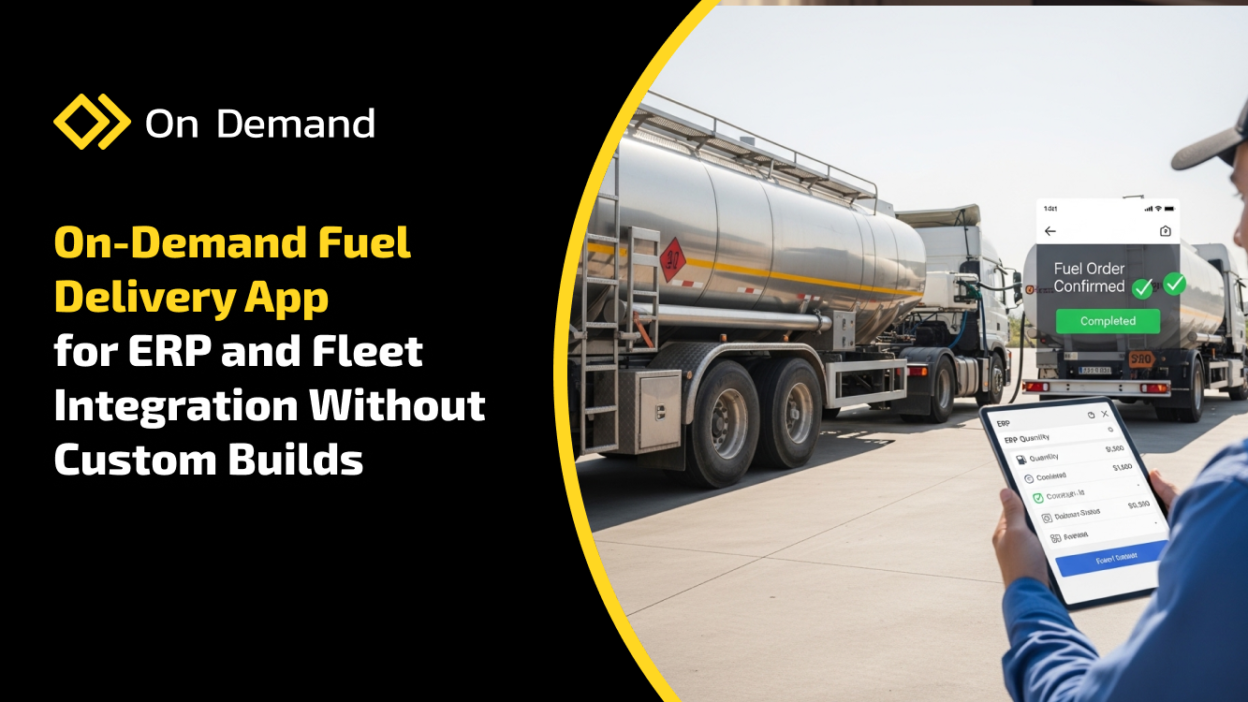
An on-demand fuel delivery app is a mobile platform that allows businesses and individuals to order fuel, diesel, petrol, or other variants directly to a specified location. For fleet operators, this means vehicles get refuelled on-site, at the yard, or at job sites, eliminating the need to route drivers to fuel stations mid-shift.
For enterprise and B2B operators, the value goes far beyond convenience. When integrated correctly, a mobile fuel delivery app becomes a data layer connecting real-world refuelling events to your financial systems, fleet telematics, and dispatch workflows. It becomes part of your operational backbone, not a standalone tool.
The on-demand economy is projected to reach $335 billion by 2026 (PwC), and fuel is one of its most promising verticals. Fleet downtime costs businesses approximately $760 per hour on average. Every hour a vehicle waits for fuel, or worse, runs dry in the field, eats directly into margins. A well-integrated fuel delivery platform directly addresses that.
Why ERP and Fleet Integration Is the Real Game-Changer
Most businesses evaluating a fuel delivery platform ask the wrong first question. They ask, “How do we build this?” when the better question is, “How does this connect to what we already have?”
ERP systems like SAP, Oracle, QuickBooks, Zoho Books, or Tally are the financial nervous system of any mid-to-large enterprise. Fleet management software and telematics platforms track vehicle location, maintenance schedules, driver behaviour, and fuel consumption. When a fuel delivery app operates in isolation from these systems, businesses end up with fragmented data, duplicate entries, and manual reconciliation, the same inefficiencies they were trying to solve in the first place.
The real value of on-demand fuel delivery for fleet operations emerges only when the app talks to your other systems. Here’s what integrated fleet fuel management software actually enables:
- Automated fuel consumption tracking synced directly to your ERP or accounting software, no manual data entry, no end-of-month scramble.
- Real-time inventory visibility so dispatch managers know exactly how much fuel each tanker carries and can allocate orders intelligently.
- Per-vehicle cost allocation linked to fleet IDs in your existing system, making financial reporting accurate and audit-ready.
- Compliance documentation is generated automatically and matched with records in your ERP for regulatory requirements around hazardous goods transport.
This is why fuel delivery app compliance for hazardous goods is not an afterthought; it’s baked into a properly integrated platform. When your ERP holds compliance records and your delivery app handles on-ground execution, the integration ensures nothing falls through the cracks.
Key Features a Fuel Delivery App Must Have for ERP and Fleet Integration
Not all mobile fuel delivery apps are built for enterprise integration. When evaluating platforms, look for these core capabilities:
1. API-First Architecture
The app should expose RESTful APIs that connect with major ERP systems (SAP, QuickBooks, Oracle, Zoho, Tally) and fleet platforms without requiring custom middleware development. This is non-negotiable for seamless data flow.
2. Real-Time GPS Tracking and Dispatch
Integrated GPS enables fuel dispatch software to assign the closest available tanker to an active request, optimise routing, and update fleet managers in real time, all synced with the fleet management layer.
3. Digital Delivery Manifests
Every delivery should generate a digital proof-of-delivery document, timestamp, GPS coordinates, quantity dispensed, and driver signature that auto-syncs with your ERP for invoicing and inventory deduction.
4. Fleet-Level Consumption Dashboard
A centralised dashboard that maps fuel usage to individual vehicle IDs, driver profiles, and department codes. This data should export directly into your accounting system to eliminate rekeying.
5. Automated Invoicing and Reconciliation
Fuel orders trigger automatic invoice generation, which flows into your ERP’s accounts payable module. This removes the manual billing cycle entirely and accelerates cash flow.
6. Role-Based Access and Multi-Site Management.
For companies with multiple depots, construction sites, or logistics hubs, the platform should allow different admins to manage their own sites while giving HQ a consolidated view.
7. Telematics and IoT Integration
Advanced fleet fuel management software integrates with telematics devices on tankers to monitor actual dispensed quantities, cross-check with meter readings, and flag discrepancies, preventing fuel theft or errors.
For a deeper look at how automated dispatching reduces chaos in fuel operations, resources like how automated dispatching software solves fuel delivery chaos provide useful operational context.
How ERP + Fleet Integration Works: The Technical Flow
Understanding the data flow helps decision-makers ask the right questions during vendor evaluation. Here’s how a well-integrated on-demand fuel delivery app operates end-to-end:
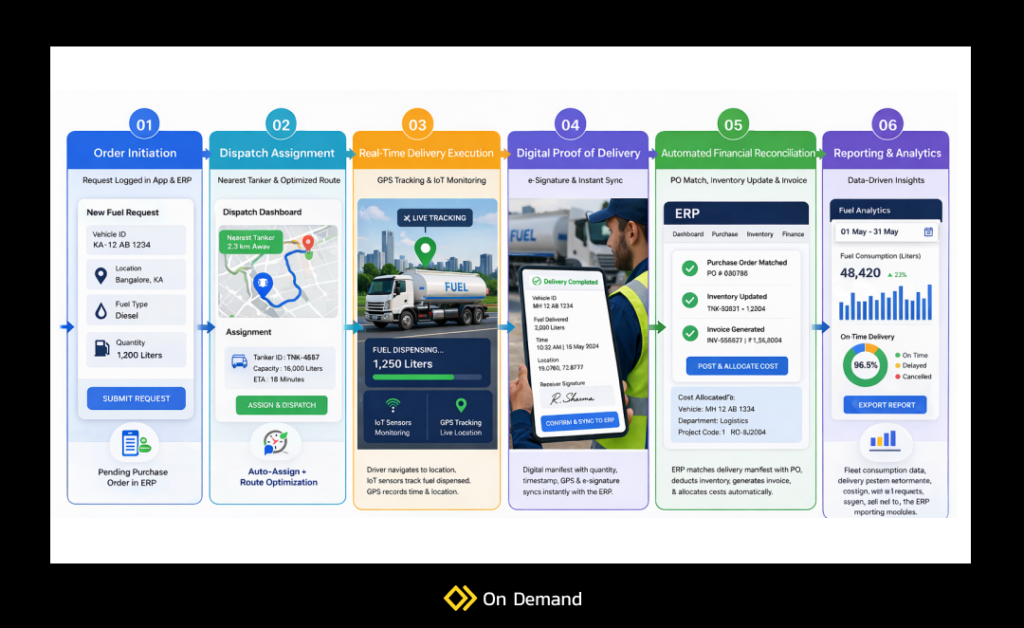
Step 1: Order Initiation
A fleet manager or driver logs a fuel request via the mobile app. The request includes vehicle ID, location, fuel type, and quantity. This request is simultaneously logged in the ERP as a pending purchase order.
Step 2: Dispatch Assignment
The fuel dispatch software identifies the nearest available tanker from the fleet, considers the current load and route, and auto-assigns the delivery. Route optimisation runs in the background to calculate the fastest path, following principles similar to fuel delivery route optimisation best practices that reduce drive time and tanker idle cost at the dispatch level.
Step 3: Real-Time Delivery Execution
The driver uses the app to navigate to the vehicle’s location. IoT sensors on the tanker track the actual fuel dispensed. GPS records the delivery location and time.
Step 4: Digital Proof of Delivery
Upon completion, the app generates a digital delivery manifest, quantity, timestamp, GPS tag, and e-signature. This document syncs instantly with the ERP.
Step 5: Automated Financial Reconciliation
The ERP matches the delivery manifest against the purchase order, deducts inventory, creates an invoice, and allocates the cost to the relevant fleet vehicle, department, or project code.
Step 6: Reporting and Analytics
Fleet consumption data, delivery performance metrics, and cost-per-vehicle reports are available on the dashboard and can be exported or scheduled into ERP reporting modules.
This end-to-end flow is what turns a mobile fuel delivery app into a genuine operational tool rather than just a convenience add-on. Every step is traceable, every data point is system-linked, and there is no room for manual error or information gaps between field operations and back-office finance.
White Label vs. Custom Build: The Business Case for Not Starting From Scratch
This is where the most common misconception lives. Many businesses believe that integrating a fuel delivery app with their existing ERP requires a full custom development project, designed from scratch, built over months, and maintained by their own dev team.
The reality is very different. A white-label fuel delivery app from an experienced platform provider already has the integration framework built in. What you’re customising is the branding, workflows, and configuration, not the core architecture.
Here’s what the comparison actually looks like:
| Factor | Custom Build | White Label Platform |
| Time to Launch | 6–12 months | 4–8 weeks |
| Development Cost | $80,000–$250,000+ | A fraction of the cost |
| ERP Integration | Built from scratch | Pre-built connectors |
| Maintenance | Your team | Vendor managed |
| Scalability | Custom scaling needed | Built-in scalability |
| Risk | High — untested | Low — proven in the market |
Businesses that have gone the custom route often find that by the time the product launches, their operational needs have shifted. The platform is already outdated, and they’re locked into expensive maintenance contracts. Companies that understand how fuel delivery startups scale without rewriting platforms consistently choose white-label infrastructure as the foundation — then configure and extend it as needed.
Read More: How Fuel Delivery Startups Expand from Pilot to Scale Without Rewriting Software Platforms
White labelling also creates a faster path to revenue. For companies offering fuel delivery as a service, whether fuel distributors, logistics operators, or energy startups, launching under their own brand in weeks rather than months translates directly to market advantage.
The Revenue Model: Why Integration Makes Subscription Pricing Work
One underappreciated benefit of ERP-integrated fuel delivery platforms is how they unlock scalable, recurring revenue models, and why integration is what makes those models sustainable in practice.
When fuel consumption data flows automatically into your accounting system, subscription billing becomes straightforward to manage. Fleet operators increasingly prefer subscription pricing over transactional billing because it simplifies budgeting, reduces invoice volume, and creates predictable cash flow for both the operator and the fuel provider.
But here’s the part that most platform discussions skip: subscription models only work reliably when the delivery data is accurate and automatic. If a fleet subscribes to weekly fuel deliveries capped at a certain volume, the platform needs to track actual delivery quantities per vehicle, match them against contract thresholds, trigger billing at the right time, and generate itemised reports, all without manual intervention. That’s only possible when the fuel delivery app is genuinely integrated with your ERP and fleet management layer.
For example, a logistics company running 40 vehicles across three depots might structure a subscription where each depot has a monthly fuel cap by vehicle class. When the delivery app records each fuelling event and syncs it to the ERP in real time, the billing module can automatically calculate overages, generate invoices per depot, and provide consumption reports to each depot manager, all from a single integrated system. Without ERP integration, this requires someone to cross-reference spreadsheets at month-end, which introduces delays, errors, and disputes.
A fleet fuel delivery subscription platform built on white-label infrastructure handles this natively; billing cycles, consumption thresholds, volume tiers, and contract terms are all managed within the platform and reflected in real time in the connected ERP. This is what transforms on-demand fuel delivery from a transactional service into a managed, contracted revenue stream with predictable margins on both sides.
Who Actually Needs This? Real-World Use Cases
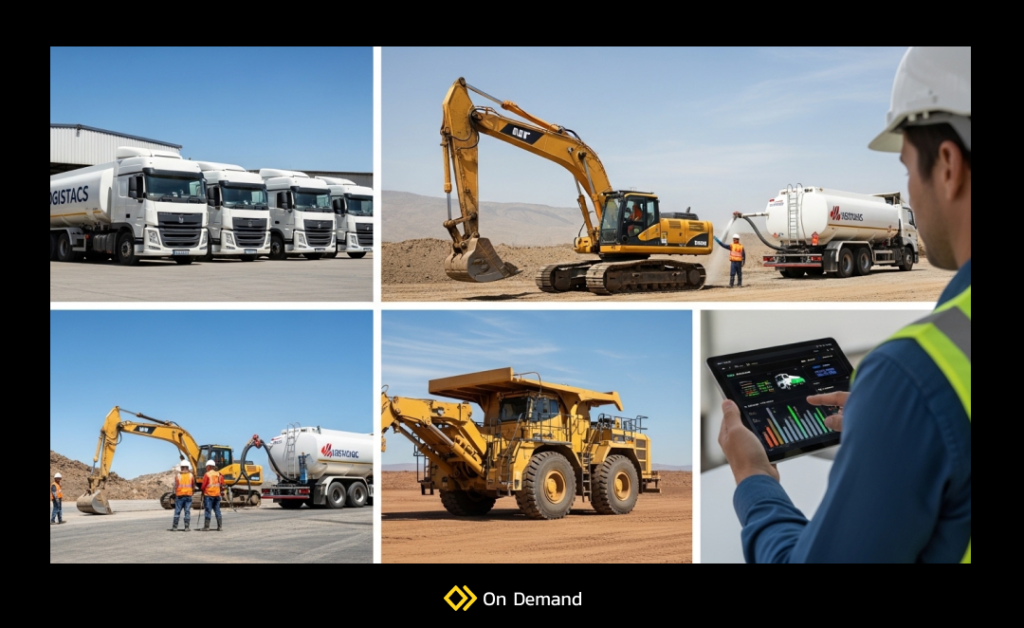
The on-demand fuel delivery app with ERP and fleet integration isn’t a one-size-fits-all consumer product. It’s built for specific business categories where fuel is a high operational cost and manual management is a liability.
Logistics and Transport Companies Businesses running large truck fleets spend significant time and money routing drivers to fuel stations. Integrating on-demand fuel delivery with their fleet management system eliminates station stops, reduces idle time, and links every litre of diesel directly to a shipment, enabling per-delivery cost accounting.
Construction and Mining Operations: On-site equipment, excavators, generators, and heavy machinery cannot be driven to a fuel station. These sectors rely entirely on delivered fuel, making mobile fuel delivery apps with on-site delivery and ERP integration a necessity, not a luxury.
Third-Party Logistics (3PL) Providers 3PL operators managing fuel for multiple client fleets need multi-tenant capability, per-client reporting, and integration with different ERP systems depending on the client. A white-label platform with flexible API connectivity makes this possible without building separate solutions for each client.
Fleet Rental and Leasing Companies. For companies managing truck booking app platforms and vehicle fleets, tracking fuel consumption per vehicle and per rental contract is critical for billing accuracy and asset management. Integration with accounting ERP makes this automatic.
Energy Distributors and Fuel Retailers. For fuel businesses expanding into the on-demand space, a white-label delivery app with integrated dispatch software and ERP connectivity allows them to launch a new revenue stream without building proprietary technology.
Exploring multi-product energy delivery apps shows how this applies across fuel types, including gas and lubricants.
Common Challenges and How the Right Platform Solves Them
Even with a white-label platform, there are real challenges businesses face during integration. Knowing them up front saves time and budget.
- Data Silos Between Systems. When fuel delivery data doesn’t automatically sync with the ERP, someone is manually entering records. A platform with pre-built ERP connectors (SAP, QuickBooks, Zoho, Oracle) eliminates this and ensures a single source of truth across departments.
- Compliance and Regulatory Records Fuel is a regulated product. From hazardous goods transport documentation to spill records, every delivery event needs a paper trail. Integrated platforms auto-generate compliance documents and sync them with the ERP’s document management module, so audits don’t become fire drills.
- Driver App Adoption Fleet drivers need a simple, intuitive mobile interface that doesn’t require training. White-label platforms designed for field use typically prioritise UX for non-technical users, one of the areas where off-the-shelf solutions consistently outperform custom builds designed by engineers for engineers.
- Fuel Theft and Meter Discrepancies Without IoT integration between the physical tanker meter and the digital delivery record, discrepancies are hard to detect. Integrated platforms cross-reference digital order quantities against physical meter readings in real time, flagging any gaps before they become losses.
- Multi-ERP Environments: Larger enterprises often run different ERP systems across business units or geographies. The right platform offers configurable API layers that can connect to multiple ERP environments simultaneously, without duplicating data or creating reconciliation headaches.
How to Get Started: A Practical Path Forward
Implementing an on-demand fuel delivery app with ERP and fleet integration doesn’t require a 12-month roadmap. Here’s a realistic path:
- Audit your existing systems – list which ERP, fleet management, and telematics platforms you currently use and identify the key data points that need to flow between them.
- Define your use case – are you the fuel provider, the fleet operator, or both? The platform configuration varies by your role in the delivery chain.
- Evaluate white-label platforms – prioritise vendors with proven ERP connectors, not just demo promises. Ask for live integration examples with SAP, QuickBooks, or Zoho.
- Pilot with one fleet or one site – launch a controlled rollout, validate the data flow, and train your dispatch team before scaling.
- Scale and add features – once the integration is stable, layer on subscription billing, compliance reporting, and multi-site management.
Conclusion
The shift toward on-demand fuel delivery isn’t just about convenience; it’s about connecting the last mile of your fuel supply chain to the systems that actually run your business. Fleet operators, logistics companies, and energy distributors that get this integration right stop managing fuel manually and start managing it intelligently.
The good news is that you don’t need a custom-built platform to get there. A white-label on-demand fuel delivery app with the right ERP and fleet integration framework can be live in weeks, not months, with proven connectivity to SAP, QuickBooks, Oracle, Zoho, and the telematics tools your team already relies on. The infrastructure already exists. The decision is simply whether to build it from scratch or deploy something that works today.
If your operation is still reconciling fuel data manually at month-end, or routing vehicles to stations when they could be refuelled on-site, the gap between where you are and where integrated fuel delivery can take you is closer than you think.
FAQs:
Q1. Can a white-label fuel delivery app integrate with SAP or QuickBooks without custom development?
Yes. Reputable white-label platforms come with pre-built API connectors for major ERP systems, including SAP, QuickBooks, Zoho, and Oracle. Configuration is required, but custom development from scratch is not.
Q2. How long does it take to launch an on-demand fuel delivery app with fleet integration?
A white-label platform can be configured and launched in 4 to 8 weeks, compared to 6 to 12 months for a fully custom build, making it the faster and more cost-effective path for most businesses.
Q3. What is fuel dispatch software, and is it different from a fleet management system?
Fuel dispatch software specifically manages the assignment, routing, and tracking of fuel delivery tankers. Fleet management software tracks the vehicles being fuelled. When integrated, both systems share data in real time for complete operational visibility.
Q4. Is a mobile fuel delivery app suitable for construction sites and remote locations?
Yes. Mobile fuel delivery apps are specifically designed for on-site delivery scenarios — construction sites, mining operations, and remote depots — where vehicles and equipment cannot travel to a fuel station.
Q5. What’s the cost advantage of a white-label fuel delivery app over a custom-built one?
Custom fuel delivery app development typically costs $80,000 to $250,000 or more, with ongoing maintenance costs. A white-label platform costs a fraction of that, includes ongoing updates from the vendor, and deploys in weeks rather than months.