A fleet of 50 vehicles. 61 hours wasted per vehicle every year, just driving to gas stations. That is 3,050 hours of dead productivity your operations budget silently absorbs. This is the problem that Filld set out to solve in 2015, and it is the same one driving rapid growth in the global on-demand fuel delivery app market.
Filld raised $12.2 million, secured investment from Shell Ventures, partnered with Bentley Motors and Car2Go, and built one of the most instructive fuel delivery models in the industry, before being fully acquired by Shell. If you are an entrepreneur, fleet operator, or fuel distributor exploring this space, Filld’s journey is your clearest blueprint.
This guide gives you everything: Filld’s full business model, including the hybrid B2B and B2C strategy that no competitor blog covers completely, an honest look at the real challenges it faced, a complete feature breakdown, and a practical step-by-step plan for building your own fuel delivery app. Whether you are looking for a ready-made fuel delivery app solution or a fully custom platform, you will find the right path here.
What Is Filld? The On-Demand Fuel Delivery App That Changed Refuelling
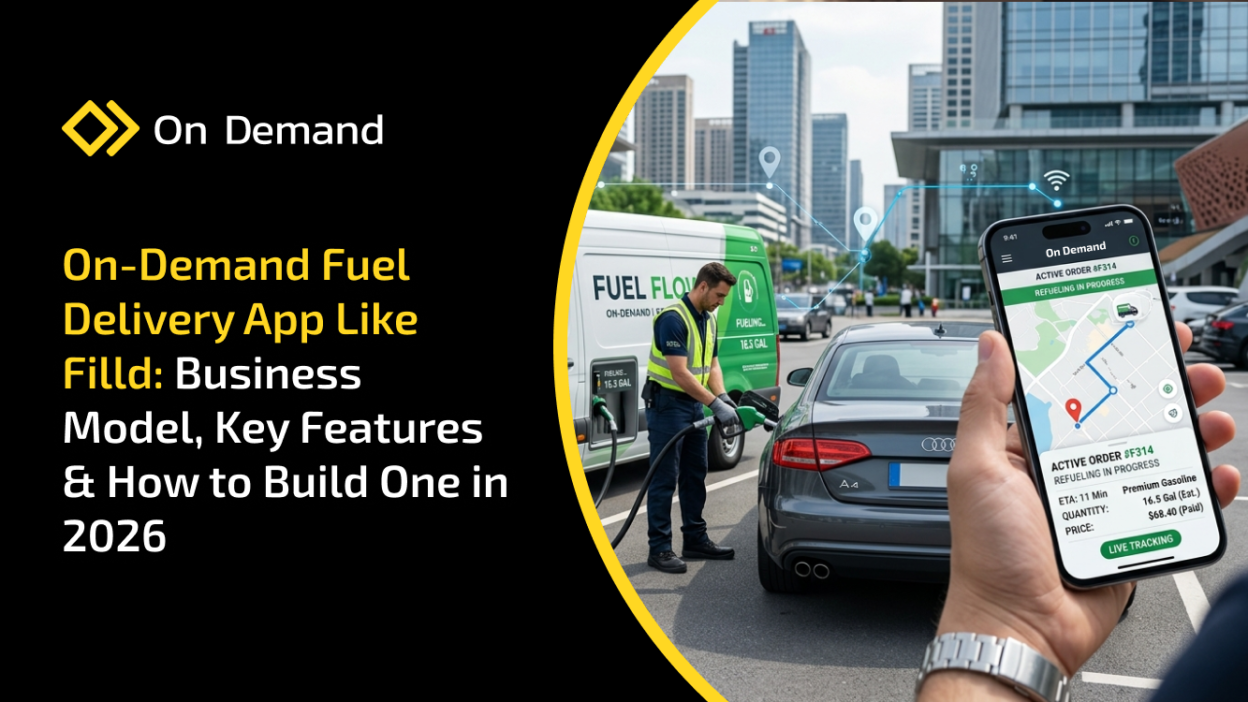
Filld is an on-demand fuel delivery platform founded in 2015 in Berkeley, California, by Gina Al-Debi, Chris Emberley, and Ian Faulconbridge. The premise is simple: instead of driving to a gas station, drivers schedule fuel delivery directly to any parked vehicle, via mobile app or SMS confirmation.
Filld operated across the San Francisco Bay Area, Washington DC, Portland, and Vancouver, Canada, making it one of the few fuel delivery platforms with genuine cross-border North American reach. Strategic partnerships with Car2Go and Bentley Motors gave it early credibility on both consumer and enterprise sides of the market.
Shell Ventures invested early, and Shell ultimately acquired the company, a direct signal that the world’s largest energy companies view mobile fuel delivery as critical infrastructure, not a startup experiment.
What Is Filld? (Quick Answer)
Filld is a mobile on-demand fuel delivery platform that allows individual car owners and commercial fleet operators to schedule fuel delivery to any parked location. It runs a hybrid B2B + B2C business model and generates revenue through fuel markup, dynamic delivery fees, and enterprise fleet contracts.
Filld at a Glance
Filld has raised a total of $12.2 million in funding since its inception. The company was founded in 2015 and, at its peak, operated across four major cities. It was ultimately acquired by Shell, making it a strategically significant player in the on-demand fuel delivery space.
Filld’s Business Model — The Hybrid B2B + B2C Strategy
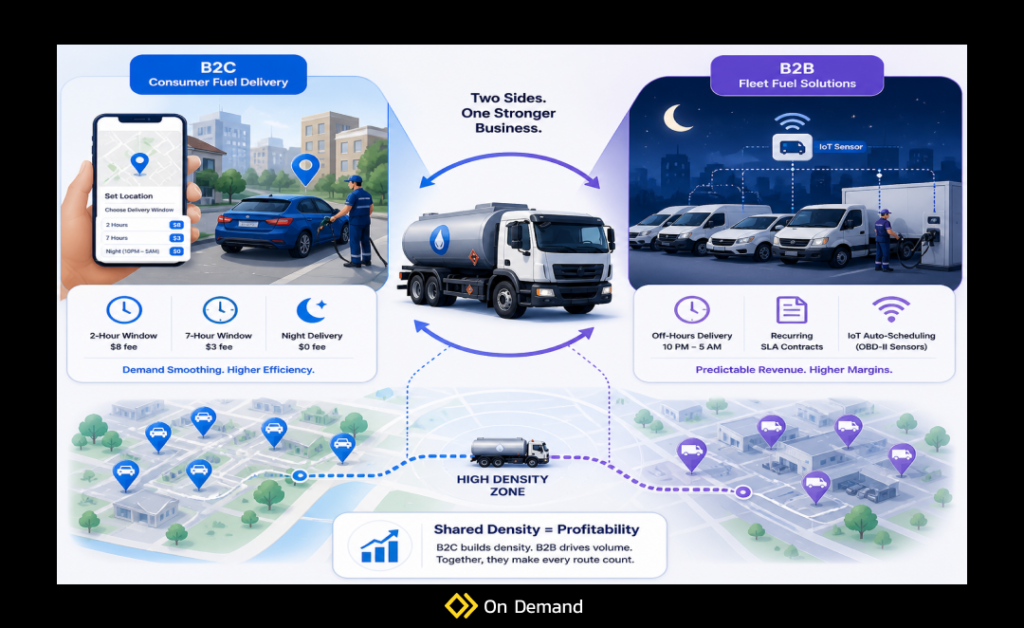
Most existing blogs about Filld cover either its consumer model or its fleet model — never both together. That is a critical omission, because Filld’s real strategic insight was how the two sides of its business reinforced each other. Here is the complete picture.
B2C Model: Consumer Fuel Delivery
Individual car owners register their vehicle, pin their parking location, and choose a delivery window. Filld’s pricing was designed to shape demand, not just reflect it:
- 2-hour window = $8 fee, high urgency, premium pricing
- 7-hour window = $3 fee, flexible, lower price
- Slow-demand nights = $0 fee, demand smoothing, not a charity offer
That $0 night delivery is Filld’s most underrated operational innovation. When trucks are already deployed in a low-booking zone, free delivery fills empty route capacity without adding operating costs. This is demand smoothing, the same pricing logic airlines use for unsold seats, and it is a mechanism that most fuel delivery businesses never implement.
B2B Fleet Model: The Real Revenue Engine
Filld’s B2B side served commercial vehicle fleets, Car2Go’s carshare network, and Bentley Motors dealerships. The mechanics were entirely different from consumer delivery:
- Off-hours delivery (10 PM–5 AM): Fleet vehicles fueled overnight, ready for the morning shift. Zero driver downtime.
- Recurring SLA contracts: Monthly service agreements with fixed fees plus market-rate fuel, predictable, high-margin revenue.
- IoT auto-scheduling: OBD-II port sensors monitored real-time fuel levels and triggered automatic delivery orders when a tank dropped below a set threshold. No manual scheduling required. This is the kind of automation that IoT development for fuel apps makes possible, and what separates enterprise platforms from consumer apps.
For a complete technical breakdown of how Filld’s IoT architecture and fleet scheduling system worked, the Filld fleet fueling case study covers the ERP integrations, REST API layer, and enterprise dashboard in detail.
Why the Hybrid Model Beats Either Alone
Here is the insight that no competitor blog explains: the B2C and B2B sides of Filld’s business were operationally interdependent. B2C orders built customer density in a geographic zone, meaning one truck could handle multiple deliveries per hour in a tight area. That density is what made B2B fleet routes economically viable in the same zone. Without B2C density, B2B routes are too expensive to run profitably. Without B2B volume, B2C alone cannot cover fixed operating costs. The hybrid is the strategy, not a coincidence.
For a deeper look at how recurring fleet contracts generate compounding revenue, see our breakdown of the fleet fuel delivery subscription model, the most important structural decision for any new fuel delivery business.
How Filld Makes Money — 4 Revenue Streams Explained
Here is a specific breakdown of Filld’s four revenue streams, with real numbers. This level of detail does not exist in any other fuel delivery blog currently ranking.
1. Fuel Markup
Filld purchases fuel at wholesale rates and sells it at the local pump price. Estimated margin: 5–10% per litre. A 20-litre fill-up at $2.00/litre generates a $40 sale with approximately $2–$4 in gross fuel margin. Multiplied across hundreds of daily deliveries, this compounds meaningfully and grows proportionally with fleet contract volume.
2. Dynamic Delivery Fees
Delivery fees range from $0 to $8 per order based on the window selected. High-urgency short windows carry premium fees; slow-night windows attract demand with free delivery. This mechanism manages demand, optimizes truck routes, and generates revenue, three outcomes from a single pricing layer.
3. B2B Fleet Contracts
Monthly SLA contracts are Filld’s highest-margin revenue stream. Pre-committed volume eliminates demand uncertainty, enables efficient route planning weeks in advance, and carries far lower customer acquisition costs than individual consumer orders. One fleet client with 40 vehicles generates the monthly equivalent revenue of 400–600 individual B2C deliveries.
This is why white-label fuel delivery software platforms built around fleet subscription logic are so commercially compelling — the unit economics at the contract level are structurally superior.
4. OEM Connected-Car API Partnerships
Filld’s partnership with Bentley Motors created a genuinely automated revenue stream: Bentley’s in-car system monitored fuel level and sent a low-tank alert to Filld’s API, triggering a delivery order with no driver action. Filld earns commission on every auto-triggered delivery. The customer never has to think about fuel again. This is the most scalable model in fuel delivery, and the one most worth replicating in any modern platform build.
Honest Challenges Filld Faced — What Every Fuel Delivery Startup Must Know
Every competitor blog about Filld presents only the success narrative. This section covers what actually made it difficult, because understanding these challenges is as valuable as understanding the business model, and Google’s quality signals reward blogs that demonstrate this kind of depth.
1. Regulatory Complexity
Fuel is a hazardous material in most jurisdictions. The San Francisco Fire Department actively opposed Filld’s operations, citing concerns about mobile hazmat dispensing in residential zones. Every new city required separate fire department clearance, HAZMAT transport permits, specific truck equipment certifications, and DOT licensing. There is no shortcut; compliance is a first-workstream task, not an afterthought.
A good development partner with experience in fuel delivery app ERP integration will build compliance workflows directly into your platform architecture, audit trails, driver certification tracking, and zone-level permit status, so that regulatory documentation is operational, not manual.
2. The Density Problem
B2C fuel delivery only becomes profitable when enough customers exist within a tight geographic zone to keep one truck busy across multiple deliveries per hour. Without density, the per-delivery cost, driver time, truck operation, insurance, fuel for the delivery truck itself, exceeds the revenue per order. This is why Filld’s focus on fleet accounts was not a pivot away from ambition; it was a rational response to unit economics.
3. Unit Economics Under Pressure
At a $5 average delivery fee and 10% fuel margin, a delivery truck needs 8–12 completed deliveries per shift just to break even on operating costs. This is mathematically very hard in consumer markets without high-density zones. Fleet contracts solve this by pre-committing volume — a single enterprise client with 30 vehicles delivers guaranteed nightly route density that no B2C marketing campaign can reliably replicate.
4. City-by-City Expansion Cost
Unlike software platforms that scale digitally, fuel delivery requires physical infrastructure in every new city: trucks, certified drivers, fuel supplier agreements, permits, and local density-building. Each expansion is essentially a new business launch. Filld expanded faster than its density metrics supported in some markets, one of the most important operational lessons any fuel delivery entrepreneur can take from its story.
Strategic takeaway: Start with fleet clients from day one. Consumer delivery can follow once you have proven unit economics and a dense operational zone. The hybrid model works, but fleet revenue is what makes the math sustainable.

Key Features of an On-Demand Fuel Delivery App Like Filld
A complete on-demand fuel delivery app solution is not one app; it is a connected ecosystem of three interfaces, each serving a different user with different needs.
Customer App Features
- Vehicle profile registration (make, model, fuel type)
- Delivery location pin with address confirmation
- Dynamic delivery window selector with live pricing ($0 / $3 / $8)
- Real-time GPS driver tracking with ETA
- In-app payment and digital receipt
- SMS confirmation option (Filld’s original low-friction entry point)
- Order history and fuel consumption summary by month
Driver App Features
- Prioritized order queue with route optimization
- Digital fuel delivery confirmation with quantity logging
- Safety checklist and HAZMAT compliance documentation
- Real-time communication with dispatch
- Low-tank alerts for connected vehicles
Admin Dashboard Features
The admin panel is where operational intelligence lives. Effective fleet fuel management software must give operators complete real-time visibility across the full delivery network.
- Live map view of all drivers, trucks, and active orders
- Demand heatmap and zone-level surge pricing controls
- Fleet account management with consolidated B2B invoicing
- IoT sensor dashboard for connected vehicle monitoring
- Driver performance analytics and compliance reporting
- Revenue analytics by channel (B2C vs fleet)
- ERP and telematics API integrations
Ready-Made vs. Custom: Which Fuel Delivery App Path Is Right for You?
This is one of the most important decisions every entrepreneur in the fuel delivery space must make early on. Your choice between a ready-made solution and custom development will directly impact your launch timeline, budget, scalability, and long-term flexibility.
Instead of vague comparisons, here is a clear, practical framework to help you choose the right path based on your business goals.
| Factor | Ready-Made / White-Label | Custom Development |
| Time to market | 4–8 weeks | 4–8 months |
| Budget range | $5K – $30K | $40K – $150K+ |
| Customization | Moderate | Unlimited |
| IoT / ERP integration | Limited | Full support |
| Scalability | Strong for regional launch | Enterprise-grade |
| Best for | Startups, new market entry | Funded ventures, large fleets |
Choose a Ready-Made Fuel Delivery App Solution If:
- Your budget is under $30K, and your launch timeline is under three months
- You are entering a new market and want to validate demand before committing to a full custom build
- You are a fuel distributor, gas station operator, or fleet manager who wants a branded delivery service without starting from scratch
Our ready-made fuel delivery app solution is pre-built around these exact use cases — deployable in weeks, customizable to your brand, geography, and pricing model.
Choose Custom Fuel Delivery App Development If:
- You need proprietary IoT integrations (like Filld’s OBD-II sensor auto-scheduling model)
- You require enterprise ERP or telematics connections to existing fleet management systems
- You are building a white-label platform for multiple operators or regions
- You have confirmed demand and institutional backing for a 4–8 month build
For custom builds with full technical ownership, custom fuel delivery app development gives you complete flexibility over architecture, integrations, and product roadmap.
How to Build an On-Demand Fuel Delivery App Like Filld — Step by Step
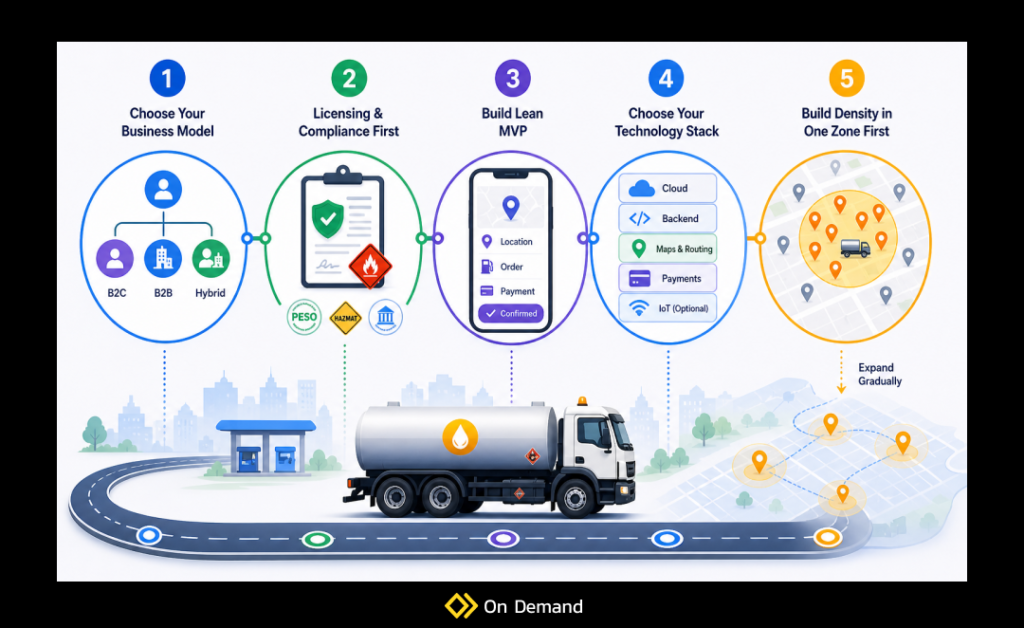
This section is structured for the practical builder. Follow this sequence to avoid the mistakes Filld made and move faster than it did.
Step 1: Choose Your Business Model
Before any technical decisions, define your model. B2C only? B2B fleet only? Hybrid like Filld? Your model determines your entire feature roadmap, driver requirements, pricing engine complexity, and launch geography. Write a one-page business model canvas before you approach any development team.
Step 2: Handle Licensing and Compliance First
Fuel is a hazardous material. In the US, DOT HAZMAT permits, fire department approvals, and HAZMAT-certified drivers are non-negotiable. In India, PESO Act compliance. In Canada, Transport Canada regulations. Each city or region is a separate compliance review. Start this workstream on day one, not after you have built the app. This is the step Filld learned the hard way in San Francisco.
Step 3: Build a Lean MVP–Validate Before You Scale
Filld launched with just three features: location pin, SMS confirmation, and payment. Everything else came after product-market fit was confirmed. An MVP development for a fuel delivery startup should follow the same principle: build the minimum viable delivery loop first: customer order → driver assignment → delivery confirmation → payment. Validate it with real customers before adding dynamic pricing, IoT, analytics, or ERP integrations.
Step 4: Choose Your Technology Stack
Key technical decisions include your mobile framework (React Native or Flutter reduce build cost significantly), cloud infrastructure for real-time data sync, mapping and routing API (Google Maps, Here, or Mapbox), payment gateway supporting recurring billing, and, if your model requires it, an IoT middleware layer for vehicle sensor integration. A mobile app development company experienced in field service or logistics applications will make far stronger architecture decisions than a generalist team.
Step 5: Build Density in One Zone Before Expanding
Do not move to city #2 until you have profitable route density in city #1. A practical benchmark: at least 200 active customers in a 5km radius, with one truck completing 8 or more deliveries per shift. Without this density, expansion multiplies losses rather than revenue. This is Filld’s most important operational lesson.
Ready to move forward? Our team at an on-demand app development company has built fuel delivery platforms across multiple markets and understands both the technical architecture and the regulatory landscape.
How an On-Demand App Helps You Build a Fuel Delivery App
Reading about Filld’s model is one thing. Actually building a platform that replicates or improves on it is another. This is where most entrepreneurs hit their first real wall — finding a development team that understands fuel delivery specifically, not just app development in general.
At On-Demand-App, we have built fuel delivery platforms for startups, fuel distributors, and fleet operators across North America and beyond. We bring something most app development agencies cannot: direct experience with the specific technical, regulatory, and operational challenges of the fuel delivery market.
Ready-Made Fuel Delivery Platform
A fully built, proven platform ready to brand and launch within weeks. Includes customer app, driver app, admin dashboard, dynamic pricing engine, and fleet management tools. Ideal for startups and regional market entry.
Custom Fuel Delivery App Development
Built from the ground up for operators who need IoT sensor integration, enterprise ERP connections, multi-city fleet management, or white-label architecture. Full technical ownership, fully scalable.
MVP Development for Fuel Startups
Launch fast, learn faster. We scope and build lean fuel delivery MVPs — covering the core delivery loop only, so you validate real demand before committing to a full platform build.
IoT & Fleet Integration
From OBD-II sensor integration and automated fuel scheduling to telematics API connections and ERP sync, we handle the technical layers that turn a delivery app into an enterprise fleet solution.
Compliance Workflow Architecture
Built-in audit trails, driver certification tracking, zone-level permit status, HAZMAT documentation, and compliance reporting are designed for the regulatory reality of mobile fuel dispensing.
Ongoing Platform Support
Post-launch support, feature iteration, performance monitoring, and scaling assistance as your delivery zones, driver network, and fleet client base grow.
Our two core tracks mirror the decision framework in the Ready-Made vs. Custom section above. You choose your path based on your stage, budget, and timeline, and we execute with a team that already knows your market.
One conversation is enough to map out your build path.
We will tell you honestly whether the ready-made solution fits your needs, or whether custom development is the right move. No upsell, no jargon.
Why the On-Demand Fuel Delivery Market Still Has Room to Grow
Filld’s Shell acquisition was not a signal that the market was won; it was a signal that the market was validated at the highest level. Shell paid to own the technology, not to shut it down. That tells you everything about where the industry is heading.
Several factors make 2025–2026 a particularly strong entry window:
- Fleet electrification is years away for most commercial diesel and gasoline operators; the fueling problem is not going away soon
- Labour costs at traditional gas stations continue rising, improving the relative economics of on-demand delivery
- Enterprise sustainability reporting requirements are pushing fleet operators to consolidate vendors and get granular fuel consumption data
- The regulatory framework and operational playbook are now better documented, thanks to pioneers like Filld and Booster
- The global on-demand fuel delivery market is projected to reach $11.9 billion by 2035, and the current market penetration remains low
Conclusion: The Market Is Proven — The Window Is Now
Filld’s story is not a cautionary tale; it is a clear validation of the market. It proved that on-demand fuel delivery works at scale, that a hybrid B2B + B2C model outperforms either approach in isolation, and that major energy companies are more likely to acquire proven technology than build it from scratch. Shell’s acquisition of Filld stands as a strong endorsement of the entire industry.
The on-demand fuel delivery app market is projected to reach $11.9 billion by 2035. At the same time, fleet electrification remains years away for most commercial operators. The regulatory playbook has already been established, and the required technology stack is now widely accessible.
The opportunity is no longer theoretical; the market is proven. The window to build a strong, defensible position is open right now.
Inspired by Filld’s model? Explore our ready-made fuel delivery app solution and launch in weeks, not months.
Our on-demand fuel delivery app solutions give you a proven, launch-ready platform built specifically for the fuel delivery market, customizable to your brand, geography, and business model.
Read More Insight
If you want to explore another real-world fuel delivery success story and understand how a different model scales operations and profitability, read our detailed breakdown of the Booster business model.
FAQs:
1. What is Filld’s business model?
Filld operates a hybrid B2B + B2C model. It earns through fuel markup (5–10% per litre), dynamic delivery fees ($0–$8 per order based on urgency window), monthly enterprise fleet contracts with recurring SLA revenue, and OEM connected-car API partnerships that trigger automatic delivery orders based on real-time vehicle fuel level sensors.
2. How does Filld make money?
Four revenue streams: wholesale fuel sold at local market rate (markup margin), dynamic delivery convenience fees tied to the time window chosen, recurring monthly B2B fleet contracts that provide predictable high-volume revenue, and commission on auto-triggered deliveries via OEM vehicle sensor API integrations (Bentley Motors).
3. How much does it cost to build a fuel delivery app like Filld?
A ready-made/white-label fuel delivery platform costs $5,000–$30,000 and can launch in 4–8 weeks. A fully custom build with IoT integration, ERP connections, and multi-city fleet management typically costs $40,000–$150,000+ and takes 4–8 months, depending on feature scope and integration depth.
4. What features does a fuel delivery app need?
Core requirements: customer app (order, track, pay, manage vehicle profile), driver app (route optimization, delivery confirmation, compliance docs), and admin dashboard (fleet management, live map, dynamic pricing controls, analytics). Advanced features include IoT sensor integration, ERP/telematics connectivity, surge pricing, automated B2B invoicing, and OEM API partnerships.
5. Is building a fuel delivery app legally complicated?
Yes. Fuel is classified as a hazardous material in most jurisdictions. In the US, DOT HAZMAT transport permits and city-level fire department approvals are required per location. In India, PESO Act compliance is mandatory. In Canada, Transport Canada regulations apply. Each new city or region requires a separate compliance review — this must begin before technical development, not after.
6. Is the on-demand fuel delivery market still growing?
Yes. The global market is projected to reach $11.9 billion by 2035. Commercial fleet electrification remains years away for most operators, diesel and gasoline demand stays strong, and enterprise sustainability reporting requirements are driving fleet operators toward consolidated, data-rich fueling solutions. The regulatory and operational playbook from Filld and Booster has made the market more accessible for new entrants.