Most fuel delivery startups begin their journey the same way: a compelling idea, a small pilot city, a handful of loyal customers, and a tech stack that just about holds together. Spreadsheets, WhatsApp groups, and basic booking forms get you through the first 90 days. They do the job. Until they absolutely don’t.
Here’s the growth trap that catches nearly every founder off guard: by the time you feel the pain of broken technology, you’re already behind. Orders are slipping. Drivers are confused. Customers are frustrated. And you’re staring down a quote from a development agency saying it’ll cost $200,000 and take 8 months to rebuild your platform from scratch.
The good news, and this is genuinely good news, is that the smartest fuel delivery startups operating in 2026 are proving there’s a better way. By choosing the right technology foundation from day one, operators are scaling from 1 city to 20+ without a single painful rewrite. They’re using modern on-demand fuel delivery apps, fuel delivery SaaS platforms, white-label apps, and hybrid architectures to grow their operations cleanly, predictably, and profitably.
This guide walks you through the entire journey: from common mistakes in the pilot stage, to critical technology decisions at early scale, through mid-scale operational complexity, and all the way to enterprise-grade expansion. Whether you’re dispatching 20 orders a day or managing 500 fleet refuelling jobs across three states, the principles here will help you scale smarter, not just faster.
The Opportunity: Why the Fuel Delivery Market Rewards Those Who Scale Smart
Before we get into strategy, it’s worth anchoring yourself in the scale of the opportunity you’re chasing. The numbers make a compelling case for urgency and for getting your technology right, early.
- The global mobile fuel delivery market is projected to exceed $13.6 billion in 2025, with fleet expansion and contactless fueling demand as the primary drivers.
- North America leads current adoption, but Asia-Pacific and Latin America are the fastest-growing regions, presenting significant white-space opportunities for agile startups.
- Fleet management and last-mile logistics are the top two application segments — exactly the verticals where on-demand fuel delivery creates the most immediate value.
- Startups leveraging AI-powered dispatch and intelligent logistics are capturing disproportionate market share, reducing operational costs by 20–35% versus manual competitors.
- Over 41% of startups globally have fewer than 3 months of cash runway, making capital-efficient tech decisions not just smart, but existential.
The market is growing. Customer expectations are rising. And the gap between operators who’ve built scalable technology foundations and those still patching together legacy systems is widening every quarter. The time to get this right is before your next city launch, not after.
From a funding perspective, the Mobile Fuel Delivery System sector is attracting serious attention. Venture capital investment is flowing into fuel-tech startups across North America, Asia Pacific, and South America, driven by a combination of equity financing from private investors and public-private partnerships that are reshaping energy logistics in both developed and emerging markets.
Understanding the market size and the broader investment ecosystem you’re entering helps founders make smarter decisions about when to raise, how much to raise, and which business model to prioritise for sustainable growth within their startup ecosystem.
Stage 1 — The Pilot Phase: Setting Up for Scale From Day One
The pilot phase, typically 1 to 3 cities, 5 to 15 drivers, and a few hundred customers, is where your business model gets validated. It’s intentionally scrappy. You’re answering the question: “Do people actually want this service in this market?” Not “Do we have perfect software?”
That’s the right instinct. But most founding teams make one critical mistake during this phase: they build or buy technology that solves today’s problem with no thought for tomorrow’s scale. And when growth comes, sometimes faster than expected, they find themselves trapped.
The 5 Most Common Pilot-Stage Tech Mistakes
- Using generic delivery apps designed for food or parcels, not fuel logistics, with its unique compliance, hazardous material, and load tracking requirements.
- Manual route planning on spreadsheets that breaks completely past 20 active drivers and 3 concurrent zones.
- No real-time GPS tracking, leading to customer complaints, missed ETAs, and zero operational visibility for the dispatch team.
- Disconnected payment and billing systems that create reconciliation nightmares and billing errors that erode customer trust.
- Zero documentation infrastructure for fuel transport compliance, a minor issue at 10 deliveries a day, a serious legal liability at 500.
The solution isn’t to build a perfect system during your pilot. It’s to choose a platform that grows with you. The moment you pick a tech foundation that can’t scale, you’re writing a check you’ll cash later, at the worst possible time.
Think of your pilot as a Minimum Viable Product (MVP)for your entire operation, not just your app. You’re running a customer validation exercise to prove product-market fit before committing capital to a full build. Collect customer feedback aggressively, from fleet managers, individual drivers, and end customers alike. That feedback directly shapes your business model, pricing options, delivery windows, subscription tiers, and market segmentation by customer type. The startups that reach scale fastest are the ones that treat the pilot as a structured learning process, not just a soft launch.
Stage 2 — Early Scale: The Most Important Technology Decision You’ll Make
When your pilot validates demand, and you’re ready to expand to 5–10 cities, you face the single most consequential technology decision of your startup’s early life: SaaS platform or custom-built software?
Most founders frame this as a binary, philosophical choice. It isn’t. It’s a practical, financial, and timing decision, and the right answer depends almost entirely on where you are in your growth journey.
Here’s the honest comparison most vendors won’t show you:
| Decision Factor | SaaS / White-Label Platform | Custom-Built Software |
| Time to Launch | 2 – 6 weeks | 6 – 18 months |
| Upfront Investment | $500 – $2,000/month | $50,000 – $500,000+ |
| Customisation Level | Moderate (config-driven) | Unlimited |
| Cloud Scalability | Built-in, auto-scaling | Depends on architecture |
| Maintenance | Vendor-managed updates | In-house dev team needed |
| USA/Canada Compliance | Pre-built tax & LCR modules | Must be coded from scratch |
| Integration (ERP/GPS) | Open API, ready connectors | Custom-built each time |
| Best For | Pilots → mid-scale operators | Enterprise (25+ cities) |
The verdict for most fuel delivery startups at the early-scale stage is clear: a fuel delivery SaaS platform wins decisively. The speed-to-market advantage alone, 6 weeks vs. 12 months, can be the difference between capturing a market window and watching a competitor do it.
The smarter long-term play is to start with a proven SaaS foundation, validate your unit economics in each new city, and invest in custom development only once you know exactly which features you’ve genuinely outgrown, not which features you imagine you might need someday.
Read More: SaaS vs Custom Fuel Delivery Software— Complete Enterprise Buyer’s Guide
The Real Cost of Rewriting: Why Startups Lose Months and Millions
It’s tempting to think of a software rewrite as a one-time cost. Pay the price, get the better system, move forward. But operators who’ve been through it tell a very different story. The true cost of a platform rewrite isn’t just the development invoice. It’s everything that happens around it. This is exactly why many startups turn to a white-label fuel delivery app rather than rebuilding from scratch.
Here’s a realistic breakdown of what a full rewrite actually costs a mid-stage fuel delivery operation:
| Rewrite Cost Category | Typical Range (USD) |
| Backend architecture rebuild | $40,000 – $120,000 |
| Driver app (iOS + Android) | $25,000 – $80,000 |
| Customer app & admin dashboard | $20,000 – $60,000 |
| Compliance & tax module rebuild | $10,000 – $30,000 |
| QA, testing & re-deployment | $8,000 – $25,000 |
| Lost revenue during downtime | $15,000 – $200,000+ |
| Total estimated rewrite cost | $118,000 – $515,000+ |
And that’s before accounting for the opportunity cost: the new cities you didn’t launch, the fleet contracts you didn’t win, and the market share your competitors captured while your engineering team was rebuilding infrastructure instead of shipping features.
The operators who avoid this trap share one trait: they chose a scalable, modular platform from the beginning, one designed to add capability through configuration and custom modules, not ground-up rewrites. That decision, made correctly at the pilot stage, saves hundreds of thousands of dollars and 12–18 months of lost growth.
Stage 3 — Mid-Scale Operations: The 5 Pillars That Separate Winners from Stagnators
Growing from 10 to 25 operational cities is where the real complexity begins. The challenge shifts from “does our service work?” to “can our operations sustain this growth without falling apart?” Five operational pillars determine whether you break through or stall out.
Pillar 1: Intelligent Dispatch and Route Optimisation
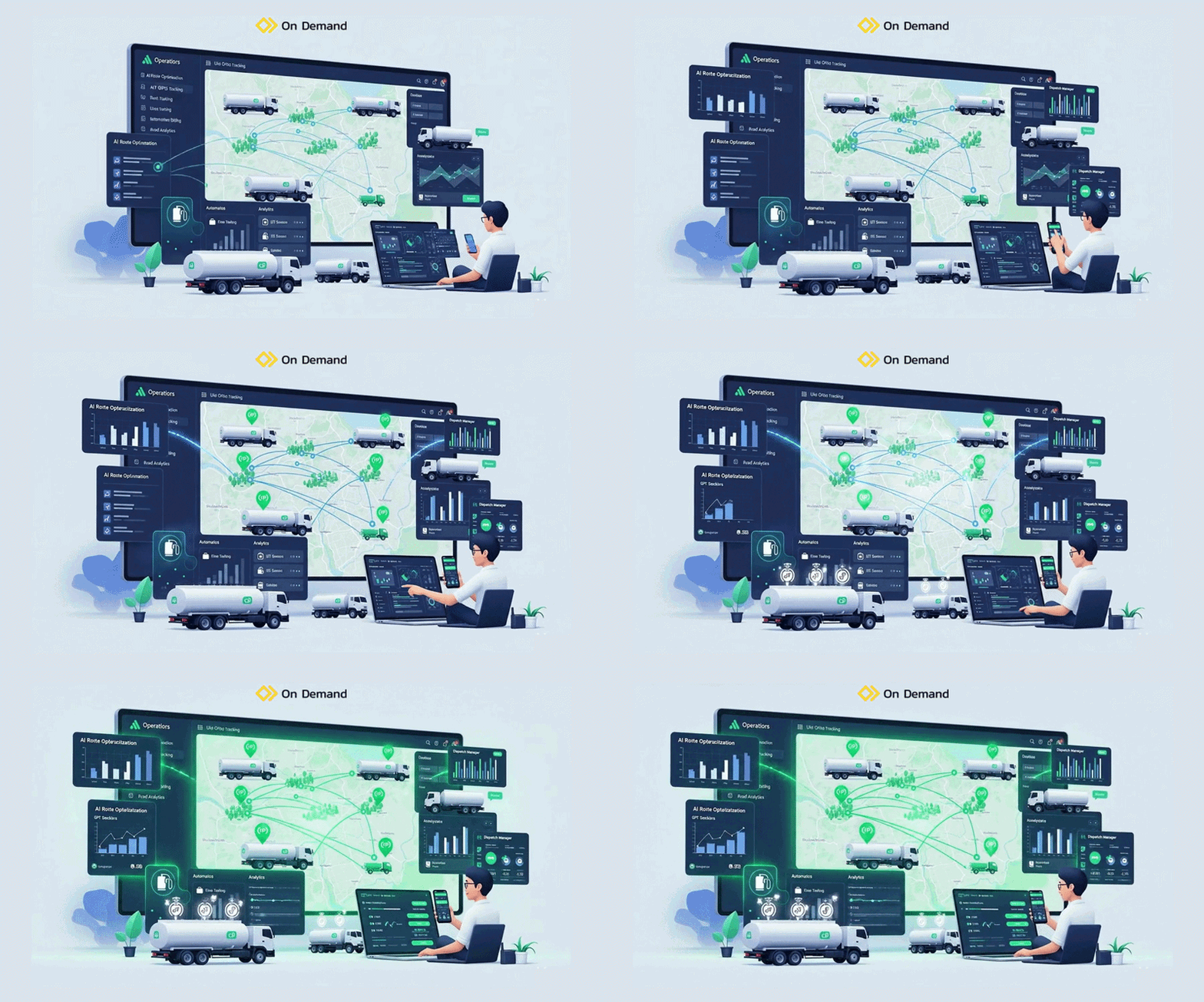
Manual dispatching doesn’t survive past 30 concurrent drivers. AI-powered dispatch engines, built into modern on-demand fuel delivery platforms, automatically assign jobs based on driver proximity, fuel load, traffic, and priority tiers. Operators using intelligent dispatch report up to 30% reduction in route time and meaningfully higher on-time delivery rates. At mid-scale, this isn’t optional; it’s your core operational advantage.
Pillar 2: Real-Time Fleet Visibility and IoT Integration
At scale, flying blind is fatal. You need live GPS tracking for every vehicle, real-time fuel load monitoring, driver performance dashboards, and automated alerts for route deviations, low tank levels, or safety incidents. The best platforms integrate directly with IoT sensors on fuel tankers, giving dispatchers and managers a single operational view across every market you serve.
Modern fleet management platforms use smart technologies and advanced tracking technology to enable automated refueling workflows and end-to-end fuel solutions for fleets of all sizes. Hardware integrations on tanker trucks include dispenser meters, safety interlocks that prevent dispensing outside authorised zones, and onboard fire suppression systems, all of which should feed real-time status data directly into your dispatch software. Platforms that support these hardware integrations natively save operators significant custom development costs at mid-scale.
Pillar 3: Automated Billing and Tax Compliance
Fuel delivery operations in the USA and Canada are subject to layered, complex regulatory frameworks: state and provincial fuel taxes, carbon pricing mechanisms, environmental levies, and jurisdiction-specific reporting requirements. A single billing error or missed compliance filing can generate thousands of dollars in fines and audit exposure that’s far more expensive. Platforms with built-in LCR (Local Compliance Reporting) integration eliminate this risk at scale. If you’re operating in Canada, look specifically for provincial tax automation features built for Alberta, BC, and Ontario.
Pillar 4: White-Label Customer Experience
At mid-scale, your brand is a competitive moat. Customers, whether B2C drivers or B2B fleet managers, expect a polished, seamless digital experience: real-time order tracking, auto-pay functionality, digital invoices, order history, and self-serve scheduling. A branded white-label fuel delivery app on iOS and Android isn’t a luxury at this stage. It’s the minimum viable customer experience. Operators running unbranded or generic interfaces are actively losing B2B fleet contracts to competitors who’ve invested in the customer-facing product.
Pillar 5: Offline-Capable Architecture
Fuel delivery happens in the real world, construction sites, remote industrial zones, rural highway corridors, and underground parking facilities where mobile connectivity is unreliable or non-existent. Platforms with true offline-capable architecture allow drivers to accept jobs, record transactions, capture signatures, and complete deliveries without a live connection. Everything syncs automatically when connectivity is restored. This is a hard technical requirement that many SaaS platforms list as a feature but implement poorly. Verify it with a real-world test before signing a contract.
Scaling Roadmap: Matching Technology to Your Growth Stage
Use this framework to identify where you are today and what technology investment makes sense at your current stage of growth:
| Growth Stage | Core Challenge | Right Tech Solution | Deploy Time |
| Pilot (1–3 Cities) | Manual ops, no tracking | White-label SaaS fuel app | 2–4 weeks |
| Early Scale (4–10 Cities) | Dispatch chaos, billing gaps | On-demand app + auto-billing | 4–6 weeks |
| Mid-Scale (10–25 Cities) | Fleet visibility, compliance | SaaS core + custom modules | 6–10 weeks |
| Enterprise (25+ Cities) | Multi-region, ERP integration | Hybrid or full custom build | 12–20 weeks |
One important note: these stages aren’t rigid timelines. Some startups move from Pilot to Mid-Scale in 18 months. Others spend three years in Early Scale as they carefully test new markets. The technology decision should track your actual operational complexity — not a calendar.
Stage 4 — Enterprise Scale: When and How to Go Custom
Once you’re operating across 25+ cities, managing hundreds of drivers, and serving both B2C and large B2B fleet accounts, the conversation about custom software development shifts meaningfully. You’ve likely hit real limitations in your SaaS platform, features it simply doesn’t offer, integrations it can’t make, and reporting it can’t generate.
But here’s what successful enterprise-stage operators consistently get right: they extend their platform, they don’t replace it.
The hybrid architecture approach, which keeps your proven, battle-tested SaaS core and builds custom modules on top, captures the best of both worlds. You maintain the infrastructure reliability, compliance features, and vendor support of your SaaS platform. And you add bespoke functionality precisely where your operations genuinely need it.
When Custom Development Makes Sense
- ERP and enterprise accounting integration (SAP, Oracle, QuickBooks Enterprise, Microsoft Dynamics)
- Multi-fuel type management with dynamic pricing algorithms (diesel, gasoline, DEF, propane, hydrogen)
- Private-label B2B fleet portal with contract pricing, volume discounts, and dedicated account management
- Advanced regulatory reporting across multiple states, provinces, or countries
- Custom API connections to fleet management systems, third-party logistics platforms, and inventory management tools
- Proprietary demand forecasting and predictive refuelling scheduling
The enterprises that get this wrong are typically those that hit one SaaS limitation and conclude they need to rebuild everything from the ground up. That decision, made reactively, in frustration, is among the most costly mistakes in the fuel delivery sector.
Operating in Canada: Compliance Considerations That US-Only Platforms Miss
The Canadian fuel delivery market is growing rapidly, particularly in Alberta’s energy corridor, British Columbia’s commercial fleet sector, and Ontario’s urban on-demand market. But it operates under a distinct regulatory framework that US-centric platforms routinely handle poorly.
Canadian operators need software that specifically addresses:
- Provincial fuel tax automation — Each province has different fuel tax structures, rates, and remittance schedules. Errors here are costly and common on platforms built solely for US compliance.
- Carbon pricing compliance — Canada’s federal carbon pricing mechanism and its provincial equivalents create reporting obligations that don’t exist in most US markets.
- HST/GST fuel tax remittance — The harmonised sales tax treatment of fuel varies by province and transaction type. Automation is essential at scale.
- Bilingual operational support — Quebec operations require French-language capability across driver apps, customer interfaces, and reporting.
Working with a development partner or platform that has Canadian-specific expertise, rather than simply toggling a “Canada mode” on a US platform, makes a substantial difference to compliance accuracy and operational efficiency from day one.
Fuel Delivery Technology Trends Shaping Scale in 2026
The technology landscape for fuel delivery is evolving fast. Startups that understand where the industry is heading can make smarter platform choices today that remain relevant tomorrow.
AI-Powered Predictive Dispatch
The next generation of dispatch tools doesn’t just optimise current routes, it predicts demand. By analysing order history, traffic patterns, weather, and local events, AI dispatch systems pre-position drivers before orders are placed. Early adopters are seeing 15–25% improvements in utilisation rates and meaningful reductions in average delivery time.
Automated Refuelling Subscriptions
Subscription-based fuel delivery, where the platform monitors a fleet’s fuel consumption and schedules automatic refuels before tanks run low, is emerging as a premium B2B offering. To understand how industry leaders structure this, see how the Booster on-demand fuel delivery model operates. This model delivers higher lifetime customer value, more predictable demand, and stronger retention than transactional-only services.
Alternative Fuel Integration
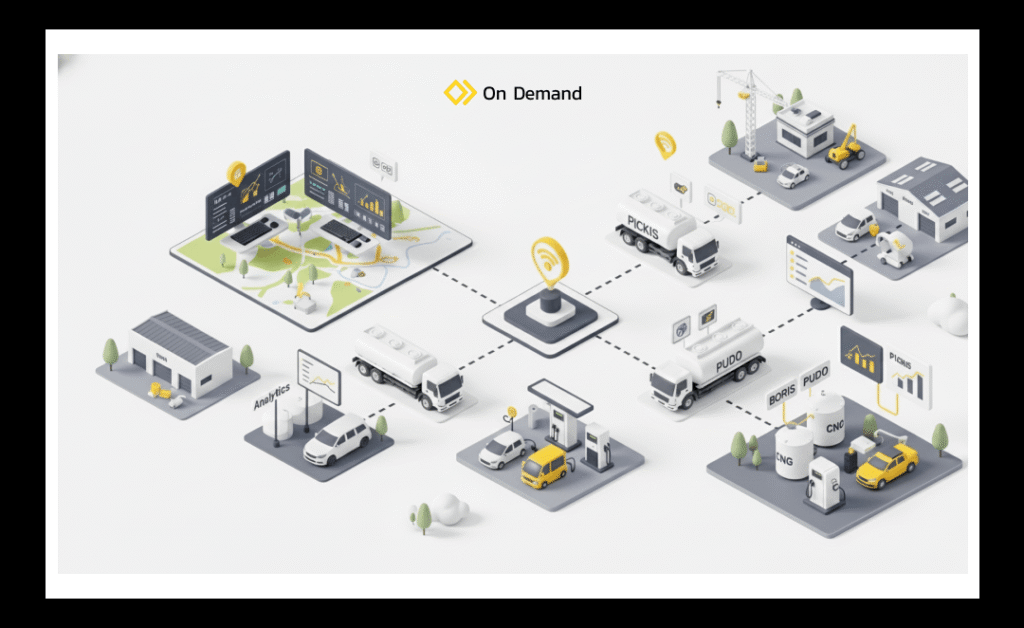
As commercial fleets begin transitioning to compressed natural gas (CNG), hydrogen, and electric charging, fuel delivery platforms need to support multiple energy types within a single dispatch and billing system. Operators who build this capability now — even at low initial volumes- position themselves well for the fleet electrification wave ahead.
BOPIS and PUDO Logistics Models
Buy Online, Pick Up In Store (BOPIS) and Pick Up, Drop Off (PUDO) hybrid models are entering the fuel sector as industrial and construction clients request more flexible delivery formats. Platforms with modular order management systems can adapt to these emerging models without significant redevelopment.
Intelligent Logistics and the Role of Artificial Intelligence
The rise of intelligent logistics is one of the most significant shifts in the fuel delivery sector in 2026. Powered by artificial intelligence, Big Data & Analytics, and digital transformation principles, modern fuel platforms are becoming fully integrated operating systems, not just delivery apps.
They handle everything from last-mile delivery optimisation and inventory management to revenue breakdown reporting and customer segmentation analytics.
The application of this technology extends well beyond urban consumer deliveries. Fuel delivery is becoming a critical input to Smart Cities infrastructure programmes, Advanced Manufacturing facilities, and large-scale construction equipment fleets that require scheduled, uninterrupted refuelling on remote job sites. Operators who build scalable, AI-native platforms today are positioning themselves to serve these high-value enterprise segments as demand grows.
This is exactly the territory where deep tech fuel delivery platforms, those combining AI, IoT, and data analytics into a single operational intelligence layer, command genuine competitive advantages and premium pricing.
How to Choose the Right Fuel Delivery Software Partner
Not all platforms, and not all development partners, are built equal. The wrong choice here doesn’t just cost money. It costs time, market position, and in some cases, the company. Before evaluating any fuel delivery app development partner, here’s what to evaluate before signing anything:
Technical Must-Haves
- Cloud-native infrastructure with a published 99.9%+ uptime SLA, verify this with references, not just the sales deck
- True offline mode for driver apps, test it in a real low-connectivity environment, not in a demo room
- Built-in USA and Canada tax automation with jurisdiction-level compliance reporting
- Open REST API with comprehensive documentation for third-party integrations
- Multi-fuel type support across the full delivery, billing, and compliance workflow
- White-label mobile apps on both iOS and Android with your branding, not theirs
Business and Partnership Must-Haves
- Modular, transparent pricing, you should pay for what you use, not for a feature set you’ll grow into in three years
- A clear product roadmap with a track record of shipping what they promise
- Active customer support with response time guarantees, not just a ticket system
- References from operators at a similar scale to your own, ask specifically how the platform performed during rapid expansion phases
- Data portability guarantees ensure you can export your complete operational data if you ever need to switch platforms
A platform that can’t pass this evaluation today will fail you at scale tomorrow. Take the time to diligence this thoroughly; it’s one of the highest-leverage decisions you’ll make in your first three years.
The 5 Most Expensive Mistakes Fuel Delivery Startups Make When Scaling
These aren’t theoretical. They’re patterns that repeat across the industry, costing operators months of progress and hundreds of thousands of dollars.
- Waiting until the pain is unbearable to change technology. Every week you operate on broken tools is a week your competitors build muscle, transition before you feel the crisis, not during it.
- Building custom software on day one. Unless you have $500K+ and 18 months to invest before your first dollar of revenue, starting with a full custom build is a strategic mistake. Validate with SaaS, then invest in custom when your requirements are proven and specific.
- Treating compliance as an afterthought. Fuel transport is one of the most heavily regulated categories of logistics. Operators who don’t build compliance infrastructure early face regulatory exposure that compounds dangerously with scale.
- Underinvesting in the customer app. B2B fleet managers and B2C customers both expect real-time tracking, digital invoicing, and self-serve order management as table stakes. Building customer loyalty in fuel delivery starts with the app experience; an unbranded or clunky customer interface actively costs you contract renewals.
- Choosing a technology partner based on price alone. The cheapest platform or development agency almost always generates the highest total cost of ownership. Platform migrations, integration failures, and compliance gaps are vastly more expensive than the premium you saved upfront.
Conclusion: Scale Is a Technology Decision First
The fuel delivery startups that win the next decade won’t necessarily be the ones with the most funding, the biggest fleets, or the most aggressive expansion plans. They’ll be the ones that made smart, stage-appropriate technology decisions at every point in their growth, and avoided the costly trap of platform rewrites that stall momentum at exactly the wrong moment.
Start your pilot on a platform designed to scale. Make the SaaS-versus-custom decision with clear eyes and real data. Invest in the operational pillars that compound, intelligent dispatch, real-time visibility, compliance automation, and a branded customer experience. And when you reach enterprise scale, extend your platform rather than replacing it.
The mobile fuel delivery market is growing fast, the competitive window is real, and the technology to scale efficiently has never been more accessible. The only remaining question is whether you choose to use it strategically, or learn its importance the expensive way.
Continue Your Journey
Launching and scaling a fuel delivery startup requires the right mix of technology, fleet operations, and a reliable platform. From intelligent dispatch and route optimization to real-time fleet monitoring, modern fuel delivery software plays a crucial role in building a scalable business.
If you’re planning to build your own platform, explore this detailed guide on fuel delivery app features, development costs, and the technology stack required to launch a fuel delivery app successfully.
Frequently Asked Questions:
1. How much does it cost to build a fuel delivery app from scratch?
A full custom build, covering the driver app, customer app, and admin dashboard, typically ranges from $80,000 to $300,000+, depending on feature complexity and the development team’s location. For most startups, a white-label fuel delivery platform with custom branding delivers 80% of the functionality at 10–15% of the cost and in a fraction of the time.
2. Can I start with a SaaS platform and move to custom later?
Yes, and this is actually the recommended approach for most operators. The key is choosing a SaaS platform with an open API and modular architecture from the beginning. This allows you to build custom features on top of the platform rather than replacing the platform entirely when you hit specific limitations.
3. What is the minimum viable tech stack for a fuel delivery startup?
At minimum, you need: a driver mobile app with GPS tracking and job management, a customer-facing booking interface, a real-time dispatch dashboard, and an integrated payment and billing module. Compliance reporting and fleet management features become essential as you scale beyond your pilot market.
4. How long does it take to launch with a white-label fuel delivery app?
With a proven white-label platform and a focused implementation process, most operators can launch a branded, operational app in 2 to 6 weeks. This compares to 6 to 18 months for a custom build, a difference that represents real market share in competitive launch windows.
5. Do I need different software for the US and Canadian markets?
Not necessarily different software, but you absolutely need software that explicitly supports both markets’ compliance requirements. Tax structures, reporting obligations, and regulatory frameworks differ significantly between US states and Canadian provinces. Ensure your platform, or your development partner, has verified, production-tested compliance features for every jurisdiction you operate in.