The fuel industry is rapidly shifting toward digital operations. Fleet operators, construction companies, mining firms, and energy startups are adopting mobile refueling to reduce downtime, optimize routes, and gain real-time visibility into fuel usage. Inspired by the convenience models of companies like Uber and Amazon, businesses now expect on-demand services with live tracking, digital payments, and automated reporting.
This shift has accelerated the growth of the on-demand fuel-delivery business model, in which fuel is delivered directly to vehicles and heavy equipment rather than relying on traditional fuel stations. Companies exploring on-demand fuel delivery app solutions are finding that this model not only reduces operational downtime but also creates a scalable, customer-centric service experience. While the opportunity is significant, the risks are equally high. Fuel is classified as a hazardous material in most countries, meaning companies must follow strict safety, environmental, and transportation regulations. Building fuel delivery management software without understanding compliance requirements can lead to penalties, operational delays, or safety failures.
That’s why many companies choose a white label fuel delivery app instead of building from scratch. It offers a faster, safer way to digitize operations, reduce development risk, and launch a compliant platform without the heavy R&D investment of a fully custom build.
The Regulatory Wall: Why Standard Apps Fail
Launching a fuel delivery platform is not the same as building a regular logistics or courier app. Fuel is a hazardous and highly regulated commodity, and this is where most standard, ready-made apps fail. In regulated industries, compliance is not an optional add-on; it must be a core feature of your fuel delivery management software.
Compliance as a Core Feature (Weights & Measures Standards)
In most countries, fuel dispensing equipment must comply with government-approved Weights and Measures (W&M) standards. These regulations ensure that the quantity of fuel delivered matches exactly what is billed to the customer. Digital systems must accurately record:
- Liters/gallons dispensed
- Time and location of delivery
- Calibration records
- Meter readings synced with dispensing units
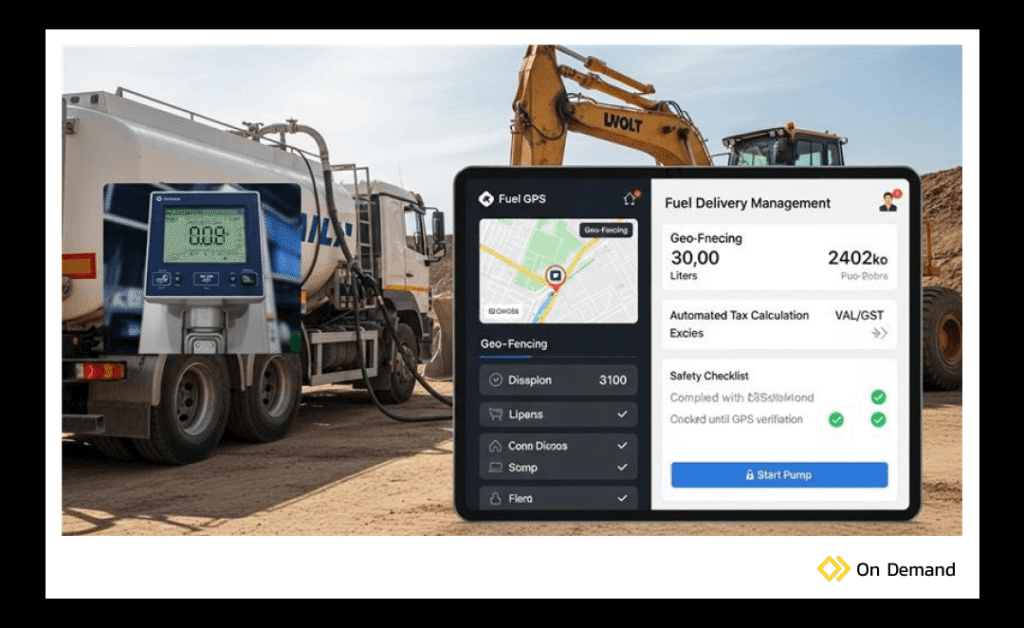
If your software cannot integrate with certified flow meters or generate tamper-proof delivery logs, it may fail regulatory audits. A basic, ready-made fuel delivery app often lacks this level of compliance integration, making it risky for regulated operations.
Taxation Complexity & Carbon Reporting
Fuel taxation is complex and varies by region. Businesses must calculate and report federal and state fuel taxes, excise duties, VAT/GST, and environmental or carbon-related levies. Manual tracking increases the risk of reporting errors, which can result in heavy penalties. Advanced white label on-demand app solutions are designed to automate regional tax calculations and generate detailed digital invoices. Some platforms also support carbon reporting and sustainability tracking, which is increasingly important for enterprise fleet operators and government contractors.
Built-In Safety Protocols
Safety in fuel transport is non-negotiable. Software must enforce mandatory pre-delivery safety checklists before allowing dispensing. These can include:
- Driver identity verification
- Vehicle inspection confirmation
- Spill kit availability check
- Digital hazard acknowledgment
Without these safeguards, companies expose themselves to liability risks. Standard delivery apps typically do not support such safety enforcement mechanisms.
Geo-Fencing & Controlled Pump Activation
One of the most critical compliance features is geo-fencing. The system should allow only the “start pump” command when the fuel truck is at the exact verified GPS location of the approved delivery site. This prevents unauthorized dispensing, reduces theft risk, and ensures accurate location logging for audits. Advanced fuel delivery management software integrates GPS fleet tracking software with pump control systems, ensuring dispensing cannot begin outside authorized zones.
In regulated industries, software must do more than manage orders; it must actively protect your business from compliance failures, safety risks, and financial penalties. This is why choosing the right fuel delivery solution is a strategic decision, not just a technical one.
Bridging the Gap: Why Flow Meter Integration Defines Enterprise-Grade Fuel Delivery Software
In regulated fuel delivery operations, the real intelligence of the system does not start in the app; it starts at the flow meter installed on the truck. No matter how advanced your dashboard, dispatch system, or payment module is, a fuel delivery platform is incomplete if it cannot directly communicate with certified dispensing hardware.
This is where many standard or ready-made fuel delivery app solutions fall short.
The Software–Hardware Disconnect
Fuel is a legally measured commodity. Every gallon or liter dispensed must be recorded through a certified metering device that complies with Weights & Measures regulations. If drivers manually enter delivery volume into the app, it creates operational risks such as:
- Quantity mismatches
- Billing disputes
- Compliance violations
- Fuel shrinkage or theft
In regulated industries, manual reporting is not only inefficient—it can be legally non-compliant. A true fuel delivery management software must eliminate human dependency in transaction recording.
Industry-Standard Flow Meter Integration
Professional fuel trucks typically use high-precision metering systems from globally recognized manufacturers such as Liquid Controls and Total Control Systems. These devices are widely used in commercial and bulk fuel distribution because they meet strict calibration and certification requirements. Building this kind of hardware-software bridge requires expert IoT app development capabilities, a specialized discipline that goes far beyond standard mobile app engineering.
Enterprise-grade platforms integrate with these meters through Bluetooth connectivity, serial or CAN bus communication, secure API integration, and onboard data modules. Without this integration, a white-label fuel delivery app cannot verify actual dispensed quantities in real time.
Automated Data Capture: Accuracy Without Manipulation
Modern systems automatically pull critical transaction data directly from the meter, including:
- Pump start and stop time
- Exact volume delivered
- Flow rate
- Meter ID and calibration reference
This automation prevents manual entry errors and significantly reduces the risk of internal fraud. For companies operating under an on-demand fuel delivery business model, this level of control ensures scalable and transparent operations.
The Digital Seal: Tamper-Proof Audit Trail
Each transaction should generate a digitally sealed record that combines:
- Meter data
- GPS coordinates
- Timestamp
- Driver authentication
This creates an immutable audit trail that regulators and enterprise clients can verify. In hazardous material transportation, tamper-proof digital documentation is no longer optional; it is essential.
Custom Build vs. Ready-Made Fuel Delivery Platform: Cost, Speed & Compliance Comparison
Choosing between a fully custom platform and a ready-made enterprise solution is one of the most critical decisions in fuel technology investment. For regulated industries, this decision impacts compliance risk, capital expenditure, time-to-market, and long-term scalability.
A custom-built fuel delivery management software offers complete control—but it also requires heavy upfront investment, regulatory research, hardware API development, and ongoing technical maintenance. Development timelines often extend beyond a year due to compliance validation, flow meter integration, tax automation logic, and security audits.
On the other hand, investing in on-demand fuel delivery app development through a pre-built enterprise solution designed specifically for regulated markets allows companies to deploy faster with built-in compliance frameworks and hardware integrations already tested in real-world conditions.
Below is a strategic comparison:
| Feature | Custom Build (In-House) | Enterprise Ready-Made Solution |
| Initial Cost | $150,000 – $500,000+ (High CAPEX) | Low setup fee + SaaS model (Low OPEX) |
| Launch Time | 12–18 months | 2–4 weeks |
| Compliance Setup | Built and validated from scratch | Pre-configured for regulated markets |
| Flow Meter Integration | Custom API development required | Pre-integrated with systems like Liquid Controls and Total Control Systems |
| Maintenance | Requires dedicated in-house tech team | 24/7 managed support included |
| Scalability | Manual upgrades and infrastructure expansion | Cloud-based instant scalability |
| Risk Exposure | High during development and testing | Reduced with proven deployment models |
For businesses evaluating the cost to build a fuel delivery app, the true expense goes beyond coding; it includes compliance engineering, hardware testing, and long-term system support.
In regulated fuel delivery, speed, accuracy, and compliance readiness often determine market leadership. The right technology choice can accelerate entry while minimizing operational risk.
The “Custom Build” Trap: Hidden Time & Financial Risks
When businesses calculate the cost to build a fuel delivery app, they often focus only on development pricing. However, in regulated industries, the real expenses appear later, during hiring, testing, compliance validation, and ongoing upgrades.
- The Developer Gap
Fuel delivery management software is not a simple logistics platform. It must integrate with certified flow meters, GPS systems, IoT hardware, and automated tax modules while complying with petroleum regulations.
Finding developers who understand both mobile app architecture and petroleum-specific IoT integration is challenging and expensive. This shortage increases hiring costs and extends project timelines.
- Extended Testing in Hazardous Environments
Unlike standard apps, fuel platforms must be tested in live dispensing conditions. Features like pump activation control, geo-fencing, and automated meter data capture must work flawlessly.
Field testing in hazardous environments often takes months, as even small software failures can lead to compliance issues or operational risks.
- Continuous Updates & Regulatory Changes
Operating systems from Apple and Google release frequent updates, and fuel regulations continue to evolve. Custom apps require continuous redevelopment to remain compatible and compliant.
Because of these risks, many regulated businesses evaluate enterprise-ready solutions from platforms like On-Demand App instead of building entirely from scratch.
For deeper insight into smart metering, compliance tracking, and IoT integration in fuel platforms, read more on integrating IoT into fuel delivery apps for smart metering
Operational Excellence with Fuel Delivery Management Software
In regulated industries, operational efficiency directly impacts profitability, compliance, and customer trust. A modern fuel delivery management software is not just an order management tool; it is a centralized system that controls routing, dispatch, tracking, and enterprise coordination.
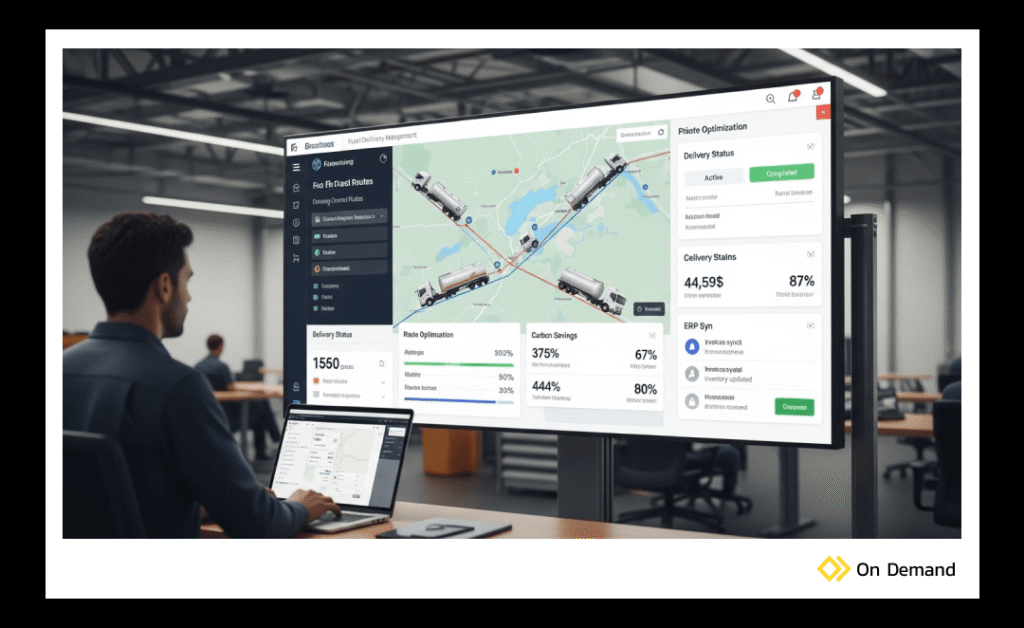
Here’s how it drives operational excellence:
1. Dynamic Route Optimization
Smart routing engines use real-time traffic data, vehicle capacity, delivery priority, and distance mapping to create the most efficient delivery paths. Pairing your platform with dedicated dispatching and route optimization software takes this a step further, enabling managers to automate assignments, reduce idle time, and respond instantly to route changes.
Benefits include reduced fuel consumption, lower operational costs, faster delivery turnaround, and a decreased carbon footprint. For large fleets, even a small reduction in daily mileage can translate into significant annual savings.
2. Real-Time Dispatch & Bulk Order Handling
A centralized admin dashboard provides complete visibility over:
- Live driver locations
- Active and completed deliveries
- Bulk fuel orders
- Emergency or last-minute requests
Dispatch managers can instantly reassign routes, prioritize urgent deliveries, and manage high-volume enterprise contracts without delays. This real-time control improves service reliability and customer satisfaction.
3. Enterprise System Integration
Enterprise-grade fuel delivery management software integrates directly with existing ERP and accounting systems. This allows automatic synchronization of:
- Invoices and tax records
- Inventory levels
- Contract pricing
- Financial reports
By eliminating manual data entry and reconciliation, businesses reduce errors and improve compliance accuracy.
When routing, dispatching, and enterprise systems operate in one connected platform, fuel distributors achieve higher efficiency, better compliance control, and scalable growth.
Choosing Your Strategic Model
Selecting the right on-demand fuel delivery business model is critical for long-term success. Most fuel startups and distributors operate under one of two primary strategies:
1. B2B / Fleet-Focused Model
This high-volume approach targets commercial fleets, construction sites, logistics companies, and industrial operators. Deliveries are scheduled in bulk, contracts are recurring, and margins are driven by volume efficiency.
This model offers:
- Predictable recurring revenue
- Large order sizes
- Long-term enterprise contracts
- Strong operational scalability
2. B2C / Consumer Convenience Model
Often described as the “Uber for Gas” approach, this model focuses on individual vehicle owners who want fuel delivered to their home or office. It emphasizes convenience, app-based ordering, and flexible scheduling. Businesses targeting local or regional markets can benefit significantly from a hyperlocal delivery app solution that is purpose-built for proximity-based service delivery and last-mile efficiency.
The White-Label Advantage
Partnering with a fuel delivery app development company allows businesses to launch quickly using a white-label platform. This reduces upfront risk and enables companies to test a new market for 6 months before committing to a full-scale expansion.
Choosing the right strategy depends on your capital, compliance readiness, and target market demand.
Conclusion
In regulated fuel delivery, speed and reliability are the only sustainable competitive advantages. Compliance requirements, certified hardware integration, automated tax reporting, and real-time tracking are no longer optional; they are operational necessities.
Businesses that deploy stable, audit-ready fuel delivery management software faster can secure contracts, build trust, and scale efficiently. Those who delay or rely on unstable systems risk compliance failures and lost opportunities.
In a high-stakes industry where every transaction must be accurate and verifiable, success belongs to companies that combine rapid deployment with uncompromising operational precision.
Continue Your Journey
If you’re evaluating whether to build from scratch or launch faster with a pre-built solution, your next step should be understanding the broader technology strategy behind both models.
Read: Custom App vs. White Label App Development: Which is Right for Your Business?
This guide breaks down cost structures, development timelines, scalability factors, and long-term maintenance considerations, helping you make a more informed decision before investing in fuel delivery technology.
FAQs:
1. What is a white label fuel delivery app?
A white label fuel delivery app is a ready-made fuel delivery platform that businesses can rebrand as their own. It includes built-in features like dispatch, GPS tracking, tax automation, and compliance tools, allowing faster launch compared to building from scratch.
2. How much does it cost to build a fuel delivery app?
The cost to build a fuel delivery app can range from $150,000 to $500,000+ for a fully custom solution. A ready-made fuel delivery app typically follows a SaaS model with lower upfront costs and faster deployment.
3. Is ready-made fuel delivery software compliant with regulations?
Yes, enterprise-ready fuel delivery management software is designed with built-in compliance features like Weights & Measures integration, geo-fencing, tax calculation, and flow meter connectivity, making it suitable for regulated industries.
4. What features should fuel delivery management software include?
It should include GPS tracking, dispatch management, route optimization, flow meter integration, digital invoices, tax automation, and safety checklists. Advanced platforms also integrate with ERP and IoT systems.
5. Should I choose a custom build or a ready-made fuel delivery app?
If you operate in a regulated market and need faster deployment, a ready-made fuel delivery app or white label solution is usually safer and more cost-effective. Custom builds offer full control but require higher investment, longer timelines, and compliance validation.