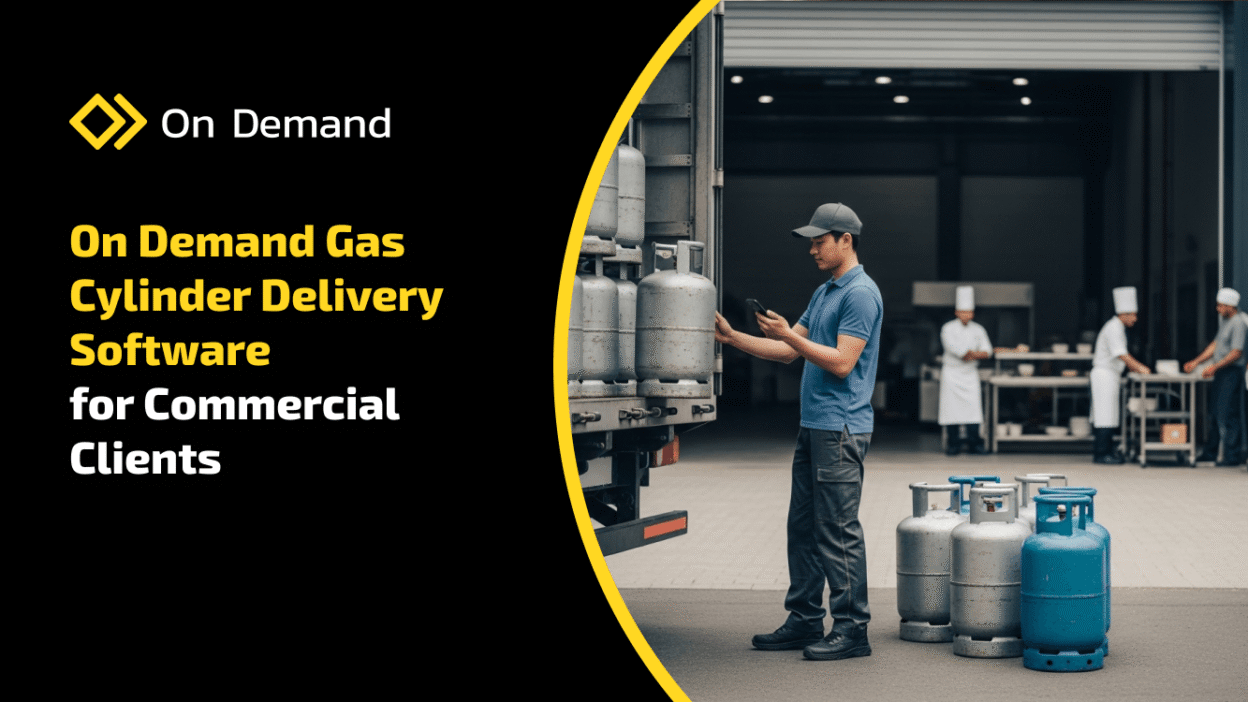
Picture a busy Saturday evening at a large hotel. The banquet kitchen is mid-service, 300 guests are waiting, and the head chef discovers the LPG cylinders are nearly empty. A call to the supplier goes unanswered. The backup cylinder was already used three days ago, and no one tracked it. Dinner service grinds to a halt.
This kind of disruption plays out more often than commercial operators care to admit. The root cause is rarely an unreliable supplier. It’s an outdated process, phone calls, paper logs, guesswork on stock levels, and zero visibility into delivery status. In 2026, when AI is optimizing logistics routes in real time and same-day delivery is the baseline expectation across nearly every industry, managing commercial gas restocking on a notepad is no longer a neutral choice. It’s a liability.
That’s exactly the gap on demand gas cylinder delivery software fills. It brings commercial gas supply into the modern era, giving distributors and commercial clients full visibility, automation, and control over every cylinder that moves through their supply chain.
This guide walks through what the software actually does, who needs it most, the features that matter in 2026, and how to decide whether to build a platform or buy a ready-made solution.
What is On-Demand Gas Cylinder Delivery Software?
On-demand gas cylinder delivery software is a multi-sided digital platform that connects commercial businesses, restaurants, hotels, hospitals, factories, and catering companies with their gas suppliers or distributors through a mobile app or web-based system.
A complete platform has three operational layers:
- Client app or portal: Used by commercial businesses to place orders, track deliveries in real time, manage on-site cylinder inventory, and review billing history.
- Driver or field agent app: Used by delivery personnel for route navigation, digital proof of delivery, and cylinder swap logging
- Supplier admin dashboard: Used by the gas distributor to manage all orders, dispatch drivers, monitor fleet locations, run demand analytics, and handle invoicing at scale.
Unlike a generic delivery app, this type of software has to handle complex requirements, cylinder deposit tracking, return management, hazardous material compliance, multi-size product catalogs, and recurring commercial account billing. Getting even one of these wrong creates real operational and financial problems. That’s why businesses consistently get better results with purpose-built fuel delivery app solutions, designed from the ground up for fuel and gas distribution, compared to adapting a general-purpose delivery platform for this use case.
The Market Opportunity and Why 2026 Is a Turning Point
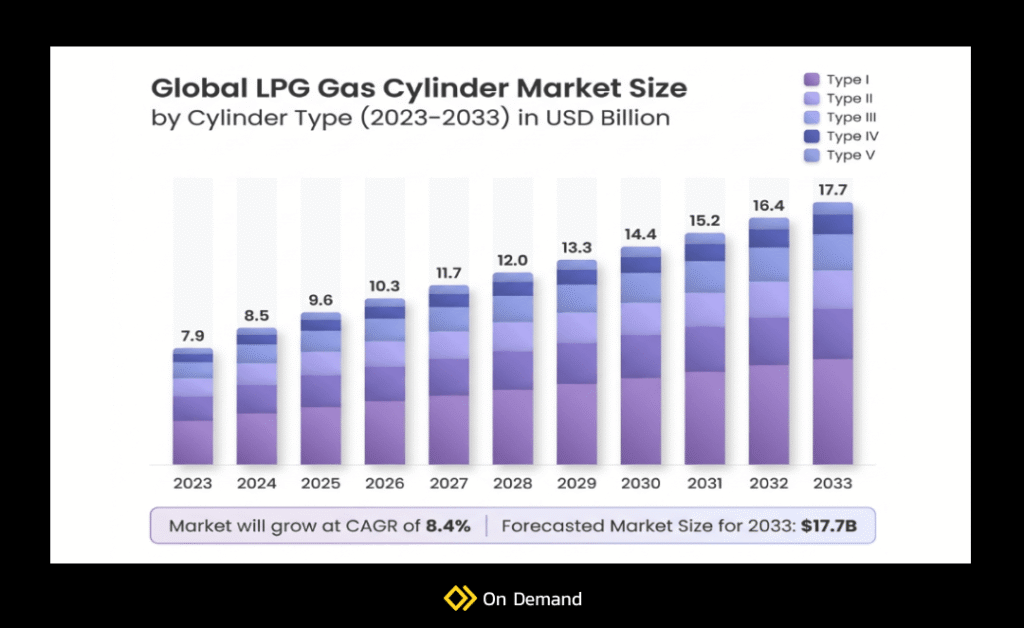
The commercial gas cylinder market is larger than most people realize. According to recent market research, the global LPG gas cylinder market was valued at approximately USD 7.9 billion in 2023 and is projected to reach USD 17.7 billion by 2033, growing at a CAGR of 8.4%. Commercial applications, hospitality, manufacturing, and healthcare account for a significant and growing share of that demand.
Despite this scale, the distribution side of the industry has been remarkably slow to digitize. The majority of commercial gas cylinder distribution in most markets still relies on phone-based ordering, paper delivery records, and manual cylinder tracking. That gap between market size and operational maturity is exactly where the demand for a proper gas cylinder delivery app for business is coming from, and why 2026 is proving to be the inflection point.
AI-Optimized Logistics Has Become the Baseline
Route planning tools now use machine learning to factor in traffic, load capacity, delivery windows, and fuel costs simultaneously, all in real time. Distributors still managing routes manually are spending 20 to 35 percent more on last-mile delivery than those using AI-assisted dispatch. That cost gap is visible to commercial clients in the form of slower service and less accurate ETAs, and in 2026, that’s enough for them to start evaluating alternatives.
ESG and Supply Chain Compliance Is Now a Procurement Criterion
Large commercial operators, hotel chains, hospital networks, and multinational manufacturers face growing pressure to document their supply chain for ESG reporting and regulatory compliance. A gas supplier that can provide digital delivery records, route-level emissions data, and safety documentation is genuinely more valuable than one that hands over paper invoices. This has moved from a preference to an active procurement requirement in many sectors.
Post-2024 Inflation Has Made Every Inefficiency Costly
Over-ordering cylinders ties up capital in deposits. Under-ordering causes stoppages that cost far more than the gas itself. Good LPG cylinder delivery management software with smart inventory alerts and usage-based forecasting cuts both problems at once, and in the current economic environment, commercial finance teams are paying close attention to those savings.
B2B Buyers Now Expect Consumer-Grade Digital Experiences
The operations managers making gas supply decisions in 2026 are accustomed to placing orders in two taps, tracking a delivery in real time, and receiving a digital invoice automatically. Suppliers who can’t offer that experience are quietly losing contracts to those who can, even when their gas price is competitive.
Features That Actually Matter in a 2026 Platform
Not every gas delivery app is built for commercial-scale operations. Here’s the feature set that separates a genuinely useful platform from a basic order form:
What Commercial Clients Need
- Live cylinder inventory dashboard: Real-time count of full, in-use, and empty cylinders across every on-site location, not a spreadsheet updated at the end of the week.
- Scheduled and recurring delivery: Automated weekly, fortnightly, or monthly delivery cycles so low-stock situations don’t happen in the first place.
- Multi-location account management: Essential for restaurant groups, hotel chains, and manufacturers managing gas supply across multiple sites from one account.
- Smart low-stock alerts: Automatic notifications when cylinder count drops below a threshold, triggered early enough to act on.
- Digital delivery confirmation: Photo proof, GPS-stamped delivery record, and digital signature on every order, all stored and searchable.
- Invoice history and accounting export: Full billing transparency with PDF download and integration with common accounting tools.
What Suppliers and Distributors Need
- Centralized order dashboard: Every commercial client’s order in one live view, with status tracking and priority flags.
- AI-assisted route optimization: Delivery routes are planned and updated automatically to minimize time, distance, and fuel cost.
- Cylinder deposit and return tracking: A live digital ledger showing every cylinder in the field — who has it, when it was delivered, and when it’s due back.
- Commercial account billing: Support for credit accounts, bulk invoicing, advance payments, and multiple payment gateways.
- Demand forecasting and analytics: Order history, seasonal trends, and per-client consumption data to plan stock levels and driver capacity.
- Compliance and safety documentation: Automated hazmat delivery records, driver certification tracking, and vehicle safety logs.
These features are the foundation of any serious on-demand fuel delivery app development project. Whether you’re configuring a white-label solution or building from scratch, this is the baseline a commercial-grade platform must meet.
Read More: How On-Demand Fuel Delivery App Development Is Changing the Energy Industry
Which Industries Are Driving the Most Demand?
Commercial gas demand runs across a much broader range of industries than most people initially expect. The need for reliable cylinder tracking software for suppliers is most acute in these sectors right now:
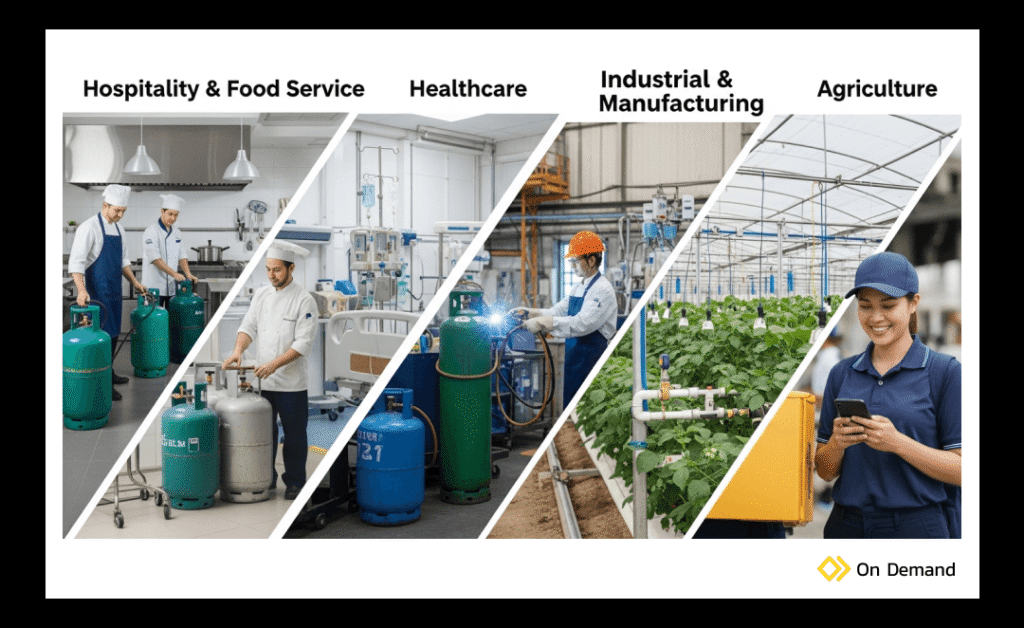
- Hospitality and food service: A large hotel can go through 20 to 35 LPG cylinders per week across kitchens, laundry, and pool heating systems. Restaurant chains and cloud kitchen operators running multiple locations are among the highest-frequency commercial users, and the ones who feel supply disruptions the hardest.
- Healthcare and pharmaceuticals: Medical oxygen, nitrogen, and specialty gas cylinders require zero-delay restocking and strict compliance documentation. Digital delivery records and full audit trails are mandatory in regulated healthcare environments, not optional.
- Manufacturing and industrial: Welding gas, cutting gas, and bulk industrial LPG are consumed in high volumes, often across multiple cylinder types and sizes. These clients typically need bulk pricing structures and integration with existing procurement or ERP systems.
- Agriculture: Grain drying, greenhouse heating, and poultry farming operations depend heavily on LPG, often at remote locations where an unexpected supply gap has serious operational consequences. Scheduled digital deliveries replace the unreliable ad-hoc supply model most agricultural operators still rely on.
- Gas distributors and resellers: Small and mid-sized distributors serving dozens or hundreds of commercial clients have the most to gain from digitization. Automating order intake, route planning, and invoicing means the same team can handle significantly more clients without adding headcount.
Across all of these sectors, the underlying need is the same: real-time visibility, automated scheduling, and digital records. A well-built logistics app development approach, one that treats gas cylinder distribution as a last-mile logistics challenge, consistently delivers better outcomes than generic delivery software retrofitted to fit.
White Label or Custom Build- Which One Is Right for You?
The first real decision anyone faces when exploring this space is whether to use a ready-made white-label platform or build something from the ground up. Here’s how to think about it honestly:
White Label: The Faster, Smarter Starting Point
A white-label fuel delivery app is a pre-built, tested platform that goes live under your own branding quickly, often within 48 hours. The cost is a fraction of custom development, and because the core system is already proven in real commercial operations, you skip months of QA cycles and unexpected bugs.
This is the right move for gas distributors entering the digital space for the first time, startups validating a delivery business model, and established suppliers who need to modernize without a large technology budget. A ready-made on-demand delivery platform can be configured specifically for gas cylinder operations — cylinder types, deposit logic, commercial billing, and running under your own brand in days, not months.
Custom Development: Worth It When the Complexity Demands It
Custom makes sense when your operations have requirements that no existing platform handles, for example, a large industrial gas company managing multiple gas types, compliance across different regulatory regions, deep ERP integration, or IoT connectivity for real-time cylinder pressure monitoring. In these cases, a purpose-built solution gives you complete control over every workflow and integration.
The practical reality: most gas distributors start with a white-label solution, validate their digital operations with real commercial clients, and then identify specific features that genuinely need custom development. Very few businesses need a full custom build on day one.
How to Choose a Development Partner You Can Trust
The software is only as good as the team that builds and supports it. Here’s what to look for:
- Real delivery logistics experience: Route optimization, hazmat compliance, deposit tracking, and commercial billing are genuinely complex. Make sure your partner has built delivery platforms before, not just general mobile apps.
- White-label launch capability: Ask whether you can be live under your own brand within days. A strong partner makes this fast and straightforward, not a drawn-out configuration project.
- Scalability from day one: Your platform needs to handle 10 orders today and potentially 1,000 per day in two years. The architecture should be built for scale, regardless of where you start.
- Honest post-launch support: Ask specifically about SLA response times, how ongoing maintenance is handled, and what the process is for adding features after launch.
- Compliance module depth: Gas cylinder delivery involves hazardous materials. Your partner should have experience building driver certification tracking, hazmat documentation, and delivery compliance systems.
The right partner is transparent about what a white-label solution can and can’t do, has a clear track record in delivery logistics, and stays with you after launch. If you’re at the point of evaluating your options and want a no-obligation conversation about what a platform built for your specific situation would look like, getting in touch for a free consultation is a straightforward first step.

Conclusion
Commercial gas cylinder distribution is going through a structural shift in 2026. AI-driven logistics, rising compliance requirements, cost pressure from every direction, and increasingly demanding commercial clients mean that operating without proper on-demand gas cylinder delivery software is an active disadvantage in a competitive market.
For gas distributors, the opportunity is clear: digitize your operations, give your commercial clients the visibility and convenience they already expect from other suppliers, and build a service quality advantage that price-only competitors can’t easily copy.
For commercial operators, kitchens, factories, hospitals, and agribusinesses, if your current gas supplier still runs on phone calls and paper invoices, it’s worth asking a simple question: Is there a supplier with a digital platform who could serve your operations more reliably?
The technology is here. The market is already moving. The only real question is how quickly you want to move with it.
Explore More: Launch Faster with White Label Delivery Apps
Building a delivery platform from scratch isn’t always the most efficient path—especially when speed, cost, and scalability matter. White-label delivery apps give commercial businesses a ready-made foundation to launch quickly, streamline operations, and focus on growth instead of development challenges.
Whether you’re a gas distributor, logistics provider, or service-based business, adopting a proven platform can significantly reduce time-to-market while ensuring enterprise-grade features from day one.
Continue Reading: White Label vs Custom App Development: Which is Right for Your Business?
Frequently Asked Questions:
1. What does on-demand gas cylinder delivery software actually do?
It replaces manual ordering and paper records with a digital platform. Businesses can place orders, track deliveries, manage inventory, and access invoices, while suppliers handle dispatch, routing, and cylinder tracking from a central dashboard.
2. Can one platform handle multiple cylinder types and gas products?
Yes. It supports LPG, CNG, medical gases, and more—each with its own pricing, sizes, and deposit rules, while keeping the ordering experience simple for clients.
3. How does cylinder deposit and return tracking work?
The system tracks every cylinder in real time, including delivery, return, and deposit status. Returns are logged instantly, updating balances and reducing billing disputes.
4. How long does it take to launch a platform?
A white-label solution can go live in as little as 48 hours, while a custom-built platform typically takes 3–6 months, depending on complexity.
5. What is the difference between white-label and custom solutions?
White-label apps are pre-built, faster, and cost-effective. Custom apps offer full control but require more time and investment. Most businesses start with white-label and scale later.