
Quick Read: Choosing the right white-label fuel delivery platform isn’t a tech decision; it’s a business decision that will shape your speed to market, your margins, and your ability to scale. Drawing from real client experiences across fuel distribution, fleet refueling, and gas station expansion projects, this guide walks you through the exact framework fuel businesses use to make this choice with confidence.
The Decision That Quietly Defines Your Next Five Years
Every fuel business owner we’ve worked with eventually arrives at the same moment. The market is shifting. Customers want digital ordering. Fleet clients want real-time visibility. Competitors are starting to look more like tech companies than fuel companies. And the question becomes unavoidable: which white label fuel delivery platform should we actually go with?
Here’s the part most founders don’t realize until later: this single decision will quietly shape the next five years of your business. Pick the right one, and you’ll be live in weeks, scaling across regions, integrated with your ERP, and adding new service verticals as needed. Pick the wrong one, and you’ll spend the next two years wrestling with rebuilds, integration headaches, and a platform that simply can’t keep up with your growth.
We’ve watched both stories play out. This blog is the framework we wish more fuel businesses had access to before signing the contract.
Why the Stakes Are Higher in the Fuel Vertical
Most on-demand verticals are forgiving. If you launch a food delivery app and the dispatch glitches, you lose an order. If you launch a fuel delivery app and the dispatch glitches, you lose a tanker, a compliance certificate, and possibly a corporate contract.
Fuel is one of the most operationally complex on-demand categories on the planet. It involves hazmat compliance, real-time GPS for heavy vehicles, fleet telematics, ERP-grade financial integration, multi-zone logistics, volumetric billing, and audit-ready documentation. A platform built casually for “Uber for X” will not survive in this environment.
Industry research from Future Market Insights estimates the global mobile fuel delivery market is on track to grow from around USD 5.84 billion in 2025 to roughly USD 11.93 billion by 2035, a steady CAGR near 7.4% (Source: Future Market Insights Report). That’s a serious market, but only the businesses with the right tech foundation will capture it.
The Six Core Criteria Fuel Businesses Use to Evaluate Platforms
Across years of helping fuel founders and distributors choose the right platform, these are the six criteria we’ve seen separate the winners from the regret stories.
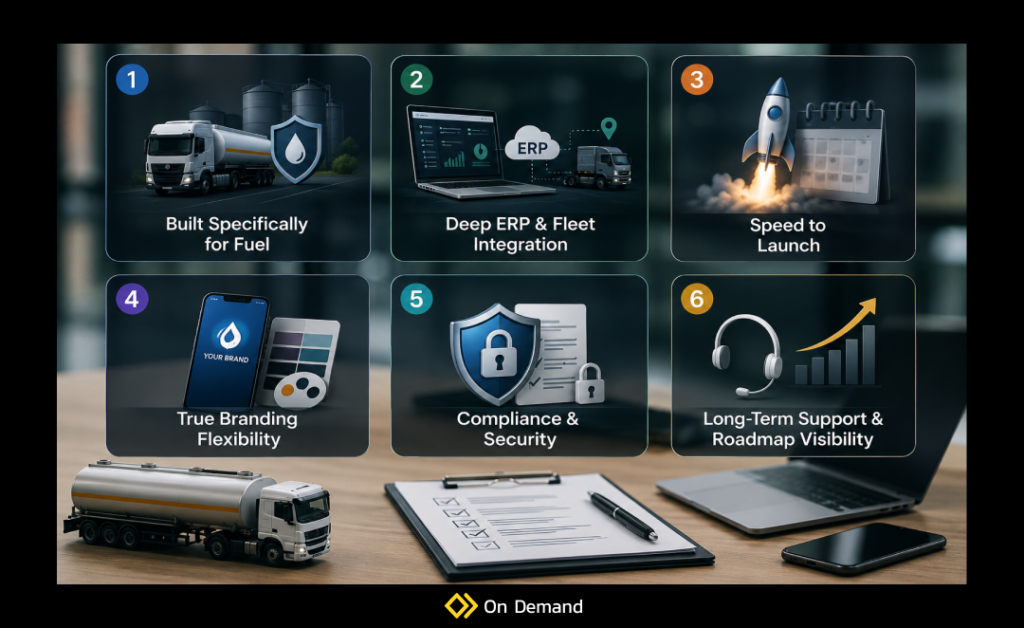
1. Built Specifically for Fuel-Not Just Adapted From Generic Delivery
This is the single biggest filter. Many “white label delivery platforms” on the market are food delivery apps with a fuel skin. They look fine in a demo and fall apart in production.
A genuine fuel-first platform should have hazmat compliance, fuel-quantity reconciliation, tanker-specific routing, IoT-based volume tracking, and digital proof-of-delivery built into the core, not retrofitted later.
2. Deep ERP and Fleet Management Integration
If your platform doesn’t natively integrate with SAP, Oracle, QuickBooks, Zoho, Tally, or your fleet telematics system, your finance and operations teams will hate you within 60 days. ERP integration isn’t a “phase two” feature; it’s a launch requirement.
We’ve covered this in extensive detail in our guide on on-demand fuel delivery app ERP and fleet integration, which we recommend any fuel business read before signing with a vendor.
3. Speed to Launch
The whole point of a white-label platform is that you skip the 6–12 month custom development cycle. A serious provider should get you live, fully branded, with a customer app, driver app, admin panel, and ERP integration — in 2–4 weeks. Anything longer than that, and you’re essentially paying white-label prices for custom development timelines.
4. True Branding Flexibility
“White label” should mean your brand, not theirs. Your logo, your colors, your domain, your app store listings, your customer experience. If a vendor restricts brand customization, exposes their own name anywhere in the user flow, or limits theming, that’s not white label, that’s a reseller arrangement.
5. Compliance and Security Baked In
PCI-DSS for payments, GDPR/CCPA-ready data handling, fuel transport license workflows, encrypted multi-currency transactions, and audit-ready digital records. These aren’t optional in fuel. If a vendor can’t show you a compliance checklist on day one, they don’t belong on your shortlist.
6. Long-Term Support and Roadmap Visibility
Your platform partner is going to be in your business for years. Look at the support model, the update cadence, and the product roadmap. Are they investing in IoT, AI dispatch, EV charging integration, and multi-language expansion? If their roadmap stops where you are today, they’ll be holding you back in 18 months.

A Side-by-Side Look: What “Good” Actually Looks Like
Here’s the comparison framework we share with most fuel business owners during their evaluation phase:
| Evaluation Area | Weak Platform | Strong Platform |
| Industry Focus | Generic delivery clone | Fuel-specific architecture |
| Launch Time | 3–6 months | 2–4 weeks |
| ERP Integration | Manual / via plugin | Native API integration |
| Compliance | Customer responsibility | Pre-configured & built in |
| Branding | Limited theming | Full white label control |
| Driver App | Basic GPS | Hazmat, IoT, route optimization |
| Admin Panel | Order list view | Heatmaps, analytics, and billing |
| Pricing | Hidden costs | SaaS, one-time, or hybrid options |
| Support | Email only | Dedicated account manager |
| Roadmap | Stagnant | Active R&D and updates |
If a vendor scores in the right column on at least eight of these ten dimensions, you’re looking at a serious partner.
The Three Business Profiles-and What Each One Should Prioritize
Not every fuel business needs the same platform. Here’s how we typically segment the conversation depending on who’s asking.
Profile 1: Fuel Delivery Startups
Priority: Speed to market and low capex. What to look for: SaaS pricing, fast deployment, strong consumer-facing UX, and a roadmap that grows with you. You don’t need every enterprise feature on day one — you need to be live, taking orders, and validating the model.
Profile 2: Gas Station Owners and Fuel Distributors
Priority: Extending reach without disrupting existing operations. What to look for: Strong admin dashboard, multi-vendor support, branded customer app, and ERP integration with whatever accounting system you already use. Your customers know your brand — the platform must protect it.
Profile 3: Fleet Operators and Enterprise Buyers
Priority: Integration depth and operational reliability. What to look for: Native ERP and fleet telematics integration, bulk delivery scheduling, audit-ready compliance, volumetric billing, and corporate account management. For this profile, the dashboard matters more than the customer app.
If you want to see how proven players have structured their model in this space, our breakdown of the Fuel4U and Jio-BP business model is one of the most instructive case studies for enterprise-scale fuel businesses.
Prefer to Explore the Platform First? Take a guided tour of our on-demand fuel delivery app development platform — fully branded, ERP-integrated, and live in 2–4 weeks.
SaaS, One-Time, or Hybrid-Which Pricing Model Works for You?
This is one of the questions we get asked most often, and the honest answer depends on where you are in your journey.
| Pricing Model | Ideal For | Trade-Off |
| SaaS (Monthly) | Startups validating the model | Lower upfront, higher long-term cost |
| One-Time License | Established operators with capital | Higher upfront, full ownership |
| Hybrid | Mid-sized businesses scaling steadily | Balanced cost + flexibility |
If you’re still proving market fit, go SaaS. If you have proven revenue and want long-term cost efficiency, go one-time. If you’re somewhere in between, and most fuel businesses are, a hybrid is usually the smartest choice.
A Practical Evaluation Checklist Before You Sign
Before you commit to any white label fuel delivery platform, run through this checklist with the vendor in a single call. If they hesitate on more than two of these, walk away.
- Can you show me a live deployment in my region or vertical?
- How long will full deployment take, with my branding and ERP connected?
- What’s included in the base license vs. add-ons?
- How is customer data handled, stored, and secured?
- What does the support model look like post-launch?
- Can I see the admin dashboard with real fuel-business workflows?
- How do you handle hazmat compliance and digital proof-of-delivery?
- What’s your product roadmap for the next 12 months?
- Are updates included, or charged separately?
- Can I add new service verticals later (fleet maintenance, EV charging, etc.)?
The answers to these questions will tell you everything you need to know about whether you’re choosing a partner or a vendor.

Common Mistakes Fuel Businesses Make at the Decision Stage
After watching this decision play out across dozens of fuel businesses, the same mistakes keep showing up.
Mistake 1: Choosing based on price alone. The cheapest platform almost always becomes the most expensive one, once you factor in the rebuild, the integration costs, and the compliance gaps.
Mistake 2: Falling for the demo. A polished demo app means nothing if the dispatch logic, ERP layer, and admin reporting fall apart in production. Always ask to see real workflows, not just a UI tour.
Mistake 3: Skipping the compliance conversation. Founders often assume compliance is a “we’ll deal with it later” problem. In fuel, compliance gaps don’t just delay launches, they shut businesses down.
Mistake 4: Not thinking about expansion. The platform you choose for fuel delivery should also be able to handle fleet servicing, equipment refueling, and possibly EV charging in the next few years. If it can’t, you’ll be migrating again sooner than you’d like.
Mistake 5: Underestimating the support relationship. Your platform vendor is a long-term partner. If their support feels transactional during the sales cycle, it’ll only get worse after the contract is signed.
What We’ve Learned From Real Deployments
A pattern we’ve seen repeatedly: the fuel businesses that succeed with white-label platforms aren’t the ones that picked the flashiest vendor, they’re the ones that picked the most operationally honest vendor.
By that, we mean a partner who tells you what the platform can’t do, not just what it can. A partner who walks you through pricing transparently, including ongoing costs. A partner who shares real client outcomes, including the messy ones, instead of curated case studies.
In our experience, that kind of honesty is the single best predictor of long-term success.
For founders who want to study which proven business models match their goals, our deep-dive on which fuel delivery app clone can boost your business in 2025 is worth the read.
How a Real Decision Process Should Look
If you’re starting your evaluation, here’s the sequence we’d recommend.
| Stage | What Happens | Time Required |
| Discovery | Define business model, target users, and must-have features | 1 week |
| Vendor Shortlisting | Identify 3–5, fuel-focused white-label providers | 1 week |
| Live Demo + Evaluation | Run each vendor against the 10-point checklist | 1–2 weeks |
| Reference Calls | Talk to 2 existing customers per vendor | 1 week |
| Commercial Negotiation | Pricing, SLA, support, roadmap commitments | 1–2 weeks |
| Contract + Kickoff | Sign, brand, integrate, deploy | 2–4 weeks |
That’s a complete decision-to-launch journey of roughly 7–10 weeks, far faster than the 9–12 months a custom build would take, and far less risky.
Closing Thoughts
Choosing the right white label fuel delivery platform isn’t about features. It’s about fit, fit with your business model, your operational reality, your compliance environment, and your growth ambitions.
The best decisions we’ve seen fuel businesses make come from a simple mindset: treat the vendor selection like a partnership, not a purchase. When you do that, the right answer usually becomes obvious.
The fuel industry is digitizing fast. The platforms are mature. The market is growing. The only thing left is making the right choice, and now you have the framework to do exactly that.
Continue Reading:
If you’re weighing different fuel delivery business models before choosing a platform, this companion guide is the natural next step: Fuel4U & Jio-BP On-Demand Fuel Delivery Business Model — Explained
FAQs:
Q1: What is a white label fuel delivery platform, and how is it different from a custom-built app?
A white label fuel delivery platform is a pre-built, fully functional software system that you brand as your own — with your logo, colors, domain, and app store listing. Unlike a custom-built app that requires 6–12 months of development from scratch, a white-label platform is already engineered for fuel-specific operations (hazmat compliance, tanker routing, IoT tracking, volumetric billing) and simply configured for your business. You get to market in 2–4 weeks instead of months, at a fraction of the cost, without compromising on operational depth.
Q2: How long does it take to launch a white label fuel delivery platform?
A serious white label fuel delivery platform should have you fully live-branded customer app, driver app, admin panel, and ERP integration, within 2 to 4 weeks. If a vendor is quoting 3–6 months for a white-label deployment, you are effectively paying white-label prices for a custom development timeline. Always ask a vendor for a live deployment reference in your region before signing.
Q3: Does a white label fuel delivery platform integrate with ERP systems like SAP, QuickBooks, or Zoho?
Yes, and this should be a non-negotiable requirement, not a “Phase 2” discussion. Reputable platforms come with pre-built API connectors for major ERP systems, including SAP, Oracle, QuickBooks, Zoho, and Tally, as well as fleet telematics tools. What you’re configuring is your specific workflows and data mapping, not building the integration from scratch. If a vendor cannot show you a live ERP integration during the demo, they belong off your shortlist.
Q4: Which pricing model is best for a white label fuel delivery platform — SaaS, one-time license, or hybrid?
It depends on where your business is in its journey. SaaS (monthly subscription) works best for startups still validating their model, lower upfront cost, faster to start. A one-time license suits established operators with proven revenue who want full ownership and long-term cost efficiency. Hybrid pricing, a middle ground of upfront fee plus reduced ongoing costs, is typically the smartest fit for mid-sized fuel businesses scaling steadily. Ask any vendor to walk you through the total 3-year cost across all three models before deciding.
Q5: Can a white label fuel delivery platform handle hazmat compliance and proof-of-delivery documentation?
It should, and if it can’t, it was not built for fuel. A genuine fuel-first platform has hazmat compliance workflows, digital proof-of-delivery with driver sign-off, audit-ready transaction records, and fuel transport license documentation baked into the core architecture. Platforms adapted from generic food or retail delivery apps typically bolt these on as afterthoughts, which creates compliance gaps in production. Always ask a vendor to demonstrate these workflows in a live environment, not just a feature checklist.