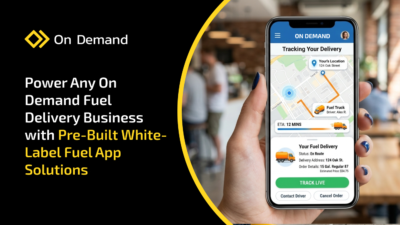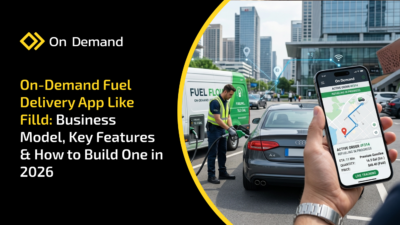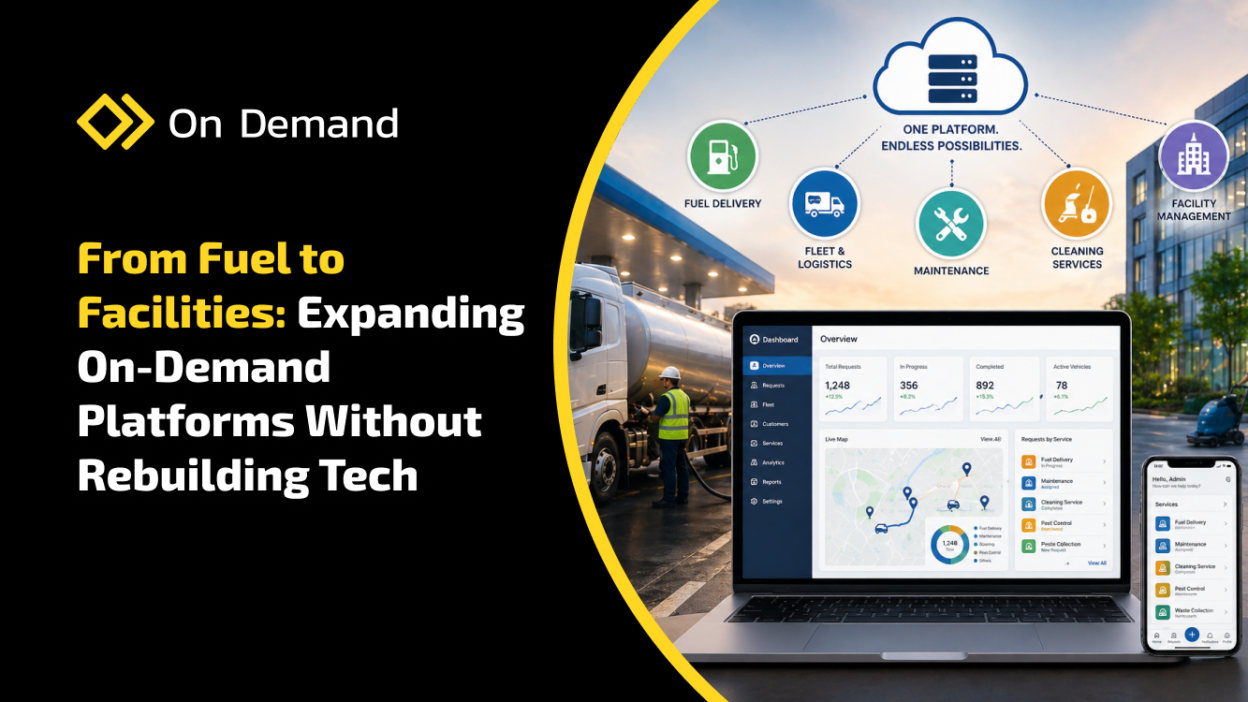
Quick Read: Whether you’re launching a new fuel delivery startup or digitizing an established distribution business, pre-built white-label fuel delivery apps offer the fastest, most cost-efficient path to market. Here’s how they actually work, what’s inside them, and why most fuel businesses we work with no longer build from scratch.
The Fuel Industry Is Moving On-Are You?
Phone-in orders. Paper logs. Manual dispatch boards. If any of these still describe how your fuel business runs, you’re not behind, but you’re close. The industry is shifting fast, and the businesses moving first are setting the new normal.
Today, fleet operators expect mobile dashboards. Construction companies expect on-demand refueling. Mining and logistics firms expect real-time delivery visibility. And consumers, yes, even retail consumers in select markets, are starting to expect doorstep fuel delivery the same way they expect doorstep food.
According to industry estimates, the global on-demand fuel delivery market is projected to grow from around USD 5.84 billion in 2025 to nearly USD 11.93 billion by 2035. (Source: Future Market Insights – Mobile Fuel Delivery Market Report).
Companies like Booster Fuels, Filld, FuelBuddy, and Cafu have already proven the model works, and proven it’s profitable.
The honest takeaway? The early-mover window is still open. But it won’t be open in two years.
So What Exactly Is a White-Label Fuel Delivery App?
Let’s keep this simple. A white-label fuel delivery app is a pre-built, fully functional platform that we (or any specialized vendor) hand over to you — already built — for you to brand, customize, and launch as your own.
Think of it like leasing a beautifully built restaurant kitchen instead of constructing one from scratch. The infrastructure is ready. You bring the menu, the brand, and the customers.
A well-built white-label fuel delivery solution is:
- Pre-built — core features already operational
- Brandable — your logo, name, colors, identity throughout
- Customizable — modules tweaked to your service area and rules
- Deployable — live on iOS, Android, and Web in 2–4 weeks
For founders entering the “Uber for Fuel” space, this is by far the fastest, lowest-risk way to enter the market.
Who Is This Actually Built For?
White-label fuel delivery platforms aren’t just for startups. We’ve deployed them across nearly every kind of fuel business model:
| Business Type | Use Case | Why White-Label Works |
| Fuel Delivery Startups | Launch a doorstep refueling brand | Fast launch, low capex |
| Gas Station Owners | Expand reach beyond the pump | Branded app + dispatch ready |
| Fleet Operators | Automate bulk fuel scheduling | ERP & fleet integration built in |
| Oil & Gas Distributors | Digitize legacy operations | Admin dashboard + compliance |
| Construction & Mining | On-site equipment refueling | Hazmat routing + IoT support |
| Logistics & 3PL Firms | Mobile fleet refueling | GPS dispatch + automated billing |
The common thread: every one of these businesses needed speed to market — and didn’t want to fund a 12-month custom build to get it.
The Real Math: Build vs. White-Label
This is the conversation founders avoid until it’s too late. Here’s the honest comparison.
| Factor | Custom Build | White-Label |
| Time to Launch | 6–12 months | 2–4 weeks |
| Development Investment | USD 50K–200K+ | USD 10K–20K |
| Maintenance Burden | High (in-house team) | Provider-managed |
| Branding Flexibility | Full | Full |
| Updates | Manual & costly | Free, ongoing |
| Tech Knowledge Required | Significant | None |
In most cases, white-label saves around 70% of total fuel delivery app development cost, and gets you live in a fraction of the time.
If you have a unique product hypothesis you need to validate, sometimes custom is the right call. But for nearly every fuel business we’ve worked with, validation is faster and cheaper after you’re live with a white-label app — not before.
What’s Inside a Real White-Label Fuel Delivery Platform
A serious white-label fuel app isn’t one app. It’s a three-sided ecosystem — customer, driver, and admin — designed to work together.
The Customer App
This is what your end users experience. They search for nearby fuel vendors, select fuel type and quantity, choose delivery location and time, pay through integrated payment gateways, and track the tanker in real time on Google Maps. Done well, the experience should feel as smooth as ordering a ride.
The Driver / Tanker App
This is where the operational magic happens. High-precision GPS, automated stock tracking, route optimization, hazmat compliance prompts, and digital proof-of-delivery — all designed to reduce mistakes, fuel theft, and delivery disputes.
The Admin Dashboard
The command center. From here, your operations team supervises tanker fleets, monitors compliance, manages volumetric billing, runs multi-currency settlements, and pulls fleet utilization heatmaps. This is the system your CFO and operations head will actually live inside.
How the Workflow Actually Works
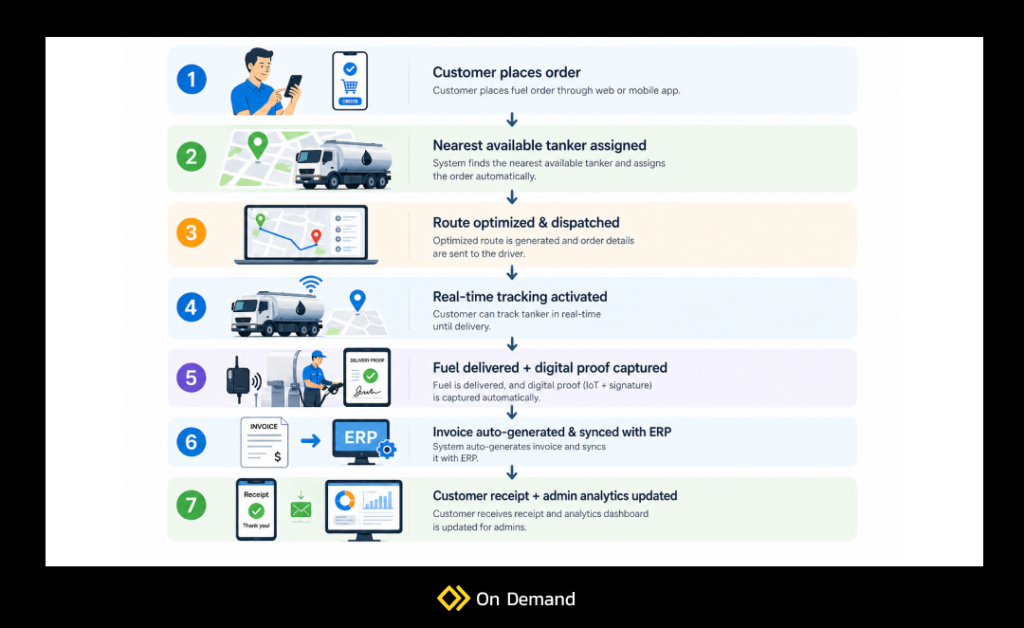
Here’s the end-to-end flow of a fuel order on a white-label platform — from the moment a customer taps “order” to the second your admin dashboard updates.
Step 1: Customer Places Order
The customer selects fuel type, quantity, location, and time slot directly from the branded app. Payment clears instantly. The whole process takes under 60 seconds — no calls, no forms, no friction.
Step 2: Nearest Available Tanker Assigned
The dispatch engine scans real-time GPS data across your entire fleet and assigns the closest available tanker automatically. No human dispatcher needed. No delay.
Step 3: Route Optimized & Dispatched
The most efficient route — factoring in traffic, delivery windows, and hazmat zones — is calculated instantly and sent directly to the driver’s app. What used to take 20 minutes of manual planning happens in seconds.
Step 4: Real-Time Tracking Activated
Both the customer and your operations team get live visibility the moment the tanker moves. Customers track their delivery. Your team tracks the entire fleet. Support call volume drops significantly.
Step 5: Fuel Delivered + Digital Proof Captured
IoT flow meters record the exact volume dispensed. The driver captures a digital signature and photo in the app. Every delivery generates a tamper-proof record — no disputes, no discrepancies, full accountability.
Step 6: Invoice Auto-Generated & Synced With ERP
The invoice is created automatically with the correct volume, price, taxes, and fees — and syncs directly to your ERP or accounting system. Your finance team gets clean, audit-ready records with zero manual entry.
Step 7: Customer Receipt + Admin Analytics Updated
The customer gets their digital receipt instantly. Your dashboard updates with delivery metrics, fleet utilization, and revenue data in real time. Every order makes your next decision smarter.
What looks like seven simple steps is actually dozens of automated processes running simultaneously, all without your team touching a single spreadsheet.
Read More: Want to understand what powers this automation? Our complete guide on Fuel Delivery Dispatch Software: The Complete Guide to Automation breaks down exactly how real-time dispatch, route optimization, and proof-of-delivery work together behind the scenes.
The Revenue Streams You Unlock From Day One
A pre-built fuel delivery platform isn’t just an operations tool — it’s a revenue engine. The monetization options we typically see across our clients:
| Revenue Stream | How It Works |
| Delivery Fees | Per order or distance-based |
| Subscription Plans | Monthly/annual plans for fleets and frequent users |
| Surge Pricing | Dynamic pricing during peak periods |
| In-App Advertising | Promote partner brands or accessories |
| Corporate Accounts | Bulk B2B billing for enterprise fleets |
| Marketplace Commissions | For multi-vendor fuel marketplaces |
The smartest operators we’ve worked with stack three or four of these streams — not just one.
Compliance Isn’t Optional in Fuel — and It Shouldn’t Be Bolted On Later
Fuel is one of the most regulated verticals on the planet. Every market has its own rules around fuel transport, hazmat handling, environmental compliance, data privacy, and payment security.
A serious white-label platform comes with these guardrails built in: PCI-DSS for secure payments, fuel transport license workflows, GDPR/CCPA-ready data handling, and digital audit trails for every delivery.
This is one of the most overlooked reasons to choose a proven white-label vendor over a freelance custom build. The compliance layer alone takes most teams 6+ months to build correctly — and the cost of getting it wrong is enormous.
Proven Fuel Delivery Clone Models in 2026-27
Founders entering this space rarely start from a blank canvas. They study the market leaders and pick the model closest to their business. Here are the dominant models in 2025:
| Clone Model | Best For | Standout Feature |
| Booster Fuels | Fleet & enterprise clients | Sustainability + AI routing |
| EzFill | Urban consumer delivery | Smart dispatch + secure payments |
| Yoshi | Multi-service add-ons | Fuel + car care bundles |
| FuelBuddy | B2B distribution | Inventory + GPS + reporting |
| PetroApp | SME fuel operators | Clean UI + invoice automation |
We dive deep into which model matches which business profile in our companion guide on fuel delivery app clones for 2026.
You can also study how Indian energy giants approached the model in our breakdown of the Fuel4U and Jio-BP business model — it’s one of the most instructive case studies in the industry.
SaaS or One-Time License — Which Should You Pick?
This is one of the most common questions we get from founders.
| Pricing Model | Best Suited For | Cost Pattern |
| SaaS (Monthly) | Startups, lean budgets, MVP testing | Pay as you grow |
| One-Time License | Established operators with capital | Higher upfront, lower long-term |
| Hybrid | Mid-sized operators scaling steadily | Core upfront + SaaS add-ons |
Our honest advice: if you’re still validating, go SaaS. If you’re confident in your model and want long-term cost efficiency, go one-time. If you’re somewhere in between, a hybrid usually wins.
Why Fleet Operators Are Quietly Choosing White-Label
Industry estimates put average fleet downtime at roughly USD 760 per hour. Every hour a vehicle waits for fuel — or worse, runs dry on the road — eats directly into operating margin.
The fleet operators we work with don’t want a fuel app. They want a system that integrates with their ERP, schedules bulk deliveries automatically, generates audit-ready compliance documentation, and tracks fuel-burn down to the vehicle. White-label platforms give them all of that — without a custom build.
If you want the technical depth on this, our guide on ERP and fleet integration for fuel delivery breaks down exactly how the integrations work.
Closing Thoughts
The on-demand fuel delivery industry is at one of those rare inflection points — large enough to be serious, early enough to still own a region, and proven enough that you don’t have to gamble on the model itself.
You don’t need a million-dollar budget. You don’t need a CTO. You don’t need a year of development. What you need is the right platform, the right partner, and the willingness to move now.
A pre-built white-label fuel delivery app gets you live in weeks — fully branded, fully compliant, and ready to take orders. The technology is mature. The market is growing. Your branded fuel business is closer than you think.
Continue Reading:
If you’re a gas station owner or fuel distributor specifically, this deep-dive is built for you: White Label Fuel Delivery Software for Gas Stations & Fuel Distributors
FAQs:
1. How much does it cost to develop or launch an on-demand fuel delivery app?
Launching a fuel delivery platform typically involves a wide cost range depending on the development path. A basic Minimum Viable Product (MVP) usually costs between $25,000 and $45,000. Choosing a white-label solution is often 50% to 70% cheaper than custom development, which can exceed $100,000, allowing for a faster market entry with a smaller initial investment.
2. Is on-demand fuel delivery legal and safe for residential or commercial use?
Yes, doorstep delivery is legal in many regions, including the USA and India, provided the business adheres to strict regulatory standards. Providers must use equipment approved by agencies like the Petroleum and Explosive Safety Organization (PESO) in India or the EPA and DOT in the United States. Safety is maintained through certified hazardous material (HAZMAT) drivers, specially designed mobile dispensing units (MDUs), and 24/7 real-time monitoring.
3. Can I expand a fuel delivery platform to include other services like EV charging or car maintenance?
Scaling into secondary services is a major trend for 2026. Platforms like CAFU and Yoshi already bundle fuel delivery with car washes, oil changes, battery replacements, and mobile EV charging. Because the underlying technology stack for routing and payments is already in place, businesses can add these “facility” services to increase customer lifetime value without rebuilding their core technology.
4. What are the main benefits of choosing white-label software over a custom build?
White-label software allows businesses to launch in just 2 to 4 weeks, compared to the 6 to 12 months required for a custom build. Key advantages include lower upfront costs, access to proven and tested technology, and ongoing maintenance handled by the provider. This allows business owners to focus on sales and brand growth rather than technical development hurdles.
5. How do B2B on-demand fuel platforms improve fleet efficiency and reduce costs?
Enterprise models use advanced AI routing engines to optimize delivery sequences, which can reduce vehicle downtime and fuel burn. For example, automated platforms can eliminate fuel card fraud and manual paperwork by providing real-time tracking and automated invoicing. Some corporate clients report saving significant labor costs by refueling vehicles on-site while they are stationary, achieving high “drop density” in office parks.