Is Your Fuel Delivery Business One Audit Away From a Shutdown?
Hazardous materials transport violations cost North American operators over $8.2 million in penalties in 2024 alone, and enforcement is only tightening. In Canada, Transport Canada increased random compliance inspections on fuel carriers by over 40% in the past two years, with fines ranging from CAD $1,000 to $50,000 per violation. For operators still running manual, paper-based workflows, the exposure is enormous.
Fuel is classified as a dangerous good under Canada’s Transportation of Dangerous Goods (TDG) Act and under the U.S. Department of Transportation’s 49 CFR regulations. Every delivery creates a regulatory footprint that must be documented, verified, and audit-ready at all times.
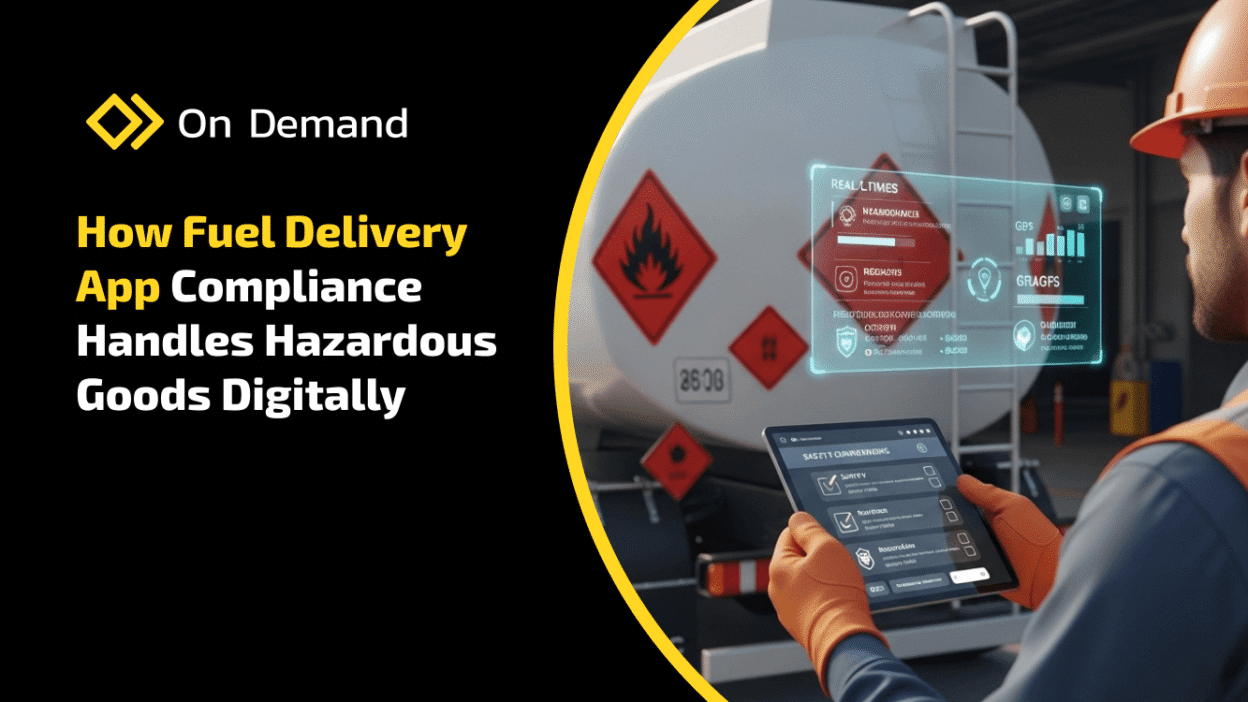
The companies winning enterprise contracts, passing audits, and scaling fastest are those that have digitised their fuel delivery app compliance workflows end-to-end. In this guide, we break down exactly how modern fuel delivery platforms handle hazardous goods compliance digitally, from the regulatory landscape to the specific features that keep operators protected and commercially competitive.
Understanding On-Demand Fuel Delivery Safety Regulations in Canada & North America
Before exploring digital solutions, it is important to understand the compliance environment fuel operators must navigate. This is one of the most complex regulatory landscapes in the logistics sector. A modern on-demand fuel delivery safety regulations guide provides a useful starting point, but the core obligations break down as follows.
Canada: The Transportation of Dangerous Goods (TDG) Act
In Canada, fuel delivery is governed primarily by the Transportation of Dangerous Goods Act, 1992. Gasoline (UN1203) and diesel fuel (UN1202) are classified as Class 3 Flammable Liquids, requiring specific documentation, labelling, placarding, and driver training at every point of transport. Key obligations under TDG compliance software Canada standards include:
- Proper shipping documents must accompany every fuel shipment, including UN number, hazard class, quantity, and emergency contact information.
- All drivers must hold a valid TDG certificate and must not be dispatched on hazmat routes with an expired certification.
- Every delivery vehicle must be placarded with the correct Class 3 Flammable Liquid safety marks visible from outside.
- Operators must maintain records of all TDG shipments and make them available to Transport Canada inspectors on demand.
- Emergency Response Assistance Plans (ERAPs) must be filed for specific high-volume fuel shipments.
United States: 49 CFR and PHMSA Regulations
South of the border, on-demand fuel delivery safety regulations fall primarily under Title 49 of the Code of Federal Regulations (49 CFR), enforced by the Pipeline and Hazardous Materials Safety Administration (PHMSA) and the Federal Motor Carrier Safety Administration (FMCSA). Violations under 49 CFR can result in $500–$75,000 per offence, with criminal penalties for serious infractions. Additionally, all drivers transporting fuel must hold a Commercial Driver’s License (CDL) with a Hazmat endorsement, and proper driver qualification has been shown to reduce accident rates by 43% (FMCSA).
Multi-Provincial & Cross-Border Complexity
One of the most underappreciated compliance challenges is operating across jurisdictions. Canadian fuel delivery operators crossing provincial lines face overlapping federal TDG requirements and provincial safety regulations specific to British Columbia, Alberta, Ontario, and Quebec. For companies operating cross-border between Canada and the U.S., both regulatory frameworks must be satisfied simultaneously — a challenge that paper-based systems simply cannot manage reliably.
Why Traditional Paper-Based Compliance Is Costing Fuel Businesses Millions
Most fuel delivery businesses still rely on handwritten TDG manifests and spreadsheet-tracked driver certifications. Without proper fleet dispatching and scheduling software to manage operations digitally, these seven pain points compound into serious financial and operational risk:
- Documentation Gaps & Human Error: A single missing field on a TDG shipping document is a violation. Paper forms are illegible, incomplete, and easily lost, creating systematic audit risk that digital systems eliminate.
- Driver Certification Blind Spots: With manual tracking, it is nearly impossible to monitor expiry dates across a fleet of 15+ drivers. Dispatching a non-certified driver on a hazmat route can result in vehicle seizure and licence suspension.
- Slow Emergency Response: In a fuel spill incident, emergency responders need instant access to Safety Data Sheets and hazard class information. Paper SDS binders in truck cabs delay response by critical minutes and increase liability.
- Audit Unpreparedness: Compiling compliance records for a Transport Canada audit manually can take days or weeks. Digital platforms export complete audit packages in minutes.
- Enterprise Contract Disqualification: Fortune 500 clients, mining firms, and construction companies increasingly require vendors to demonstrate digital compliance certifications during procurement. Operators without them are being excluded from tenders.
- Multi-Province Rule Management: Tracking the differences between TDG federal requirements and provincial overlays manually leads to cross-provincial compliance failures that cost more to fix than prevent.
- Cost Overruns and Operational Downtime: Beyond fines, compliance failures trigger vehicle suspensions, lost delivery days, and insurance premium increases that compound the financial damage.
How Fuel Delivery App Compliance Platforms Handle Hazardous Goods Digitally

A purpose-built hazardous goods transport software platform does not just digitise paper forms. It embeds regulatory compliance directly into the operational workflow, making it structurally impossible to execute a non-compliant delivery. Here are the seven core ways these platforms handle compliance digitally:
1. Automated TDG Documentation & Digital Manifest Generation
When a delivery is created in the platform, the system automatically generates a compliant TDG shipping document populated with the correct UN number (UN1203 or UN1202), proper shipping name, hazard class (Class 3), packing group, emergency response information, and shipper details. The manifest is delivered digitally to the driver’s mobile device before dispatch. Built-in validation rules prevent the delivery from being marked ‘ready to dispatch’ if any required field is incomplete — eliminating the root cause of most TDG violations.
2. Real-Time GPS & IoT-Based Hazmat Tracking
Every fuel tanker is tracked in real time via GPS, with IoT sensors monitoring the vehicle’s route, speed, and cargo conditions. Operations managers can view every active delivery on a live map, set geofenced compliance zones, and receive instant alerts if a driver deviates from the approved route or enters a restricted area. This level of real-time oversight is essential for meeting both TDG compliance software Canada requirements and U.S. PHMSA regulations, which mandate traceability of hazmat shipments. For deeper integration, see how fleet dispatching and scheduling software supports compliant, coordinated fuel delivery operations.
3. Driver Certification Management with Dispatch Lockouts
The platform stores each driver’s TDG certificate, CDL/Hazmat endorsement, and licence details with expiry date tracking. When a driver’s certification is within 30 days of expiry, the system automatically triggers a renewal alert. When a certification expires, the driver is locked out from being assigned to hazmat routes — a dispatch lockout that prevents the most common driver qualification violations before they occur. This feature alone is responsible for a significant reduction in preventable violations for fleet operators who adopt digital compliance tools.
4. Digital Safety Data Sheet (SDS) Access & Emergency Response
All Safety Data Sheets are stored digitally and accessible by drivers via a mobile app, offline, in real time, without a physical binder. This directly addresses one of the highest-risk moments in any hazmat incident, and teams building this capability should consider custom fuel delivery app development for enterprises to embed SDS libraries natively into the driver workflow.
5. Environmental Compliance: Automated Spill Reporting & SPCC Integration
Environmental compliance is increasingly scrutinised by regulators on both sides of the border. Digital platforms automate Spill Prevention, Control, and Countermeasure (SPCC) plan compliance by requiring drivers to complete digital spill prevention checklists before each delivery and by enabling instant digital incident reporting in the event of a spill. Reports are timestamped, geotagged, and automatically routed to the operations manager and the relevant regulatory authority. The EPA has reported that proper SPCC implementation reduces environmental incidents by 72%, and digital platforms are the most effective way to ensure SPCC protocols are followed consistently at the driver level.
6. AI-Powered Route Compliance & Predictive Violation Prevention
This is the area where leading platforms are now pulling ahead of the competition, and one that most competitor blogs miss entirely. Modern hazmat delivery app development increasingly incorporates AI-powered route compliance engines that cross-reference planned delivery routes against municipal hazmat restriction maps, bridge weight limits, tunnel prohibitions, and time-of-day restrictions. The AI flags non-compliant routes before the truck leaves the depot. Additionally, predictive analytics models use historical compliance data to identify drivers, routes, or times of day with elevated violation risk, enabling proactive intervention rather than reactive penalty management.
7. Audit-Ready Regulatory Dashboard & One-Click Reporting
Enterprise-grade hazardous goods transport software includes a centralised compliance dashboard giving operations managers and compliance officers full visibility into every TDG shipment, driver certification status, incident log, and environmental report. When a Transport Canada or PHMSA audit is initiated, the platform exports a complete, timestamped compliance record for any specified date range in the formats accepted by regulatory authorities. Companies using digital audit dashboards report a reduction in audit preparation time from days to under two hours.
Paper vs. Digital Compliance: A Side-by-Side Comparison
| Compliance Area | Manual / Paper Process | Digital Platform |
| TDG Documentation | Handwritten, error-prone, easily lost | Auto-generated, validated before dispatch |
| Driver Certification Tracking | Spreadsheet/manual, expiry easily missed | Real-time alerts + dispatch lockout on expiry |
| SDS Emergency Access | Physical binder in the cab, slow to find | Mobile app access, offline, instant |
| Spill / Incident Reporting | Handwritten, delayed submission | Instant digital report, timestamped & geotagged |
| Route Compliance | Driver discretion, no oversight | AI-flagged hazmat-restricted routes pre-departure |
| Audit Preparation | Days to manually compile documents | One-click export, under 2 hours |
| Regulatory Update Adoption | Manual re-training, reprinting forms | Centralised rule engine, auto-synced across fleet |
Real-World Case Study: How a Canadian Multi-Provincial Operator Went Digital
In 2022, this operator was flagged during a Transport Canada audit for three shipments with incomplete TDG documentation. Two vehicles were suspended, and the company faced CAD $62,000 in combined fines and operational losses. Their compliance process was entirely paper-based: drivers filled out TDG documents by hand, SDS binders were kept in truck cabs, and driver certifications were tracked on a shared spreadsheet.
After migrating to a digital fuel delivery app compliance platform, the transformation was immediate. Drivers received digital TDG manifests on their mobile devices before each dispatch, with built-in validation preventing departures with incomplete documents. Driver certifications were stored centrally with automated 30-day expiry alerts. The SDS library was made accessible offline on every driver’s device.
Results within 12 months: zero TDG violations across two subsequent audits, 35% reduction in administrative overhead, and two new enterprise contracts won, both of which required digital compliance certification as a vendor prerequisite. Operators looking for a ready-to-deploy solution can explore a white-label fuel delivery app solution built for a compliant launch across Canada and North America.
Operators looking for a ready-to-deploy solution can explore a white-label fuel delivery app solution built for a compliance-ready launch in the Canadian and North American markets.
What to Look for in a Hazmat Delivery App Development Partner
Not all fuel delivery platforms are built with genuine compliance architecture. When evaluating a hazmat delivery app development partner or white-label solution, look for these five non-negotiable capabilities:
- Native TDG & 49 CFR Logic Built In: The platform must have compliance rules embedded at the system level, not just form fields added onto a generic delivery app. Ask to see how the platform generates TDG documents and what happens when a required field is missing.
- Multi-Jurisdiction Rule Engine: For Canadian operators, the platform must manage federal TDG requirements alongside provincial overlays. For cross-border operators, it must handle both Canadian and U.S. regulatory frameworks simultaneously without manual adjustment.
- Driver Certification Management with Hard Lockouts: Expiry alerts are not enough. The platform must prevent the dispatch of uncertified drivers at the system level, not just send a notification that can be ignored.
- Real-Time Incident & Spill Reporting: Incident reports must be timestamped, geotagged, and automatically routed to the correct regulatory contacts. Manual report entry after the fact does not meet the standard.
- udit Export in Regulatory-Accepted Formats: The platform must generate compliance reports that Transport Canada and PHMSA actually accept. Ask for an example export before committing to a solution.
For businesses building a fully custom compliance platform, a partner experienced in custom fuel delivery app development for enterprises can design TDG-native workflows from the ground up, tailored to your specific regulatory obligations and fleet size.
For those who need scalability and SaaS-based deployment, a scalable SaaS platform for logistics compliance provides the cloud-first architecture required to support high-volume fuel delivery operations across multiple provinces or states.
Conclusion: Compliance Is Now a Competitive Differentiator
The fuel delivery industry is entering a new phase of digital compliance maturity. Increasing regulatory enforcement, enterprise vendor requirements, and the complexity of multi-province and cross-border operations have made manual systems a genuine business risk. The operators scaling fastest are those who have built fuel delivery app compliance into the foundation of their operations, not bolted it on as an afterthought.
Whether you are a startup or an established fleet operator, the right hazardous goods transport software does more than protect you from fines. It becomes a commercial asset: the proof of compliance that opens enterprise accounts, the operational infrastructure that scales without adding headcount, and the audit record that makes every inspection routine.
Frequently Asked Questions:
Q1. What is fuel delivery app compliance, and why does it matter in Canada?
Fuel delivery app compliance refers to the digital systems within a platform that ensure every delivery meets TDG Act and 49 CFR requirements automatically. It matters because fuel is a dangerous good, meaning every delivery carries legal documentation obligations. In Canada, Transport Canada has significantly increased enforcement activity, and manual compliance processes are a growing liability. Additionally, enterprise clients now require verified digital compliance records as part of vendor qualification, making it a commercial necessity, not just a legal one.
Q2. How does TDG compliance software Canada handle multi-province deliveries?
A robust TDG compliance software Canada platform uses a built-in multi-jurisdiction rule engine that automatically applies the correct regulatory requirements based on each delivery’s origin and destination. When a route crosses a provincial boundary, the system cross-references both regulatory frameworks and flags any additional documentation or certification requirements specific to the destination province, eliminating manual research and reducing cross-provincial compliance failures.
Q3. What regulations apply to cross-border Canada–U.S. fuel delivery?
Cross-border operators must satisfy both Canada’s TDG Act and the U.S. 49 CFR simultaneously. Documentation standards, placarding rules, and driver certification requirements differ between the two. Platforms designed for cross-border compliance maintain separate rule sets and generate dual-compliant shipping documents automatically before each departure, removing the manual burden of managing two regulatory frameworks at once.
Q4. Can small fuel delivery businesses afford digital compliance tools?
Yes, and the cost of not adopting one is typically far higher. A single TDG violation in Canada can carry fines from CAD $1,000 to $50,000. Add vehicle suspension costs and lost contracts, and most operators recover the platform cost within a single avoided violation. Modern white-label solutions offer tiered pricing accessible to startups and SMEs, with many deployable in under 48 hours.
Q5. What separates a genuine hazmat delivery app from a generic delivery app?
A genuine hazmat delivery app development approach embeds compliance logic at the architecture level, and the platform structurally prevents non-compliant deliveries. Examples: TDG documents auto-generate with mandatory validation; dispatching is hard-blocked for uncertified drivers; incidents auto-route to regulators. A generic app simply moves the paper form to a screen, leaving all the same human error risk in place. The test: ask the vendor what happens if a driver attempts dispatch with an expired TDG certificate. If the answer is ‘they get a warning,’ it is not a genuine compliance platform.