Posted At: Jan 17, 2026 - 7,749 Views
10 minutes to read
The way we shop for groceries has undergone a massive transformation in recent years. With the rise of grocery delivery apps, the days of long queues and crowded aisles are becoming a thing of the past. These delivery apps in 2025 put together a fresh shopping method beyond basic comfort features. These grocery shopping apps exist to make your daily life simpler regardless of your work and family situation or your preference for online orders.
This blog highlights the top 10 grocery apps that create the best online shopping experience for 2025. These applications now let people shop for everyday items with faster service and personalized recommendations. We will explore how businesses can use white-label grocery delivery app solutions to succeed in the market by following new custom grocery app trends.
Why Grocery Delivery Apps Are the Future
What’s Fueling the Online Grocery Boom?
The rapid rise of online grocery delivery hasn’t happened by chance. A combination of powerful factors is reshaping how people shop for everyday essentials and fresh produce:
Shifting Lifestyles: Modern consumers are increasingly focused on saving time for what truly matters—whether it’s family, personal interests, or relaxing at home. Online grocery shopping helps eliminate time spent navigating store aisles or waiting in checkout lines.
Technology Makes It Simple: Advanced mobile apps and user-friendly websites have made grocery ordering effortless. Features such as real-time inventory updates, personalized product recommendations, and secure mobile payments create a seamless shopping experience.
Demand for Speed and Convenience: Leading platforms like Instacart and Amazon Fresh now offer delivery in as little as an hour. This level of speed aligns perfectly with today’s expectations for instant access and convenience.
Pandemic-Driven Habits: The COVID-19 pandemic introduced millions of consumers to grocery delivery services, and many continue to rely on them even after restrictions were lifted.
Wider Selection and Personalization: Online platforms allow shoppers to access specialty products and dietary-specific items that local stores may not carry, supported by recommendations tailored to individual preferences.
Together, these factors are transforming online grocery shopping from a niche offering into a daily necessity—and as innovation continues, the industry’s growth shows no signs of slowing.
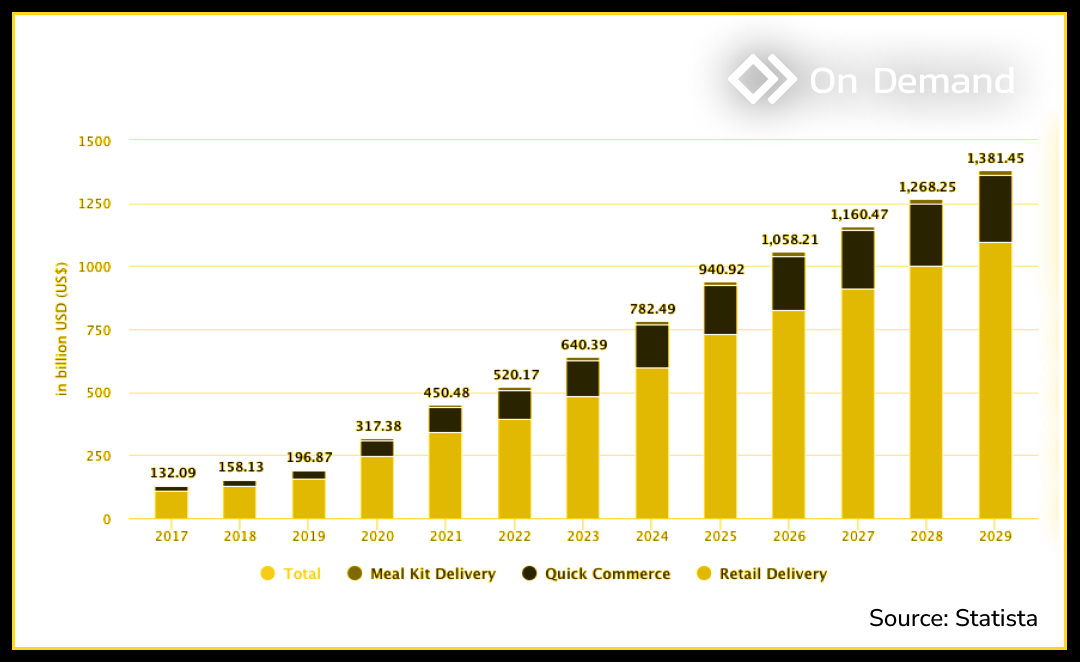
The worldwide online grocery store app market is experiencing rapid expansion and is forecasted to surpass $550 billion by 2025. People prefer easy solutions for their daily needs because they have limited time available in densely populated urban spaces. People can now shop easily online because grocery delivery apps let users see a large selection of goods at ideal prices while arranging home deliveries without leaving their houses. Integrated AI AR and IoT technology boost the user experience during grocery app development. Features like real-time tracking, personalized recommendations, and voice search are making these apps indispensable for modern shoppers.
Top 10 Grocery Delivery Apps to Watch in 2026
When it comes to the most popular and reliable grocery delivery apps in the USA, the digital shelves are brimming with options designed to meet every shopper’s needs—whether you crave lightning-fast delivery, fresh produce straight from the farm, or simply the best prices in town. Let’s dive into the standout apps leading the pack this year:
1. Amazon Fresh

Amazon Fresh stands as a leader in the sector, seamlessly merging the massive Amazon marketplace with speedy grocery delivery. Prime members enjoy same-day deliveries, access to exclusive Whole Foods and 365 brands, and real-time order tracking in many urban areas.
Key Features:
- Same-day delivery for Prime members
- Access to Whole Foods’ 365 brand
- Real-time order tracking
2. Instacart

Instacart now embodies the term “convenient”, as it links users with local grocery stores for a day of delivery. The app model allows shoppers to pick from different retailers — e.g., Costco or Publix — for its on-demand app development supporting these services. Busy families are massive fans of Instacart which gets over 10 million downloads.
Key Features:
- Same-day delivery in as little as one hour
- Partnerships with 250,000+ retailers
- Instacart Express membership for free delivery
3. Walmart Grocery
Walmart has turned its retail dominance into a powerful grocery delivery experience, providing a broad inventory and the option for unlimited free deliveries with a subscription. Scheduling is flexible, and customers can mirror their in-store routine from the comfort of home.
Key Features:
- Affordable pricing and weekly deals
- Free shipping on orders over $35
- Integration with Uber Eats for faster deliveries
4. Shipt

Shipt connects users with a network of shoppers who retrieve orders from regional and national retailers. With tailored sale alerts, a simple reordering option, and flexible membership plans, it’s a stress-free solution for regular grocery needs.
Key Features:
- Same-day delivery in under an hour
- Membership options starting at $14/month
- Access to premium retailers
5. FreshDirect

For those who prize transparency and freshness, FreshDirect is a favorite in the Northeast. This service highlights farm-sourced produce and detailed origin information, delivering to major cities like New York and Philadelphia with a focus on quality.
Key Features:
- Fresh produce from local farms
- Flexible delivery schedules
- Seasonal product offerings
6. GoPuff

GoPuff sets new standards in the on-demand grocery app market with its network of small delivery facilities. Through its 30-minute delivery process, the app provides fast access to all necessary supplies.
Key Features:
- 24/7 delivery service
- A flat delivery fee of $3.95
- Wide range of essentials
7. DoorDash

Expanding beyond restaurant fare, DoorDash now delivers groceries and everyday essentials rapidly. With perks for DashPass members and a growing list of retail partners, it’s a convenient option for those last-minute must-haves.
Key Features:
- Same-day delivery options
- Real-time order tracking
- Partnerships with local retailers
8. Uber Eats

Through its platform, Uber Eats provides a single ordering experience that combines a food delivery app with its grocery delivery app services for customers. The delivery app lets users track their orders in real time and offers easy navigation which makes it the preferred service for city residents.
Key Features:
- Wide range of grocery and meal options
- Real-time delivery tracking
- Easy-to-use interface
9. Peapod

Peapod specializes in making online grocery shopping intuitive, featuring recurring order suggestions, smart product recommendations, and even meal kit bundles for home cooks looking to save time
10. Safeway
Leveraging its established brand and stores across the country, Safeway offers convenient app-based ordering with a wide selection—from pantry goods to household essentials. Each store acts as a micro-fulfilment centre to ensure fast, trusted service.
Trends and Growth Drivers in the U.S. Grocery Delivery Market
In the United States, the surge in online grocery delivery is more than just a fleeting pandemic response—it's become a lifestyle shift fuelled by several dynamic trends and market drivers.
First, changing consumer habits is playing a huge role. Shoppers now expect near-instant gratification, and the convenience of ordering groceries from the couch (or the office desk) has quickly become non-negotiable. People appreciate accessing everything from local produce to household essentials with a few taps, often scheduling deliveries to fit their busy routines.
This growth is also powered by technology. U.S. grocery delivery apps are investing in advanced features such as real-time order tracking, smart recommendations based on personal preferences, and integrated payment processors that make checkout seamless. Artificial intelligence is making apps smarter every year, while emerging tech like IoT and augmented reality keep the shopping experience engaging and interactive.
Another significant driver is the ongoing commitment from major retailers, independent grocers, and tech giants to expand logistics capabilities. The result? Faster delivery options, wider product assortments, and increased geographic reach—including service to suburbs and smaller cities.
Finally, increased consumer trust in online payments and a preference for contactless transactions have accelerated adoption across diverse age brackets. As busy American households continue demanding flexibility, these market forces combined are set to keep grocery delivery apps on a strong upward trajectory through 2025 and beyond.
Opportunities for Entrepreneurs and Investors in the Online Grocery Delivery Market
The surge of online grocery delivery isn’t just changing the way consumers fill their fridges—it’s also opening up lucrative doors for forward-thinking entrepreneurs and investors. The combination of shifting shopping habits, increasing demand for instant and convenient solutions, and a constant infusion of new technologies has created fertile ground for those looking to make their mark.
If you’re considering entering this space, here’s why now is the perfect time:
How Grocery Delivery Platforms Partner with Retailers and Handle Logistics
So, how do grocery delivery apps actually operate behind the scenes? It begins with strategic partnerships between the platform and grocery retailers, ranging from large supermarket chains to trusted local stores. App operators negotiate agreements covering product assortment, pricing, commission structures, and delivery zones, allowing users to access a wide selection of groceries without leaving their homes.
Once an order is placed and payment is completed through a secure in-app system, the logistics process is set in motion. Retail partners begin preparing the order, either directly in-store or at regional distribution centres. Throughout this process, the app keeps customers informed with real-time order tracking, clearly defined delivery windows, and simple communication options to connect with the retailer or delivery personnel.
When delivery time arrives, a network of drivers—often guided by integrated navigation and routing tools—collects the order and delivers it straight to the customer’s doorstep. This system ensures smooth operations whether the customer is in New York, Mumbai, or Toronto. The result is a streamlined, technology-driven workflow that seamlessly connects shoppers, retailers, and delivery partners to deliver fast and reliable grocery services every time.
Excited to create your own on-demand grocery app to capture this growing global market? Read more about how to create your own grocery app clone here!
The Future of Grocery Delivery Apps in India, the US and Canada
The grocery delivery app industry is evolving rapidly, with innovations like AI-powered meal planning, AR shopping experiences, and autonomous delivery vehicles shaping the future. Organizations can develop unique grocery delivery apps to handle their business needs or they can select ready-to-use grocery delivery app solutions to improve their efficiency.
Every region around the world demonstrates distinct consumer preferences as the grocery delivery app market continues to expand. In the United States, Amazon Fresh and Instacart dominate the grocery delivery space by offering same-day delivery and partnering with leading retail chains. Instacart, in particular, stands out as one of the most widely used grocery delivery apps in the country. Through partnerships with major retailers such as Whole Foods, Kroger, and Costco, it provides shoppers with access to an extensive range of products. Its intuitive app experience, broad delivery network, and fast fulfilment options have played a key role in building strong market share and consumer trust across the U.S.
In Canada, consumers commonly rely on apps like Voila by Sobeys and Walmart Grocery, as these platforms enable convenient online grocery shopping while offering cost-effective savings options. Meanwhile, in India, demand for rapid grocery delivery continues to rise in urban areas through services such as BigBasket and Zepto, which effectively cater to densely populated cities where speed and convenience are essential.
Companies interested in this market need to research either customised grocery delivery application creation or obtain white-label grocery delivery apps to meet the specific needs of different areas. Every nation, including the US, Canada, and India, will benefit from grocery shopping apps that let users shop without hassle.
Challenges of Building a Grocery Delivery App from Scratch
Technical Complexity: Building a grocery delivery app may sound exciting, but it is far from simple. The process involves multiple layers and requires careful planning across several critical areas. Developers must create a scalable architecture, intuitive user interface, and a reliable backend capable of handling thousands of concurrent orders, similar to platforms like Amazon Fresh.
Logistics and Operations: Establishing an efficient delivery network, managing real-time inventory visibility, and optimizing last-mile delivery are ongoing operational challenges that directly impact customer satisfaction.
Time and Cost Investment: Every stage of development—from UI/UX design and app development to payment gateway integration—requires significant time, effort, and financial investment.
Regulatory Compliance: Grocery delivery apps must securely handle customer data while complying with local data protection and delivery regulations. These requirements become more complex when expanding into new cities or countries.
User Expectations: Modern consumers expect features like one-tap checkout, real-time order tracking, instant notifications, and seamless browsing experiences. Meeting these expectations demands continuous development, testing, and optimization.
These challenges explain why many businesses choose ready-made or white-label solutions as a faster and more efficient way to enter the grocery delivery market.Estimated Development Time and Cost for Grocery Delivery Apps
If you’re considering building your own grocery delivery app, it’s important to weigh both your budget and your timeline expectations upfront. Development costs and timeframes can vary widely based on the app’s complexity, feature set, and your chosen development team’s location.
Key Cost Factors
- Type and number of features (real-time tracking, push notifications, reviews)
- Number of user roles or app versions (customer, driver, retailer, admin)
- Level of customization in design and third-party integrations
- Technology stack and scalability requirements
Typical Cost Ranges by Region
- India: $30–$60 USD per developer hour
- Eastern Europe: $60–$100+ USD per developer hour
- United States: $70–$150+ USD per developer hour
Development Time Estimates
- Simple App: 600–900 hours
- Mid-level App: 1,600+ hours
- Full-scale App Suite: Up to 2,000+ hours
Businesses focused on faster time-to-market often opt for white-label grocery delivery solutions, while fully custom apps offer greater flexibility at a higher cost and longer timeline.
Factors Influencing the Cost of Building a Grocery Delivery App
Developing an online grocery delivery app is a major undertaking, and the investment required can vary widely. Several core factors play a big role in determining your overall costs, whether you’re building your app in New York, Mumbai, or anywhere in between.
Some of the primary cost drivers include:
App Features and Complexity: Are you envisioning a simple platform with basic delivery and payment options, or do you want features like real-time order tracking, customized recommendations, advanced search, ratings, and push notifications? The more bells and whistles, the steeper the price tag and development timeline.
Design and User Experience: A sleek, intuitive interface isn’t just nice to have—it’s what sets apart top apps like Instacart and BigBasket. Custom UI/UX design tailored for multiple users (customers, couriers, store partners, and admins) will increase both time and expense.
Choice of Technology Stack: Selecting the right backend and frontend technologies plays a part in both performance and ongoing maintenance. Integrating third-party APIs or building from scratch can impact cost efficiency.
Development Team Location and Rates: Labor costs fluctuate dramatically by geography. For instance, hiring engineers in India or Eastern Europe is generally less expensive than in North America or Western Europe.
Number and Type of User Apps: Typically, a suite of grocery delivery apps includes:
- The customer app for browsing and ordering
- The delivery driver app with route management
- The retailer interface for managing inventory and orders
- An admin dashboard
The more app “faces,” the more resources you’ll need for thorough development and testing.
Timeline and Project Scope: A basic grocery delivery solution might take a few hundred hours, while a comprehensive multi-platform service could demand 2,000 hours or more, especially if it covers unique requirements for each region (think: US, Canada, and India’s diverse needs).
In short, your total investment depends on how ambitious your vision is, which countries you’re targeting, and whether you’re customizing everything from scratch or building atop a pre-made framework. Smart planning at this stage helps ensure your grocery delivery app stands out—without breaking the bank or blowing your timeline.
Core Features of Grocery Delivery Apps for Every User
A robust grocery delivery platform generally includes four main applications tailored for different roles: the customers, delivery drivers, retail partners, and administrators. Here’s what you can expect from each:
1. User App
- Effortless account creation and management
- Browsing and searching for products with filters
- Easy-to-navigate catalog with up-to-date inventory
- Cart and wishlist options for simplified shopping
- Multiple secure payment methods, including cards and wallets
- Real-time order tracking and push notifications
- Personalized offers and recommendations
- Order history and reordering capabilities
- Ratings and reviews for products and delivery experience
2. Delivery Driver App
- Access to new delivery assignments with optimized routes
- Turn-by-turn navigation and status updates
- In-app chat or calling for customer communication
- Earnings dashboard and delivery history
- Proof of delivery options (photo, OTP, or signature)
3. Retailer/Seller App
- Product and inventory management tools
- Order notifications and fulfillment management
- Real-time sales tracking and analytics
- Options to update pricing, stock, and promotions
- Integration with payment systems and reporting tools
4. Admin App
- Centralized dashboard to monitor app performance
- Manage users, retailers, and delivery partners
- Track orders, payments, and resolve issues
- Access to analytics, reporting, and marketing tools
- Control over discounts, offers, and push notifications
These features ensure a seamless process from placing an order to doorstep delivery, giving all parties involved—shoppers, partners, and drivers—the tools they need for a hassle-free experience.
Conclusion
The rise of grocery delivery apps has transformed the way we shop for essentials, offering unparalleled convenience and efficiency. As grocery industry growth continues businesses can commission Grocery delivery app development to succeed in the marketplace and serve their modern customers better.
So, why wait? Try the new-generation grocery shopping applications now to make your grocery purchases effortless, and discover the incredible benefits of commissioning a professional grocery app development.
Frequently Asked Questions (FAQs)
1. What are the top grocery delivery apps in 2025?
In 2025, several grocery delivery apps have gained prominence due to their innovative features and user-friendly interfaces. Leading the pack are Amazon Fresh, Instacart, Walmart Grocery, Shipt, and FreshDirect. These platforms offer a range of services tailored to modern consumers' needs.
Key highlights include:
- Amazon Fresh: Offers same-day delivery for Prime members and access to Whole Foods’ 365 brand.
- Instacart: Provides partnerships with over 250,000 retailers and delivers in as little as one hour.
- Walmart Grocery: Features affordable pricing, weekly deals, and integration with Uber Eats for faster deliveries.
2. How do grocery delivery apps enhance the shopping experience?
Grocery delivery apps have revolutionized shopping by offering unparalleled convenience and personalized services. Users can browse extensive product selections, compare prices, and schedule deliveries at their convenience, all from their devices.
Enhancements include:
- Real-time tracking: Allows users to monitor their orders from placement to delivery.
- Personalized recommendations: Utilize AI to suggest products based on user preferences and purchase history.
- Multiple payment options: Provide flexibility with various payment methods, including digital wallets and cash on delivery.
Beyond these core features, the success of grocery delivery platforms is built on a seamless ecosystem that connects retailers, customers, and delivery partners. The typical journey starts with users browsing a wide range of products from both major chains and local stores, all presented with clear pricing, detailed descriptions, and estimated delivery times. Once an order is placed, retailers prepare the items for pickup, ensuring accuracy and freshness.
Meanwhile, delivery partners—guided by built-in navigation tools—collect the prepared orders and deliver them efficiently to customers’ doorsteps. The apps often facilitate communication between users, retailers, and delivery partners, so any questions or changes can be handled in real time. This interconnected system not only streamlines the entire grocery shopping process but also emphasizes reliability, convenience, and ease of use, making it an indispensable tool for modern living.
3. What are custom grocery delivery app development solutions?
Custom grocery delivery app development involves creating a tailored application that meets specific business requirements. This approach allows businesses to design unique features, user interfaces, and functionalities that align with their brand identity and operational needs.
Benefits of custom development:
- Scalability: Easily adapt to growing business demands.
- Unique branding: Maintain a distinct market presence.
- Enhanced security: Implement robust security measures specific to the business.
4. What is a white-label grocery delivery app solution?
A white-label grocery delivery app solution is a pre-built application that businesses can rebrand and customize as their own. This approach offers a quicker and often more cost-effective way to enter the market without developing an app from scratch.
Advantages include:
- Faster deployment: Quickly launch the app under your brand.
- Cost efficiency: Reduce development expenses.
- Proven reliability: Utilize a tested and functional platform.
5. What features should I look for in a grocery delivery app?
When selecting a grocery delivery app, it's essential to consider features that enhance usability and convenience. Key features to look for include:
- User-friendly interface: Ensures easy navigation and a seamless shopping experience.
- Real-time inventory updates: Provides accurate stock information to prevent order issues.
- Flexible delivery options: Offers various delivery slots and pickup choices to suit user schedules.
- Customer support: Accessible assistance for order inquiries and issues.
By focusing on these features, users can enjoy a more efficient and satisfying grocery shopping experience.