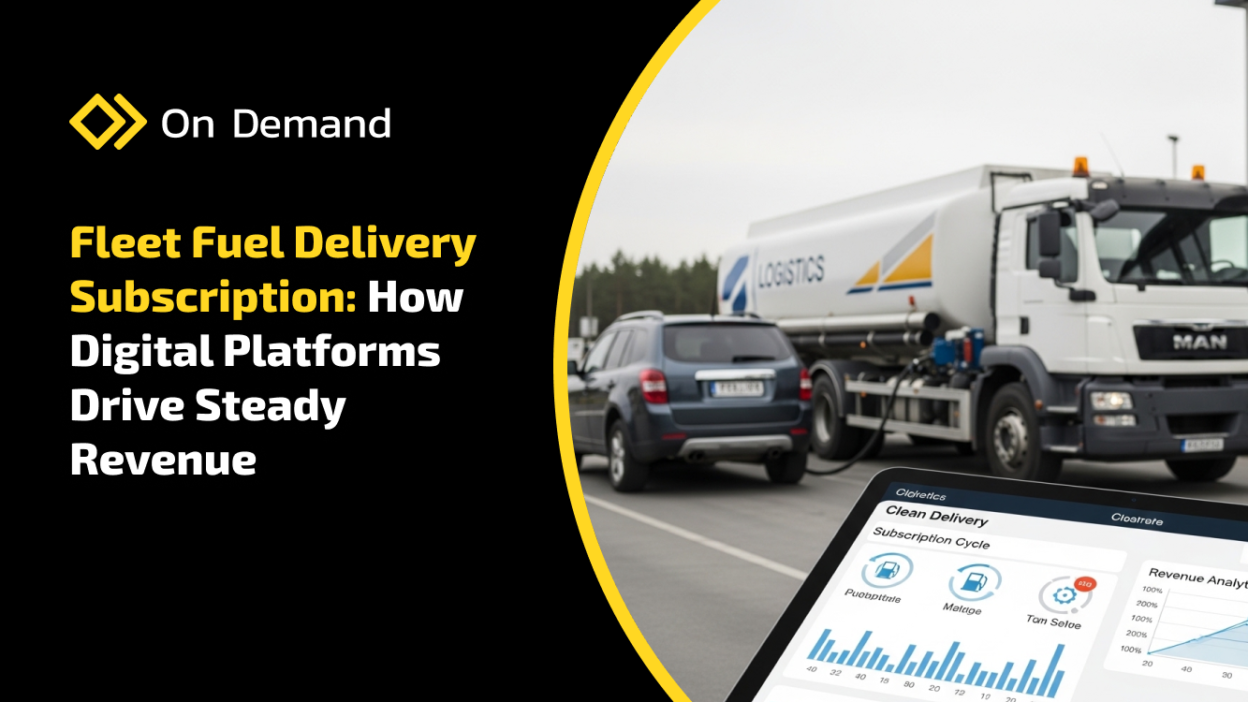
The on-demand economy has reshaped how businesses consume essential services, and fuel is no exception. Fleet operators managing dozens or hundreds of vehicles can no longer afford the inefficiency of reactive fueling. According to Cognitive Market Research, the global on-demand fuel delivery market was valued at USD 251.2 million in 2024 and is projected to expand at a CAGR of 18.20% through 2031. That growth is being driven largely by one model: the fleet fuel delivery subscription.
For fuel delivery businesses, subscriptions are no longer a nice-to-have. They are fast becoming the primary vehicle for building stable, scalable revenue in a market historically dominated by volatile spot orders and unpredictable demand. But making subscriptions work at the fleet level requires more than a payment plan; it requires the right platform infrastructure underneath it.
This guide breaks down how the fleet fuel delivery subscription model works, what platform features actually enable it, how to price and retain subscribers, and why this model is becoming the gold standard for fuel delivery businesses looking to grow. If you are exploring fuel delivery app development, understanding the subscription layer is the most important thing you can build right.
Why Fleets Are Moving Away from On-Demand Fueling Orders
Traditional on-demand fueling, where a fleet manager calls or taps an app to request fuel when a vehicle is nearly empty, creates operational chaos. Drivers wait. Routes get disrupted. Fuel costs spike because emergency or last-minute orders rarely come with volume discounts.
Fleet operators running logistics companies, construction fleets, ride-hailing pools, or municipal vehicles face the same core problem: fuel is their single largest variable expense, yet they treat it like an afterthought. The result is unpredictable downtime, cost overruns, and a procurement process that consumes more management time than it should.
The fleet fuel delivery subscription model solves this by flipping the dynamic. Instead of reacting to empty tanks, fleets pre-commit to scheduled deliveries, daily, weekly, or triggered automatically by telematics data. The fuel reaches the vehicle on schedule, often overnight, while the fleet is parked and idle.
For fuel delivery providers, this shift is equally powerful. Subscriptions convert unpredictable order flow into Monthly Recurring Revenue (MRR), the metric that defines the health of every scalable service business. As detailed in research on the fuel delivery subscription model, companies moving from transactional billing to subscriptions report 3–5× higher customer lifetime value (CLV) compared to one-off models.
What a Fleet Fuel Delivery Subscription Actually Looks Like
Before diving into the platform requirements, it helps to understand what a subscription offering looks like from the customer’s perspective, because this shapes every technical decision downstream.
Tiered Fleet Plans
Most successful subscription models for fleets are structured in tiers based on fleet size and fuel volume. A small logistics company with 10 vehicles has very different needs from a construction firm running 80 pieces of heavy equipment. Tiered pricing lets fuel providers serve both segments profitably.
A typical structure might look like: an entry-level plan covering up to 15 vehicles with weekly scheduled deliveries and a basic usage dashboard; a mid-tier plan covering up to 50 vehicles with daily delivery windows, priority dispatch, and telematics integration; and an enterprise plan with unlimited vehicles, custom scheduling, dedicated account management, and compliance reporting.
Prepaid Fuel Credits
Some fleet operators prefer to pre-purchase fuel credits at a locked-in price rather than pay a fixed monthly fee. This model is particularly attractive when fuel prices are volatile, the fleet locks in cost certainty, and the fuel provider locks in revenue. Platforms need to support credit wallet management, usage tracking, and expiry rules to make this work correctly.
IoT-Triggered Auto-Scheduling
The most sophisticated version of the fleet fuel delivery subscription removes human scheduling entirely. IoT sensors on fleet vehicles or storage tanks communicate fuel levels in real time. When a vehicle drops below a defined threshold, say 25% tank capacity, the platform automatically triggers a delivery order for the next available slot.
This is a feature that sets advanced on-demand fleet fueling platforms apart from basic scheduling tools, and it is one that most competitor blogs have not adequately addressed.
The Platform Features That Make Fleet Subscriptions Scalable
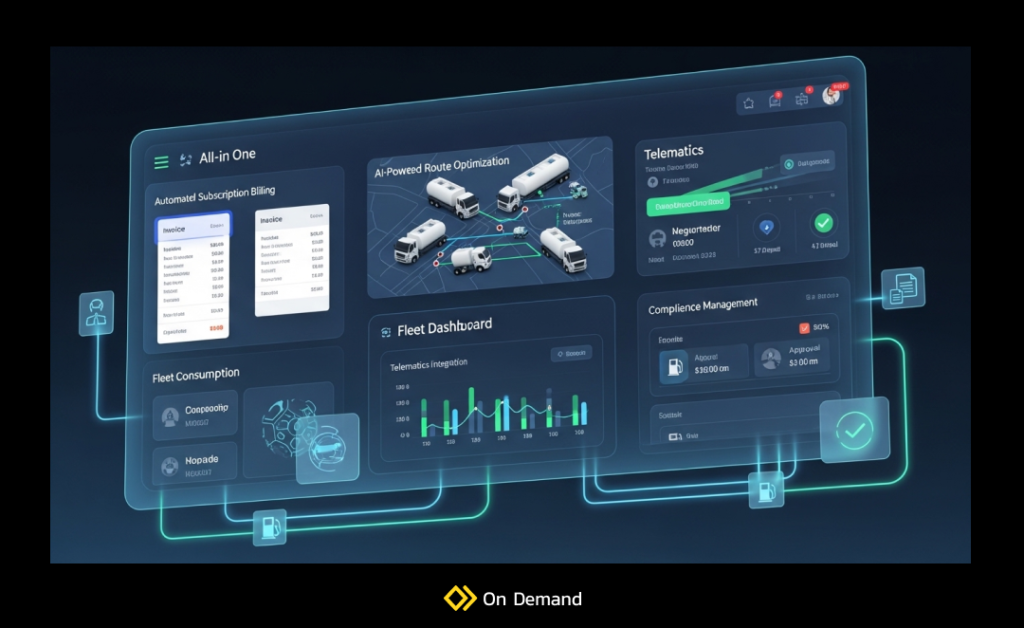
This is where most discussions of fuel delivery subscriptions fall short. Business model theory is easy to describe, but the real question for fuel delivery operators is: what does the platform actually need to support this? Here is what matters most.
1. Recurring Billing Engine with Fleet-Level Logic
A standard payment gateway is not sufficient. Fleet subscriptions require billing logic that handles per-vehicle pricing, mid-cycle fleet additions or removals, prorated charges, bulk invoice generation, and automated payment retries. The billing engine must also support multi-contact invoicing, where fuel charges go to a fleet manager, but compliance documents go to a finance controller.
Platforms built with a robust fuel delivery app for fleet functionality integrate billing directly with delivery confirmation, so a subscription charge only triggers when a delivery is completed and verified, protecting both the provider and the fleet client. Purpose-built fleet fueling software handles these billing complexities automatically
2. Smart Dispatch and Route Optimisation
Subscription models create predictable demand patterns, and predictable demand is a logistics gift. When a platform knows that Fleet A needs fueling every Tuesday night and Fleet B every Thursday morning, it can pre-plan tanker routes, optimise driver schedules, and reduce the cost per delivery significantly compared to random on-demand orders.
Route optimisation algorithms that factor in vehicle capacity, delivery windows, geographic clustering, and traffic patterns can reduce operational costs by 15–25% compared to unplanned dispatch. This is the margin improvement that makes fleet subscription models not just attractive to customers, but genuinely profitable for providers.
3. Fleet Dashboard and Usage Analytics
Fleet managers subscribe and stay subscribed for two reasons: convenience and visibility. A well-designed fleet dashboard shows fuel consumption per vehicle, delivery history, cost-per-kilometre trends, and upcoming scheduled deliveries, all in one place. This level of visibility is something fleet managers cannot easily get from traditional fuel cards or pump visits.
Advanced fleet reporting platforms transform operations management with customizable KPIs, real-time analytics, fuel tracking per vehicle, and actionable insights that drive efficiency and profitability.
The analytics layer also serves the fuel provider. Consumption data helps predict when a subscriber might need to upgrade their plan, flags accounts at risk of churn due to declining usage, and identifies upsell opportunities, such as offering DEF (diesel exhaust fluid) top-ups alongside regular fuel deliveries.
4. Telematics Integration
Modern fleet operations run on telematics, GPS tracking, engine diagnostics, driver behaviour monitoring, and fuel efficiency reporting. A fleet fuel delivery platform that integrates with existing telematics providers like Geotab, Samsara, or Motive becomes genuinely embedded in the fleet’s operational stack. That level of integration dramatically reduces churn because switching providers means losing data continuity.
5. Compliance and Documentation Automation
This is a feature almost no competitor blog covers, yet it is critically important for B2B fleet clients. Fuel delivery for commercial fleets involves significant compliance obligations, delivery receipts, IFTA reporting data, hazardous material documentation, and carbon emission records. Platforms that automate the generation and delivery of these documents remove a significant administrative burden from fleet managers. In regulated industries like government fleet fueling and transportation, compliance automation can be the deciding factor in winning and retaining enterprise contracts.
Pricing Strategy: How to Structure Fleet Subscription Plans
Getting the subscription pricing right is as important as the platform features. Underprice and you erode margins. Overprice and acquisition stalls. Here is how successful fuel delivery operators approach this.
The foundation of fleet subscription pricing is the cost-plus model with a service premium. Calculate the cost of fuel procurement, delivery logistics, platform overhead, and driver time per vehicle per month. Add a margin that reflects the value of convenience, scheduling reliability, and analytics access, typically 12–20% above the equivalent pay-per-delivery cost.
Equally important is the annual commitment discount. Offering fleet operators a 10–15% discount for annual prepayment improves cash flow dramatically and locks in revenue. From the fleet manager’s perspective, the discount justifies the commitment. From the provider’s perspective, annual subscribers have a significantly lower churn rate and higher lifetime value. Platforms supporting the on-demand fleet fueling platform model should also build in plan upgrade triggers, automated prompts that suggest a plan upgrade when a fleet’s monthly consumption consistently exceeds its current tier. This drives revenue expansion without sales

Churn Prevention: The Metric That Separates Good Subscriptions from Great Ones
Acquisition is only half the equation. The power of the fleet fuel delivery subscription model lies in retention, and retention requires deliberate platform design, not just good service.
The highest-impact churn prevention mechanism is delivery reliability. A fleet that experiences even two or three missed or delayed deliveries in a quarter will begin evaluating alternatives. Platform-level features like real-time delivery tracking, proactive delay notifications, and automated rebooking protocols are not optional; they are the foundation of subscriber trust.
The second layer is value reinforcement. Monthly fuel reports automatically delivered to fleet managers, showing money saved versus pump prices, emissions reduced versus traditional fueling, and hours of driver time recovered, make the subscription’s ROI visible and tangible. Subscribers who can see the value of what they are paying for are significantly less likely to cancel.
The third layer is switching cost engineering. The deeper a platform integrates with a fleet’s existing telematics, ERP, and accounting systems, the harder it becomes to switch providers. This is not about locking customers in unfairly; it is about becoming genuinely essential to their operations. Well-architected fuel delivery business model platforms build these integrations deliberately from day one.
White-Label Fleet Subscription Platforms: The Opportunity Most Operators Miss
Here is something virtually no other resource on fleet fuel delivery subscriptions covers: the white-label platform opportunity.
Most discussion of subscription models assumes that the fuel delivery business builds its own platform. But there is a growing market of regional fuel distributors, oil company affiliates, and logistics fuel providers who want to offer subscription services to fleet clients but do not have the technology capability to build a platform from scratch.
White-label fleet fueling software solves this. A technology provider builds a configurable subscription platform, with all the billing, dispatch, dashboard, and compliance features described above, and licenses it to fuel operators who deploy it under their own brand. The technology provider generates SaaS-based recurring revenue without managing logistics. The fuel operator gets enterprise-grade platform capabilities without a multi-year development investment.
This model is already well-established in adjacent industries like food delivery and ride-hailing. In the fuel delivery space, it represents a significant untapped opportunity. For operators exploring on-demand app development for fuel delivery, the white-label licensing model can multiply revenue potential well beyond a single-market deployment.
Real-World Revenue Impact: What the Numbers Show
The business case for building fleet subscription capabilities into a fuel delivery platform is compelling when you look at the actual revenue metrics.
A fuel delivery operator with 200 fleet vehicle subscribers on a mid-tier plan at USD 150 per vehicle per month generates USD 30,000 in predictable MRR, USD 360,000 annually, before a single on-demand order is placed. Compare that to the same operator relying entirely on transactional orders, where monthly revenue might range from USD 18,000 to USD 45,000 depending on seasonal demand and fuel price fluctuations.
The subscription model also reduces the cost of sales. Acquiring a new fleet subscriber is more expensive than a single-order customer, but that subscriber generates 12–24× the revenue of a one-time buyer over their lifetime. When customer acquisition cost (CAC) is spread across a 24-month subscription, the payback period compresses dramatically, making fleet subscriptions one of the most capital-efficient growth strategies available to fuel delivery operators.
Industry data supports this trajectory. The global subscription economy was valued at approximately USD 487 billion in 2024 and is projected to exceed USD 2,100 billion by 2034. Fuel delivery is following this macro trend, with B2B fleet fueling solutions increasingly structured around subscription contracts rather than spot orders.
Conclusion: The Platform Is the Product
Fleet fuel delivery subscriptions are not simply a billing preference; they are a complete operational model that requires purpose-built platform infrastructure to work at scale. The fuel businesses that will lead this market over the next five years are not the ones with the cheapest fuel price. They are the ones with the best platform: smarter dispatch, richer fleet analytics, seamless billing, deep integrations, and compliance automation that saves fleet managers hours every month.
The shift from transactional to subscription revenue in fleet fueling is already underway. For fuel delivery operators, the question is not whether to build subscription capabilities; it is how quickly they can deploy the right platform to capture fleet clients before competitors do.
Whether you’re building a new fuel delivery platform from scratch or adding subscription functionality to an existing operation, the architecture decisions you make today will define your revenue ceiling for the next decade.
Continue Your Journey
Ready to build predictable fleet revenue? Explore white-label vs custom fuel delivery platforms. The definitive guide comparing speed-to-market, scalability, and enterprise features for gas stations and distributors.
Launch your fleet fueling platform today with production-ready subscription billing, IoT automation, and analytics that convert one-time deliveries into recurring revenue streams.
FAQs:-
1. What is a fleet fuel delivery subscription, and how does it work?
A fleet fuel delivery subscription is a service where businesses schedule regular fuel deliveries (daily, weekly, or automated) instead of placing one-time orders. Using fleet fueling software, deliveries are pre-planned or triggered by vehicle fuel levels, ensuring uninterrupted operations and predictable monthly billing.
2. Is a fuel delivery subscription cheaper than traditional fueling?
Yes, in most cases. A fuel delivery app for fleets reduces emergency refuelling costs, minimises downtime, and offers bulk pricing or fixed-rate plans. Over time, fleets save on operational costs, driver hours, and fuel price fluctuations.
3. What features should I look for in a fleet fueling platform?
A good fleet fueling platform should simplify operations, not complicate them. It should automate fuel scheduling, reduce delivery costs through smart planning, handle billing smoothly, and give clear visibility into fuel usage. It should also integrate easily with your existing fleet systems, so everything works in one place.
4. Can small fleets benefit from fuel delivery subscriptions?
Absolutely. Even fleets with 5–15 vehicles can benefit from a fuel delivery business model based on subscriptions. It helps reduce manual coordination, improves cost predictability, and allows small businesses to operate with the efficiency of larger fleets.
5. How do fuel delivery platforms help businesses generate predictable revenue?
Subscription-based models convert irregular fuel orders into monthly recurring revenue (MRR). With the right fleet fueling software, providers can forecast demand, optimise delivery routes, reduce operational costs, and increase customer lifetime value (CLV).