Most fuel companies make the software decision the same way.
The dispatcher is managing delivery routes over WhatsApp. Drivers call in their job status from the road, and by the time the admin logs it, two hours have passed, and the numbers still do not reconcile. A competitor just launched an app. Customers are asking why they cannot book online.
That is the moment when manual processes stop being a minor inconvenience and start costing real money, when fuel operators start evaluating fuel delivery software. And that is exactly when the wrong decision can set a business back by months, or cost far more than the problem it was supposed to solve.
Buying a fuel delivery platform is not like choosing a CRM. Fuel is a regulated hazardous material. Delivery involves compliance documentation, real-time fleet coordination, payment processing, and customer trust, all at once. The platform you choose will shape how your business operates, how fast it scales, and whether your drivers, dispatchers, and customers can actually use what you have built.
This guide gives you the ten questions that cut through vendor presentations and reveal how a platform performs when your business depends on it, plus what a good answer looks like, and what should send you walking. It is designed for businesses evaluating fuel delivery software vendors, fleet digitisation strategies, and long-term on-demand fuel delivery app development investments.
What Is On-Demand Fuel Delivery Software?
Before evaluating platforms, it helps to define what you are actually buying, because “fuel delivery software” means very different things depending on the vendor.
Traditional fuel delivery software manages scheduled depot routes for heating oil and propane companies. It has existed since the 1990s and is built for fixed-route, B2B logistics. Most of the blog posts and comparison articles you will find online are written for this buyer.
On-demand fuel delivery software is a different category. It is a mobile-first platform that lets customers, individuals, businesses, or fleet operators order fuel to a location in real time, the way they order a ride or a meal. A production-ready platform connects three panels:
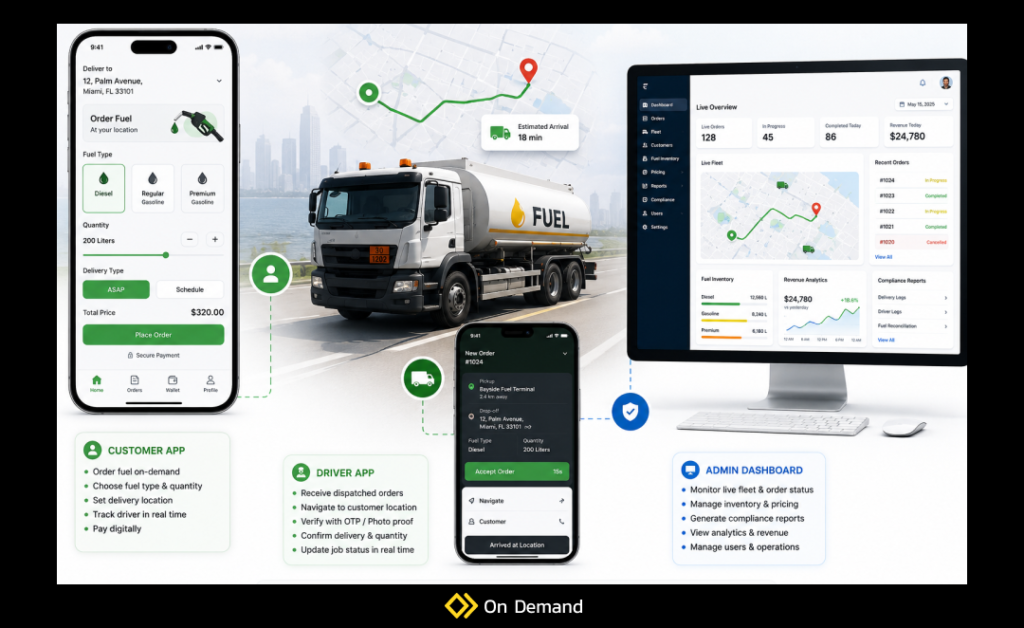
- Customer app: order fuel, choose type and quantity, set delivery location, track the driver, pay digitally.
- Driver app: receive dispatched orders, navigate to locations, confirm delivery with OTP or photo proof, and log dispensed quantity.
- Admin dashboard: monitor live fleet positions, manage inventory, configure pricing, generate compliance reports, and view revenue analytics.
This is the model behind operating businesses like Booster Fuels, Filld, and CAFU, and the model that fuel companies across the US, UAE, Canada, and India are now adopting at scale.
Why Fuel Companies Are Making the Switch Right Now
The timing of this decision matters. The global mobile fuel delivery market was valued at $5.84 billion in 2025 and is projected to reach $11.93 billion by 2035, growing at a compound annual growth rate of 7.4%(Source: Future Market Insights). That is not a niche trend; it is a structural shift in how fuel reaches end users.
The pressure to digitise is coming from multiple directions simultaneously. Fleet operators in logistics, construction, and transportation are actively replacing manual fueling logs with app-based, trackable solutions. Urban fuel delivery startups are entering markets that were previously served only by traditional fuel stations. And consumers, particularly in B2B segments, now expect the same visibility and convenience from fuel delivery that they get from food and grocery apps.
On top of market pressure, the economics have changed. Ready-made fuel delivery app solutions now launch in weeks rather than months, at a fraction of what custom development used to cost. The barriers that once made technology adoption slow and expensive for mid-size fuel operators are largely gone.
The question for fuel companies today is not whether to invest in a fuel delivery platform; it is which platform to choose and what to look for before signing anything.
Custom Build vs. White-Label Ready-Made vs. Generic SaaS
There are three main ways to get a fuel delivery platform. Each serves a different business profile and comes with very different tradeoffs.
| Factor | Custom Build | White-Label Ready-Made | Generic SaaS |
| Time to launch | 3–6 months | 2–4 weeks | Days to weeks |
| Upfront cost | $50,000–$250,000+ | $5,000–$40,000 | Monthly subscription |
| Source code ownership | Yes | Yes, full code delivered | No, you rent access |
| Customisation | Full control | High — branding, features, zones | Low — config only |
| Fuel-specific compliance | Built to your spec | Pre-built | Usually generic |
| Best for | Large enterprises with technical teams | Fuel startups and growing operators | Testing before investing |
For most fuel companies entering or scaling in the on-demand space, a white-label fuel delivery app offers the strongest combination of speed, code ownership, and cost control. You get a platform designed specifically for fuel operations, not adapted from a restaurant or grocery delivery template, that can be fully branded as your own.
The practical rule most experienced operators follow: if you are pre-revenue and validating whether your market will buy on-demand fuel delivery, launch on a ready-made platform. Get your first 100 orders. Once you have real revenue and real data, make an informed decision about custom development. Commissioning a custom build before proving market demand is one of the most expensive mistakes in the on-demand business space.
Read More: White-Label vs. Custom Fuel Delivery App — What Fleet Operators Need to Know Before Choosing
10 Questions You Must Ask Before Buying
Every platform looks impressive in a demo. These questions are designed to cut through the presentation and reveal what actually happens when your operation depends on the software day to day.
Question 1: How Quickly Can the Platform Go Live?
Time to revenue is not a vanity metric. Every week spent in configuration or development delays is a week a competitor is signing up customers in your market.
A production-ready on-demand fuel delivery platform should be deployable in 2 to 4 weeks from contract to a live app on iOS and Android. That timeline covers branding configuration, payment gateway setup, service zone definition, and app store submission. Ask for the schedule in writing, broken into specific milestones.
What a strong answer looks like: A week-by-week launch plan with named milestones, discovery and configuration, branding and testing, soft launch and handover. The vendor commits to specific dates, not estimates.
Red flag: “It depends on your requirements” with no baseline timeline offered. For a ready-made platform, the core is already built. Vague timelines at the proposal stage reliably become vague delivery dates at the project stage.
Question 2: Do I Get Full Source Code Ownership?
This is the question most buyers forget to ask until they are already locked in, and it is the most consequential one on this list.
If you do not own the source code, you are renting your business’s technology from someone else. The vendor can change pricing, discontinue the product, or exit the market, and you have no recourse, no backup, and no way to continue operations without starting over from scratch.
For a white-label, ready-made purchase, the vendor should deliver the complete, clean source code to you at handover. You own it outright. You can modify it with any development team. You have no ongoing dependency on the original vendor.
What a strong answer looks like: “You receive 100% of the source code upon handover. It is transferred to your repository. All IP belongs to you from that point. We also sign an NDA before sharing any proprietary details of the platform.”
Red flag: “You will have full access to the platform through our system” or “we manage the codebase on your behalf.” These describe a SaaS rental model, not ownership. If future updates require going back to the original vendor at their pricing, you are a subscriber, not an owner.
Question 3: How Does Automated Dispatch Work?
Manual dispatch is the single biggest operational bottleneck in fuel delivery businesses. Dispatchers managing routes through calls and spreadsheets consistently miss orders, create overlapping routes, and produce driver downtime that compounds across every shift.
The dispatch capability of the platform you choose directly determines how efficiently your operation runs at scale. Ask for a live demonstration, not a walkthrough of features, but an actual order placed and dispatched in real time.
What a strong answer looks like: The system assigns delivery orders automatically based on driver location, availability, remaining fuel capacity, and route efficiency, without a dispatcher making individual decisions for each job. Drivers receive orders and turn-by-turn navigation directly in their app. The admin panel shows every active delivery on a live map with status updates.
Red flag: A demo where dispatch is a manual drag-and-drop process on a map. That is administrative tooling, not automation. Digitising a manual process without improving it does not scale.
Read More: Fuel Delivery Dispatch Software — The Complete Guide to Automation
Question 4: What ERP and Fleet Tools Does It Integrate With — and How Deep?
Most fuel companies already run accounting software, fleet management tools, or ERP systems. If a new fuel delivery platform cannot connect to those systems, you end up with data living in two places, staff manually reconciling records, and financial reporting that is always slightly behind reality.
The question is not “does it integrate?”, every vendor will say yes. The question is how deep those integrations actually go and whether data flows automatically or requires manual exports.
Ask the vendor to name specific systems they have built connectors for, SAP, QuickBooks, Oracle, Zoho, Tally, and explain what data passes between systems automatically. Ask for the API documentation link. A platform built for enterprise fuel operations should have a well-documented API that connects to your stack without your IT team writing custom middleware.
The ERP and fleet integration guide for fuel delivery apps covers what full integration actually looks like: automated fuel consumption synced to your ERP, per-vehicle cost allocation, and compliance documentation matched to financial records.
What a strong answer looks like: A live demonstration of a fuel order flowing through dispatch and appearing in the accounting system automatically, not a slide that says “QuickBooks integration available.”
Red flag: “We integrate with everything” without documentation or a live demo to back it up. This is almost always a significant overstatement.
Question 5: How Does the Platform Handle Compliance and Hazmat Documentation?
Fuel is classified as a hazardous material in every market it is transported in. That classification carries real regulatory obligations: geo-tagged delivery logs, driver certification records, quantity reconciliation, spillage documentation, and audit trails that regulatory bodies can request at any time.
A fuel management software platform that does not handle compliance natively will create manual administrative work that grows more expensive as you scale, and creates genuine legal exposure if an audit finds gaps.
What a strong answer looks like: Every delivery automatically generates a compliance record: delivery location with GPS coordinates, quantity dispensed, driver ID, vehicle ID, timestamp, and customer confirmation. These records are stored in a searchable, exportable format. Driver certification expiry dates trigger automatic alerts before they lapse. For B2B clients, the platform supports Net-30/Net-60 billing alongside digital invoicing.
For a full breakdown of what fuel delivery app safety and hazmat compliance requirements look like in practice, including DOT, EPA, and regional regulations, this guide covers the complete compliance checklist fuel operators need to build into their platform from day one.
Red flag: “We can add compliance features based on your requirements.” Compliance is not an add-on for fuel delivery — it is a core operating requirement. A platform that positions itself as optional has not been built for the fuel industry.
Question 6: What Happens to My Data If I Stop Using the Platform?
Customer records, delivery histories, driver profiles, compliance logs, and financial data represent years of operational intelligence. If a vendor controls that data and you cannot export it cleanly, you are not running your business independently; you are depending on a third party to keep operating.
What a strong answer looks like: You can export all data, customers, orders, drivers, financial records, and delivery logs in standard formats (CSV, JSON, XML) at any time, without involving the vendor. The contract states this explicitly. Ask what happens to data after termination: how long it is retained, what format it is available in, and whether the vendor provides exit assistance.
Red flag: “We manage your data securely in our cloud” without a clear export mechanism. Or contracts where data is deleted 30 days post-termination without an export process. These are not security features; they are lock-in strategies.
Question 7: Can I Control Pricing, Fuel Types, and Delivery Zones Myself?
No two fuel businesses operate identically. A startup serving individual consumers in one city has a completely different pricing logic, service zones, and fuel type requirements than a B2B operator running logistics fleets across multiple regions.
If the platform cannot adapt to your operational model, and if making changes requires contacting the vendor’s development team, you will spend your time working around the software rather than with it.
What a strong answer looks like: The admin panel lets you set different prices per fuel type, update them in real time without a developer, draw service zones using geofencing, set minimum order quantities, configure promotions, and manage loyalty programmes. For multi-location operations, zone management works independently per location with centralised reporting in the dashboard.
Red flag: Customisation that requires submitting a support ticket and waiting for the vendor’s development team. If changing a fuel price in your own app requires contacting someone else, you do not have operational control of your business.
Question 8: How Are Fuel Theft and Meter Discrepancies Managed?
A single fuel tanker can carry $20,000–$50,000 worth of product. Discrepancies between what the dispatch system records as delivered and what the physical meter reads are not data entry errors; they represent real financial losses. Without automated reconciliation, these gaps compound over time and become almost impossible to audit retrospectively.
What a strong answer looks like: The platform cross-references the quantity recorded in the digital delivery order against the physical meter reading at the point of delivery. Discrepancies above a configurable threshold trigger an automatic alert to the dispatcher and admin, before the driver leaves the delivery location. Geo-tagged, timestamped proof-of-delivery photos add a further layer of accountability that is available for audit at any time.
For fleet operators evaluating this in depth, the guide to fuel delivery fleet management software features covers how meter reconciliation and IoT integration work at a technical level.
Red flag: Platforms that rely on drivers’ self-reporting quantities with no automated cross-check. Manual entry without independent verification is where losses occur, and they are almost always invisible until the monthly reconciliation reveals a gap that cannot be traced back.
Question 9: What Do the Customer App and Driver App Actually Look Like in Use?
The quality of software is ultimately experienced by the people using it every day. A technically capable platform with a confusing interface gets abandoned by drivers on shift and deleted by customers after one difficult order. App experience is not cosmetic; it directly affects adoption, retention, and the operational efficiency of your entire service.
Ask for a live walkthrough of both apps on a real device, not a screen recording or a prototype presentation.
The customer app should allow a new user to place an order in under two minutes: register, choose fuel type, enter location, confirm quantity, select payment method, and track the driver. The driver app should work effectively under field conditions, with large, high-contrast buttons, minimal steps per delivery action, and offline functionality that maintains core features when connectivity drops in low-coverage areas.
The ready-to-use fuel delivery software overview shows how dispatch automation and real-time tracking reduce the operational errors that typically come from poor UX in the driver panel.
What a strong answer looks like: The vendor demos both mobile apps on real devices during your evaluation call, without switching to a slide deck to cover either one.
Red flag: A demo that focuses entirely on the admin dashboard, with the driver and customer apps shown briefly or skipped. A surprising number of vendors invest heavily in the management panel and treat the mobile apps as afterthoughts. These are the apps your customers and drivers use every single day.
Question 10: What Is the Post-Launch Support Model and SLA?
Launch day is when the real test begins. A driver encounters an unexpected screen. A customer hits a payment error during your morning peak. A geofencing zone needs adjusting before the first order of the day. How quickly your vendor responds to these moments determines whether your operation runs smoothly or stalls.
What a strong answer looks like: The vendor provides a documented SLA, written commitments to response times for critical issues (ideally under 4 hours), standard issues (under 24 hours), and feature requests. Support is available through a channel your team can actually reach, with access to technical staff who know your platform configuration and do not require you to re-explain your setup each time.
Red flag: “We are very responsive” and “our team is always available” with no SLA in the contract. Verbal support promises mean nothing at 9 PM when your drivers are waiting, and customers are watching a delivery timer count up. If a vendor will not put response time commitments in writing, that is your answer about how they treat post-sale relationships.

Driver App and Customer App Evaluation Checklist
Run through this checklist during every vendor demo. These are the features that determine whether your operation runs smoothly day to day, and the ones most commonly glossed over in presentations.
Customer App
- New user places first order in under 2 minutes
- GPS location pin with manual address override
- Fuel type and quantity selector with real-time price display
- Scheduled and immediate delivery options
- Multiple payment methods: card, digital wallet, cash, UPI
- Live driver tracking with accurate ETA
- OTP-based delivery confirmation
- Order history with fuel consumption analytics
- In-app driver communication (chat or call)
- Push notifications at every order status change
- Promo codes, loyalty points, or referral programme
- Automatic digital invoice after delivery
Driver App
- Instant order notification with full delivery details
- Turn-by-turn navigation (Google Maps or equivalent)
- Fuel quantity entry at delivery, linked to meter or manual input
- Proof-of-delivery photo capture
- OTP confirmation before order closure
- Offline mode: core functions available without internet
- SOS emergency alert to dispatch
- Daily and weekly earnings dashboard
- Status toggle: Online / Offline / On Delivery
Admin Dashboard
- Live fleet map with real-time driver and order positions
- Automated dispatch with manual override capability
- Inventory management with low-stock alerts
- Geofencing zone configuration per service area
- Pricing management by fuel type, zone, and customer segment
- Compliance report generation, delivery logs, quantity records, timestamps
- Revenue and performance analytics
- Driver and vendor management with document storage
- Multi-location support with centralised reporting
5 Vendor Red Flags to Watch For
These patterns show up consistently in vendor evaluations that end badly.
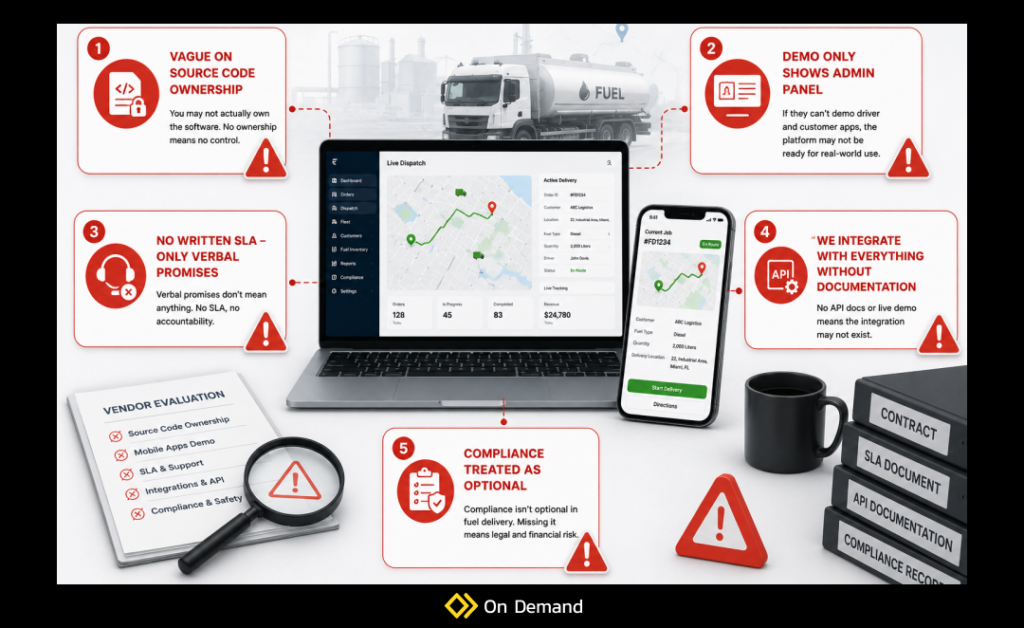
1. Vague answers on source code ownership.
If a vendor says, “You will have full access to the platform” or “we will discuss the licensing structure after you sign,” those are not answers to the ownership question. Ownership means the source code is delivered to you, you can modify it with any developer, and you owe the vendor nothing after the initial transaction. If this is not stated in writing before you sign, assume it does not apply.
2. The demo only shows the admin panel.
An admin panel that looks impressive in a presentation is relatively straightforward to build. What reveals the true quality of a platform is the driver app working under real field conditions and the customer app completing an order from start to finish. If a vendor cannot demo both mobile apps during your evaluation call, the apps are probably not ready for production operations.
3. No written SLA, only verbal promises.
“We are very responsive” is a marketing statement, not a commitment. Ask for specific response time commitments in the contract, escalation paths, and consequences if those commitments are not met. Vendors who refuse to document support terms are accurately signalling that they do not treat post-sale support as a contractual obligation.
4. We integrate with everything without documentation.
Ask for the API documentation, the certified integration list, and a live demonstration of data flowing from a fuel order into your accounting system. If the vendor cannot show this on a screen share, the integration does not exist to the depth your operation requires.
5. Compliance treated as optional.
Fuel delivery operates under hazmat transport regulations in every market. Geo-tagged delivery logs, driver certification tracking, and audit-ready documentation are standard operating requirements. If a vendor positions these as future features or add-ons, they have not built software specifically for the fuel industry.
Time-to-Launch and Real Cost Breakdown
One of the most common reasons fuel companies choose the wrong platform is comparing headline prices without accounting for the total cost of getting to market, and the cost of being late.
Custom Build
- Timeline: 3–6 months minimum; frequently longer for the first production release
- Cost: $50,000–$250,000+ for the initial build
- Ongoing: Requires a dedicated development team or agency retainer
- Time to first revenue: 4–8 months minimum
White-Label Ready-Made Fuel Delivery App
- Timeline: 2–4 weeks from contract to live app
- Cost: $5,000–$40,000 including branding, configuration, and deployment
- Ongoing: Maintenance handled by the vendor as part of the platform
- Time to first revenue: Within the first month of operation
Generic SaaS Subscription
- Setup: Days to weeks
- Cost: $200–$2,000/month, depending on scale
- Customisation: Minimal, you adapt your operations to the platform
- Ownership: None, access only
For most fuel companies in the growth phase, a production-ready on-demand fuel delivery app that goes live in under 30 days offers the clearest path from investment to revenue. Every month spent in custom development is a month your operation runs manually, and that cost is real, even when it does not appear on an invoice. For a detailed breakdown of what drives fuel delivery app development cost across each build type, including hidden costs like hosting, third-party APIs, compliance modules, and ongoing maintenance, this fuel delivery app cost analysis covers every line item fuel operators need to budget for before signing with any vendor.
How a Ready-Made Platform Can Get Your Fuel Business Live Faster
Understanding what to look for in fuel delivery software is one thing. Knowing how to go from evaluation to a live, earning operation in a matter of weeks is another.
A well-structured, ready-made fuel delivery app solution eliminates most of the delays that plague custom development projects. The core architecture, customer app, driver app, admin panel, payment gateway, GPS integration, dispatch logic, and compliance reporting are already built, tested, and deployed across real operations. What your business receives is that proven foundation, configured for your brand, your service zones, your fuel types, and your pricing structure.
The onboarding process for a quality white-label fuel delivery platform typically runs in three phases.
The first week covers discovery: defining your service zones, fuel types, pricing model, driver onboarding flow, and compliance requirements for your market.
The second week handles configuration and branding: your logo, colour scheme, app store listings, and back-end settings are applied to the platform.
By the third and fourth week, testing runs with your actual drivers in your actual service area, real orders, real deliveries, real feedback, before the public launch.
The result is a fuel delivery app business that goes live with an established platform architecture, not a first-draft product. Your drivers receive an app that experienced field teams have already used. Your customers receive an ordering experience that has been refined across multiple deployment cycles. Your dispatchers get a dashboard built specifically for fuel operations, not adapted from a restaurant or grocery delivery template.
Fuel companies evaluating this path can see how the full platform is structured, from customer ordering to admin reporting, by exploring this on-demand fuel delivery app solution overview. For businesses specifically in the startup and early-scale phase, the fuel delivery solution outlines how the platform adapts to different business models, aggregators, single operators, and multi-location networks, with the same underlying technology base.
What this approach means in practice is that the question shifts from “how long will this take to build?” to “when do we want to start delivering fuel?” For most operators, that is a more useful question to answer.
Final Thoughts
The manual processes your team is working with today will not improve on their own. The competitors entering your market with a digital platform are not waiting for conditions to be perfect.
The ten questions in this guide exist to make sure that when you move, you choose fuel delivery software built for your industry, not a generic delivery tool with “fuel” in its marketing copy.
Ask about launch timelines with concrete milestones. Get source code ownership confirmed in writing before you sign anything. Demand a live demo of the driver app and customer app on a real device, not just the admin dashboard. Understand how your data is handled, and what happens to it if your relationship with the vendor changes.
These are not difficult questions to ask. They are simply the questions that separate fuel companies that launch confidently from the ones that end up locked into platforms that were never built for their industry.
Explore the Full Fuel Delivery Platform
If you are evaluating fuel delivery software and want to understand how a purpose-built on-demand fuel delivery platform works in real operations, explore the complete platform overview before making your final decision. See how the customer app, driver panel, automated dispatch system, admin dashboard, live tracking, and compliance tools work together to support modern fuel delivery businesses at scale.
Frequently Asked Questions:
1. What is the difference between fuel delivery software and an on-demand fuel delivery app?
Traditional fuel delivery software manages scheduled depot deliveries for heating oil and propane businesses. An on-demand fuel delivery app is a mobile platform where customers order fuel to a specific location in real time. If you are launching a consumer fuel service or B2B fleet fueling operation, you need the on-demand platform, not the depot management system.
2. How much does a ready-made fuel delivery app cost in 2026?
A white-label fuel delivery platform with customisation typically ranges from $5,000 to $40,000, depending on features and integration requirements. This compares to $50,000–$250,000+ for a custom build. Hosting, payment gateway fees, and post-launch maintenance are additional costs to confirm with your vendor before signing.
3. Do I get source code ownership with a white-label fuel delivery app?
Yes, if you purchase correctly. Legitimate white-label platforms transfer full source code ownership at handover. SaaS-model platforms do not transfer code ownership. Confirm this in writing before signing. The distinction determines whether you own your business’s technology or are renting it indefinitely.
4. How long does it take to launch an on-demand fuel delivery app?
With a production-ready white-label platform, deployment typically takes 2–4 weeks. This includes branding, payment gateway configuration, delivery zone setup, and app store submission. Custom development from scratch takes 3–6 months or longer.
5. What compliance features must a fuel delivery platform include?
At minimum: geo-tagged proof of delivery with photo and timestamp, immutable quantity logs cross-referenced with meter readings, driver certification document storage with expiry alerts, and automated invoicing for audit trails. Hazardous materials transport documentation requirements vary by jurisdiction; confirm your specific local obligations with a compliance advisor.
6. Can a ready-made platform handle B2B fleet fueling as well as consumer delivery?
Yes, if the platform was built for fuel operations specifically. Confirm that it supports bulk ordering, recurring delivery scheduling, per-vehicle fuel allocation, corporate billing with payment terms, and ERP integration for automated fuel cost reporting. These features separate fuel-specific platforms from generic delivery software.