Quick Read: Scaling an on-demand business across new verticals doesn’t have to mean starting your tech from zero. In this guide, we break down, from real industry experience, how modular, white-label platforms (especially those built for fuel delivery) let founders expand into facility services, fleet operations, and beyond, without burning months in development cycles.
The Expansion Question Every Founder Eventually Asks
If you’ve spent any real time running an on-demand business, you’ve probably hit this wall: orders are flowing in, customers are loyal, the team is hungry to grow, and then someone says, “What if we expanded into a new service vertical?”
That’s where most founders freeze. Because the next question that follows is brutal: “Do we need to rebuild the entire app?”
Here’s what I’ve seen across dozens of on-demand businesses we’ve worked with at On-Demand App: the founders who scale fastest are the ones who stop thinking like product builders and start thinking like platform operators. They don’t ask, “How do we build this?” They ask, “How do we extend what already works?”
That single mental shift, from rebuild to extend, is the difference between an 18-month delay and an 18-day deployment.
Why Fuel Delivery Became the Blueprint for Multi-Service Expansion
It might sound counterintuitive, but the fuel delivery vertical has quietly become the most respected architectural model for on-demand expansion. Here’s why.
Fuel delivery isn’t just “Uber for gas.” It’s one of the most operationally complex on-demand categories you can run. It involves real-time GPS dispatch, hazmat compliance, fleet telematics, ERP-level financial integration, multi-vendor coordination, and high-stakes safety documentation. If a platform can handle the operational weight of fuel delivery, it can handle almost anything else — facility maintenance, fleet servicing, equipment refueling, even mobile inspections.
This is why the fuel delivery platform architecture has become a foundation for multi-service growth. The plumbing is already built for the hardest-use case.
If you’re building for fleet operators specifically, it’s worth exploring what enterprise-grade fuel delivery app development actually requires at scale — the expectations have shifted dramatically in the last two years.
The Market Is Moving Faster Than Most Realize
According to industry research, the global mobile fuel delivery market is on track to grow from around USD 5.84 billion in 2025 to nearly USD 11.93 billion by 2035, a steady CAGR of roughly 7.4%. PwC projects the broader on-demand economy will cross USD 335 billion by the end of 2025, with U.S. consumers alone spending more than USD 57 billion annually on on-demand services.
Translation: the businesses that expand quickly across adjacent verticals will own the next decade.
On-Demand Vertical Growth Snapshot
| Vertical | 2025 Estimate | 2030–2035 Outlook | Growth Trend |
| Mobile Fuel Delivery | USD 5.84B | USD 11.93B by 2035 | Strong, steady |
| On-Demand Economy (Global) | ~USD 335B | Continued double-digit | High |
| Fleet Management Software | ~USD 26B | USD 50B+ by 2030 | High |
| Facility Management Tech | Growing rapidly | Strong B2B demand | Medium-High |
Source data referenced from PwC, industry mobility reports, and on-demand market research.
What “Expanding Without Rebuilding” Really Means in Practice
When we say “expand without rebuilding,” we’re talking about a very specific architectural approach, one we’ve watched mature over years of working with energy, logistics, and facility-services clients.
It boils down to this: a well-designed white-label platform should treat the service vertical as a module, not as the platform itself.
Here’s a simple way to picture it:
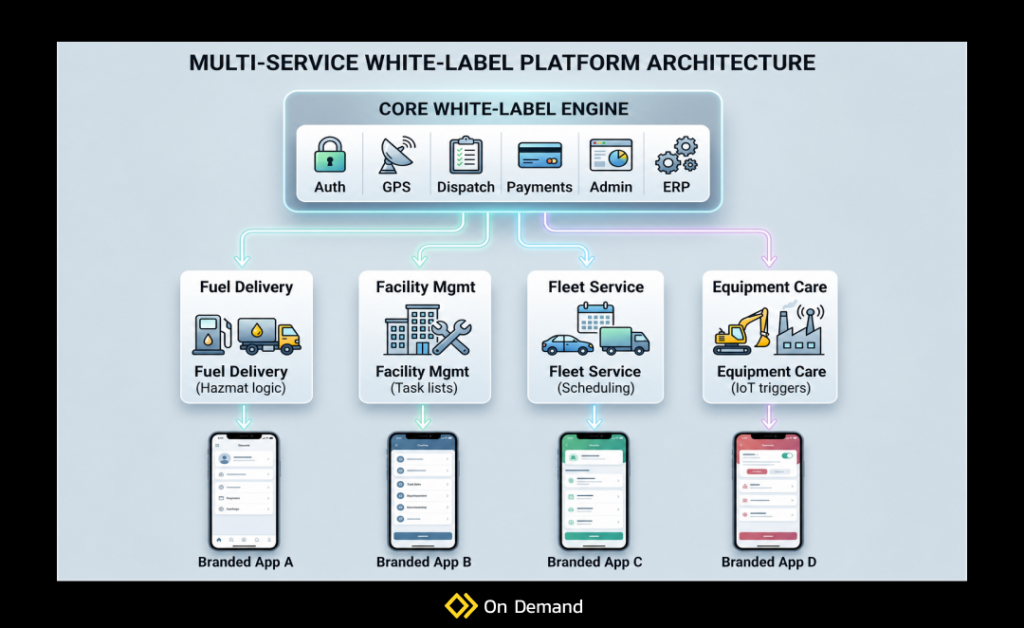
Each new vertical reuses the same authentication, GPS, dispatch, payments, ERP integration, and admin dashboard. The only thing that changes is the service-specific logic — the rules unique to that vertical.
That’s the secret behind 70% lower cost of ownership when teams choose white-label over custom development.
The Five Pillars That Make Tech-Agnostic Expansion Possible
After years of helping fuel and facility businesses extend their platforms, these are the five non-negotiables we always check before recommending any white-label foundation.
1. Open APIs That Speak to ERP Systems
Whether your client uses SAP, Oracle, QuickBooks, Zoho, or Tally, the platform must connect cleanly — without custom middleware. This is what eliminates duplicate data entry and manual reconciliation across departments.
2. Real-Time GPS and Smart Dispatch
The same dispatch engine that routes a fuel tanker to a construction site can route a maintenance technician to a commercial building. Strong GPS infrastructure isn’t a feature — it’s the spine of multi-service expansion. Businesses serious about scaling across verticals need multi-location dispatch solutions that are built to handle the operational complexity from day one.
3. Digital Proof-of-Service Workflows
Whether you’re delivering diesel, completing an HVAC inspection, or refueling generators, you need GPS-stamped, signature-backed proof of service. This same logic powers compliance across nearly every B2B service vertical.
4. Multi-Vendor, Multi-Currency Payment Layers
A modular billing engine, one that handles volumetric pricing, enterprise settlements, and global currencies, protects you from re-architecting payments every time you enter a new market or country.
5. Operational Analytics That Travel Across Verticals
Fleet utilization, technician productivity, average response time, fuel-burn rate, these are the same metrics in different uniforms. A solid analytics layer is what turns a single-service app into a real platform business.
A Real Expansion Story: From Fuel to Facilities
We worked with a fuel distributor in the Middle East who started with a straightforward on-demand fuel delivery app. Within 14 months, the same white-label core had been extended into three additional service lines, without rebuilding the platform once.
| Service Vertical | Reused Components | New Module Added |
| Fuel Delivery | GPS, dispatch, payments, ERP | Hazmat & compliance docs |
| Generator Refueling | IoT triggers, dispatch | Auto-replenishment logic |
| Fleet Maintenance | Driver app, scheduling | Work order workflows |
| Facility Servicing | Admin panel, billing | Inspection checklists |
Each new vertical took 3–5 weeks of customization, not 6–12 months of development. That’s what extension looks like when the foundation was built right from day one.
ERP and Fleet Integration: The Most Underrated Growth Lever
In our experience, the single biggest determinant of whether a platform can scale to multiple verticals is the depth of its ERP and fleet integration.
When apps run in isolation from financial and fleet systems, you end up with fragmented data, manual reconciliation, and finance teams that hate the platform. When apps are deeply integrated, every delivery, every invoice, and every vehicle event flows automatically into the systems that already run the business.
We’ve broken this down extensively in our guide on on-demand fuel delivery app ERP and fleet integration — worth reading if you’re evaluating any white-label provider.
Mistakes We See Founders Make When Expanding
A few patterns repeat themselves over and over:
- Choosing app-first platforms with weak backends. A polished UI hides nothing if the dispatch logic falls apart at scale.
- Rebuilding when extension was possible. Custom development is sometimes the right call — but rarely the first right call.
- Ignoring compliance early. In regulated verticals like fuel, hazmat, or facility services, retrofitting compliance is painful and expensive.
- Treating each vertical as a silo. Brand inconsistency across service lines slowly erodes customer trust.
What to Look for in a Truly Expandable White-Label Platform
If you’re evaluating providers, here’s the honest checklist we’d recommend any founder use:
- Open APIs for ERP, fleet, and IoT systems
- Modular service-vertical architecture
- Full white-label branding (logo, theme, language)
- Cross-platform deployment (iOS, Android, Web, Admin)
- Compliance-ready documentation built in
- Transparent pricing, SaaS, one-time, or hybrid
- Ongoing support, free updates, and dedicated account management
A genuinely expansion-ready white-label platform should get a new branded vertical live in 2–4 weeks, not 6 months.

Closing Thoughts
Expanding from fuel to facilities, or any adjacent vertical, isn’t a technology problem. It’s a strategy problem masquerading as one.
The companies winning today made one early decision right: they chose a platform built to extend. That single choice gave them speed, optionality, and operational leverage when the market started moving.
If your platform was built well from the beginning, your next vertical is probably 3 weeks away, not 12 months.
Continue Reading:
If you’re exploring fuel delivery specifically, our deep dive on the right clone model will save you weeks of research: Which Fuel Delivery App Clone Can Boost Your Business in 2026?
FAQs:
1: What is the difference between a white-label fuel delivery app and a custom-built one?
A white label fuel delivery app is a pre-built, ready-to-launch platform that you rebrand as your own. It can go live in 2–4 weeks at 70% lower cost than custom development. A custom-built app is developed from scratch, giving you full control over every feature but requiring 6–12 months of development time and significantly higher investment. For most fuel delivery startups and on-demand businesses looking to scale quickly, white-label is the faster and smarter first step.
2: How long does it take to launch a white-label fuel delivery app?
With a modular white-label platform, most fuel delivery businesses can go live in 2 to 4 weeks. This includes branding customization, ERP integration setup, and deployment across iOS, Android, and web. Custom development, by comparison, typically takes 6 to 12 months. The key factor is choosing a platform with pre-built compliance, dispatch, and payment modules, so no time is lost rebuilding what already exists.
3: Can a fuel delivery app integrate with my existing ERP or fleet management system?
Yes, a well-built white-label fuel delivery platform should connect directly with ERP systems like SAP, QuickBooks, Oracle, Zoho, and Tally through open APIs, without requiring custom middleware. The same applies to fleet telematics and management tools. This integration is critical because it eliminates manual data entry, automates invoicing, and gives you real-time visibility across both fuel delivery operations and financial reporting in one place.
4: How much does it cost to build or launch a fuel delivery app?
The cost depends on the approach. A white-label fuel delivery solution typically ranges from $10,000 to $50,000, depending on customization level, integrations, and ongoing support. Building a custom fuel delivery app from scratch can cost anywhere from $50,000 to $200,000+, with additional maintenance costs over time. For businesses expanding into multiple service verticals, a white-label platform with a modular architecture offers the lowest total cost of ownership, often 70% less than custom builds.
5: Can one fuel delivery app platform support multiple service verticals like fleet maintenance or facility management?
Yes, and this is exactly the architectural advantage of a modular white-label platform. The core engine (GPS dispatch, ERP integration, payments, admin panel) is built once and shared across verticals. Each new service line, whether generator refueling, fleet maintenance, or facility servicing, is added as a module on top of the same foundation. This means expanding into a new vertical takes 3–5 weeks of configuration, not 6–12 months of rebuilding.