
Posted At: Dec 19, 2025 - 711 Views
10 minutes to read

The on-demand economy has transformed how consumers access services, creating a $335 billion global market that's projected to reach $1.8 trillion by 2030. From food delivery to home services, entrepreneurs are capitalizing on the convenience economy by launching on-demand platforms that instantly connect service providers with customers.
But here's the challenge: most founders think building an on-demand app takes 12-18 months and requires a six-figure budget. The reality? With the right strategy and approach, you can launch a fully functional on-demand app in just 90 days—and for a fraction of what you'd expect.
This comprehensive guide walks you through every step of launching your on-demand business, from market validation to post-launch growth strategies. Whether you're targeting food delivery, home services, healthcare, or any other vertical, you'll discover the exact roadmap successful founders use to go from concept to revenue-generating platform in three months.
Understanding the On-Demand Business Model
Before diving into the launch process, it's essential to understand what makes on-demand businesses successful. The on-demand model connects service providers directly with customers through a digital platform, enabling instant access to services with just a few taps.
Key Components of On-Demand Apps
Every successful on-demand platform consists of three core elements:
Customer App: The interface where users browse services, place orders, track delivery or service progress, and make payments. This app must be intuitive, fast, and reliable to ensure customer satisfaction.
Service Provider App: The platform where service providers receive requests, manage their availability, navigate to customers, and track their earnings. A well-designed provider app directly impacts service quality and provider retention.
Admin Dashboard: The command center where business owners manage operations, monitor transactions, handle disputes, analyze performance metrics, and scale the business effectively.
Market Opportunity by Vertical
The on-demand economy spans multiple lucrative verticals, each presenting unique opportunities. According to recent market research, the combined market opportunity across on-demand services exceeds $935 billion globally.
Food delivery commands approximately $151 billion in annual revenue, with major players like Uber Eats and DoorDash continuing to expand. Transportation and ridesharing generate over $218 billion annually, while home services, including cleaning, repairs, and maintenance, represent a $150 billion market.
Healthcare on-demand services have grown to $86 billion, accelerated by telemedicine adoption during recent years. Beauty and wellness services account for approximately $128 billion, and grocery delivery has reached $95 billion globally. Each vertical offers distinct advantages depending on your target market, local regulations, and competitive landscape.
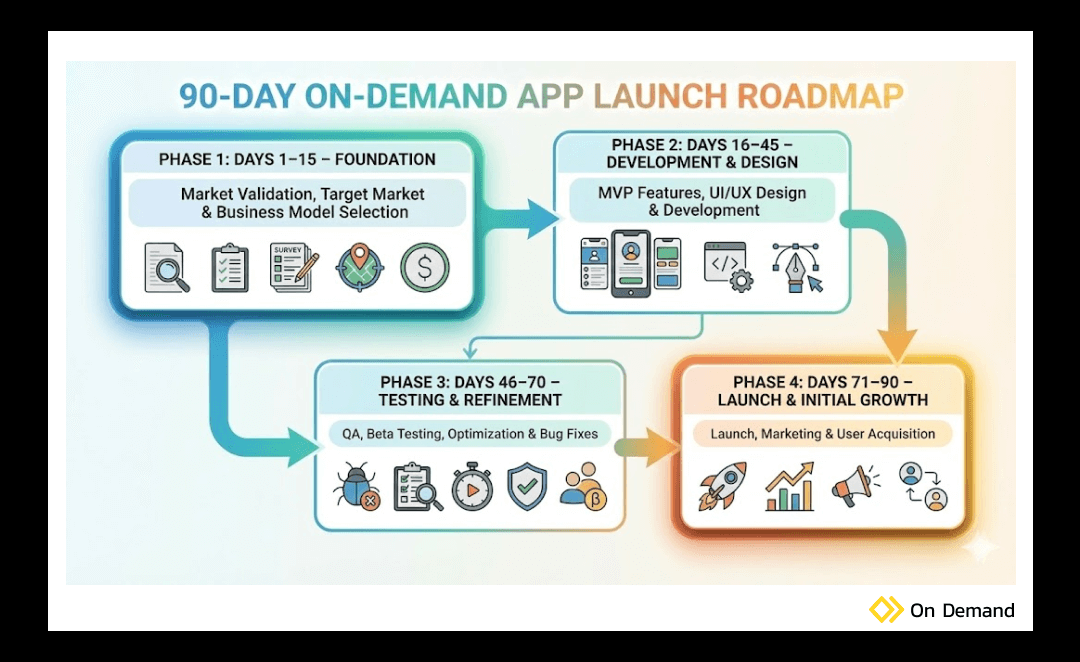
Phase 1: Days 1-15 - Foundation and Planning
The first two weeks determine whether your on-demand app will succeed or struggle. This crucial planning phase involves market validation, business model selection, and strategic positioning.
Validating Your On-Demand Business Idea
Market validation isn't optional—it's the difference between building something people want versus building something that sits unused. Start by identifying a genuine pain point in your target market.
Conduct surveys with at least 100 potential customers in your target demographic. Ask specific questions about their current solutions, pain points, willingness to pay, and frequency of need. Online tools like Google Forms or Typeform make this process straightforward and cost-effective.
Analyze your competition thoroughly. Who are the major players? What are their strengths and weaknesses? More importantly, what gaps exist in their service offerings? Customer reviews on app stores provide invaluable insights into competitor weaknesses you can exploit.
According to CB Insights, 42% of startups fail because there's no market need for their product. Spending two weeks validating your idea can save you months of wasted effort and tens of thousands in development costs.
Defining Your Target Market
Generic targeting leads to generic results. Successful on-demand businesses serve specific customer segments exceptionally well before expanding.
Create detailed customer personas that include demographics, behavioral patterns, pain points, and spending capacity. For example, a meal delivery service targeting busy professionals aged 25-40 requires different features and positioning than one targeting families with young children.
Geographic focus matters significantly in the early stages. Starting with a single city or region allows you to refine operations, build local brand awareness, and achieve market density before expanding. Companies like Uber and DoorDash followed this playbook, dominating individual markets before national expansion.
Selecting Your Business Model
How you monetize your on-demand platform fundamentally impacts everything from pricing strategy to growth trajectory. Discover how white-label solutions can accelerate your 90-day timeline while cutting costs by 80% when planning your development approach. The most common models include:
Commission-Based Model: You take a percentage (typically 15-30%) from each transaction. This aligns your success with service provider success and requires minimal upfront payment from users.
Subscription Model: Customers or service providers pay recurring fees for platform access. This creates predictable revenue streams and higher customer lifetime value.
Markup Model: You purchase services wholesale and sell them at retail prices, controlling the entire pricing structure.
Hybrid Model: Combining elements of multiple models—such as subscription memberships with commission-based transactions—can maximize revenue while providing value to different user segments.
According to McKinsey research, on-demand businesses with hybrid monetization strategies achieve 40% higher revenue per user compared to single-model approaches.
Phase 2: Days 16-45 - Development and Design
With your foundation solidified, you now face the most critical decision in your launch timeline: how to build your on-demand app. This choice impacts your budget, timeline, and ultimate success more than any other factor.
Custom vs White-Label Development: Making the Right Choice
Many entrepreneurs assume custom development is the only path to a professional on-demand app. This misconception costs them months of time and hundreds of thousands in unnecessary expenses.
Custom Development Approach:
Building from scratch gives you complete control over features, design, and functionality. However, this approach typically requires 6-12 months and $150,000-$500,000 in development costs, according to industry data from Clutch and GoodFirms.
White-Label Solution Approach:
White-label solutions provide pre-built, fully functional platforms that you can customize with your branding and specific features. This approach reduces development time to 2-4 weeks and cuts costs by 70-80%.
Modern white-label platforms aren't generic templates—they're sophisticated systems built on years of industry experience. They include proven features, tested user flows, and robust infrastructure that would take months to build from scratch.
For a 90-day launch timeline, Ready-Made SaaS Solutions represent the most viable path. You can always transition to custom development after achieving product-market fit and generating revenue.
Essential Features for Your MVP
Feature bloat kills launch timelines. The Minimum Viable Product (MVP) approach focuses on core functionality that delivers value, not everything you imagine your platform might eventually need.
Critical MVP Features for All On-Demand Apps:
User registration and profile management with social login options streamlines onboarding. According to Janrain research, 77% of users prefer social login for faster access.
Real-time search and filtering help users find exactly what they need quickly. Poor search functionality is cited as a primary frustration in 60% of negative app reviews. p>
In-app booking and scheduling with calendar integration prevent double-bookings and reduce no-shows by up to 40%, according to Appointy data.
Secure payment processing supporting multiple payment methods, including credit cards, digital wallets, and cash options, increases conversion rates by 25-30%.
Real-time tracking and notifications keep users informed throughout the service journey, significantly reducing support inquiries and improving satisfaction scores.
Rating and review systems build trust and accountability. Platforms with robust review systems see 15-20% higher customer retention, according to BrightLocal research.
Push notifications for order updates, promotional offers, and engagement triggers drive 88% higher app engagement according to Localytics data.
Designing for User Experience
Superior user experience isn't an aesthetic preference; it's a competitive advantage. According to Forrester Research, every dollar invested in UX returns $100, an ROI of 9,900%.
Mobile-First Design Principles:
On-demand services are inherently mobile. Design for thumb-friendly navigation with primary actions easily accessible in the lower third of the screen. The average user's thumb comfortably reaches approximately 45% of a smartphone screen, according to MIT research.
Minimize required steps for core actions. Each additional step in your booking flow reduces conversion by approximately 7%. Amazon's one-click ordering demonstrates the power of reducing friction.
Speed and Performance Optimization:
App loading time critically impacts retention. According to Google research, 53% of mobile users abandon apps that take longer than 3 seconds to load. Every additional second increases bounce rates by 32%.
Optimize images and assets, implement lazy loading, and use content delivery networks (CDNs) to ensure fast performance across geographic locations and network conditions.

Phase 3: Days 46-70 - Testing and Refinement
Quality assurance separates successful launches from embarrassing failures. This phase ensures your app works flawlessly when users first experience it—you only get one chance to make a first impression.
Comprehensive Testing Strategy
Testing isn't a single event; it's an ongoing process covering multiple dimensions of your platform's functionality and user experience.
Functional Testing:
Verify every feature works as intended across different devices, operating systems, and network conditions. Create detailed test cases for each user journey, including edge cases and error scenarios.
According to Tricentis research, inadequate testing causes 88% of app crashes, which lead to immediate uninstalls by 55% of users. The cost of fixing bugs increases exponentially the later they're discovered—10x more expensive in production than during development.
Performance Testing:
Simulate high user loads to ensure your platform handles peak demand without crashes or slowdowns. Test across various network conditions, including 3G, 4G, 5G, and WiFi. According to Akamai research, a 100-millisecond delay in load time can decrease conversion rates by 7%.
Security Testing:
Protect user data through thorough security audits. Test authentication systems, payment processing, data encryption, and API security. According to IBM's Cost of Data Breach Report, the average cost of a data breach is $4.35 million—far more than investing in proper security testing.
Usability Testing:
Watch real users interact with your app through moderated testing sessions. According to Nielsen Norman Group, testing with just 5 users uncovers 85% of usability problems.
Beta Testing Program
Before the full public launch, release your app to a controlled group of beta testers who represent your target audience.
Aim for 50-100 beta testers who match your customer personas. Offer incentives like free credits, premium features, or early adopter status to encourage participation and feedback.
Create structured feedback channels, including in-app surveys, email questionnaires, and direct communication options. Track metrics including completion rates, average session duration, feature usage, and drop-off points.
According to Centercode research, beta testing reduces post-launch support costs by 60% and increases customer satisfaction scores by 25%.
Understanding On-Demand App Development Costs
Budget planning determines whether your on-demand venture is financially viable. Understanding cost components helps you allocate resources effectively and avoid budget overruns.
Cost Breakdown by Development Approach
Custom Development Costs:
Full custom development from a North American agency typically ranges from $150,000 to $500,000, according to data from Clutch and GoodFirms. This includes discovery and planning ($10,000-$25,000), UI/UX design ($15,000-$40,000), iOS and Android app development ($40,000-$100,000 each), backend development ($35,000-$80,000), admin dashboard ($15,000-$40,000), testing and QA ($10,000-$30,000), and project management ($15,000-$35,000).
White-Label Solution Costs:
Ready-made on-demand platforms typically cost $5,000-$30,000 for initial setup and customization, representing 80-90% cost savings compared to custom development.
Monthly SaaS fees range from $200-$2,000 depending on transaction volumes, feature sets, and support levels. This predictable pricing model helps with financial planning and removes massive upfront capital requirements.
Cost Comparison Table:
| Cost Component | Custom Development | White-Label Solution |
| Initial Development | $150,000-$500,000 | $5,000-$30,000 |
| Timeline | 6-12 months | 2-4 weeks |
| Ongoing Maintenance | $3,000-$10,000/month | $200-$2,000/month |
| Feature Updates | $5,000-$20,000 each | Included in the SaaS fee |
| Total First Year | $186,000-$620,000 | $7,400-$54,000 |
Hidden Costs to Consider
Many entrepreneurs underestimate ongoing expenses beyond initial development:
Infrastructure and Hosting: Cloud hosting costs scale with user growth. Budget $200-$2,000 monthly initially, increasing to $5,000-$20,000+ at scale.
Third-Party Services: Payment processing fees typically run 2.9% + $0.30 per transaction. SMS notifications cost $0.01-$0.05 each. Mapping APIs charge based on usage, typically $5-$20 per 1,000 requests.
Marketing and User Acquisition: Customer acquisition costs (CAC) for on-demand apps range from $5-$50 per user, depending on the vertical and competitive landscape. Expect to spend $10,000-$50,000 monthly on marketing to achieve meaningful traction.
Legal and Compliance: Terms of service, privacy policies, and compliance documentation cost $2,000-$10,000. Background check services for service providers run $25-$50 per check.
ROI Timeline Expectations
Understanding realistic revenue timelines prevents premature panic or unrealistic expectations.
Months 1-3: Focus on user acquisition and platform stability rather than profitability. Expect minimal revenue while building critical mass.
Months 4-6: Transaction volumes increase as network effects kick in. Revenue typically covers 30-50% of operating expenses during this period.
Months 7-12: Mature markets reach break-even between months 8-12 according to CB Insights analysis of on-demand startups.
Year 2+: Profitable on-demand platforms typically achieve 15-40% net margins as they optimize operations and achieve scale efficiencies.

Phase 4: Days 71-90 - Launch and Initial Growth
The final sprint brings everything together. Your launch strategy determines whether you build momentum or struggle with adoption.
Pre-Launch Preparation
Start marketing before launch day. Create a landing page capturing email addresses of interested early adopters. According to Kickstarter data, companies with pre-launch email lists of 1,000+ subscribers see 3x higher first-month adoption.
The chicken-and-egg problem plagues all marketplace businesses: you need customers to attract providers, and providers to attract customers. Break this cycle by recruiting providers first.
For fuel delivery or similar services, secure partnerships with 10-20 service providers in your target area before launch. Offer preferential terms, guaranteed minimum earnings, or signing bonuses to secure early commitments.
Launch Strategy
Rather than announcing availability nationwide, focus on a single neighborhood or small city. This geographic concentration creates density, reduces logistics complexity, and allows you to deliver consistently excellent experiences.
Monitor performance metrics obsessively during the first week: app crashes, booking completion rates, average service times, customer satisfaction scores, and provider utilization rates.
According to Localytics, 21% of users abandon apps after one use. First impressions determine whether users become advocates or detractors.
Early User Acquisition Strategies
Incentivized Referrals:
Implement a referral program from day one. According to Nielsen research, 92% of consumers trust recommendations from people they know more than any other form of advertising.
Offer compelling incentives for both referrers and new users. Successful programs typically provide $10-$20 in credits or discounts, structured as "$10 for you, $10 for your friend" to benefit both parties.
Uber's referral program generated 50% of new user signups during their growth phase. Dropbox grew 3900% in 15 months largely through referral incentives.
Paid Advertising:
Focus spending on social media ads targeting by location, demographics, and interests. Start with $1,000-$3,000 budgets to test creative and targeting variations.
Google Search Ads target high-intent keywords like "[your city] [service] delivery." These users are actively seeking solutions and convert at 2-3x higher rates than social ads.
According to Invesp research, on-demand companies spend an average of $22 to acquire a customer in their first year, declining to $12-$15 as brand awareness grows.
Measuring Success
Track these critical metrics from day one:
User Acquisition Metrics: Daily/weekly/monthly active users, cost per acquisition by channel, registration conversion rates.
Engagement Metrics: Booking conversion rates, average bookings per user, session duration, and frequency.
Operational Metrics: Average order value, service completion rates, average delivery times, and provider utilization rates.
Financial Metrics: Gross merchandise value, revenue, customer acquisition cost, customer lifetime value, LTV: CAC ratio (should exceed 3:1).
Retention Metrics: Day 1, 7, 30, 90 retention rates, churn rates by cohort, Net Promoter Score.
According to Mixpanel benchmarks, top-performing on-demand apps achieve 25% Day 1 retention, 15% Day 7 retention, and 8% Day 30 retention.
Monetization Strategies for Long-Term Profitability
Choosing the right revenue model impacts everything from pricing strategy to growth trajectory. Successful on-demand platforms often employ multiple monetization approaches simultaneously.
Commission-Based Revenue
Taking a percentage of each transaction aligns your incentives with marketplace growth. Commission rates vary by industry: ridesharing (20-30%), food delivery (20-35%), home services (15-25%), healthcare services (10-20%), and beauty services (20-30%).
Subscription Models
Recurring revenue creates predictable cash flow and increases customer lifetime value. Amazon Prime exemplifies this model's power—Prime members spend $1,400 annually compared to $600 for non-members, according to Consumer Intelligence Research Partners data.
Provider Subscriptions: Service providers pay monthly fees for platform access, lead generation, or reduced commission rates.
According to Zuora research, subscription-based businesses grow revenues 5x faster than traditional businesses and deliver higher customer lifetime values.
Additional Revenue Streams
Advertising Revenue: Once you've achieved significant user scale, offer advertising opportunities to relevant brands. Food delivery platforms like Grubhub generate 15-20% of revenue from restaurant advertising.
Premium Listings: Allow service providers to pay for enhanced visibility through featured placements or priority ranking in search results.
Post-Launch Growth and Scaling
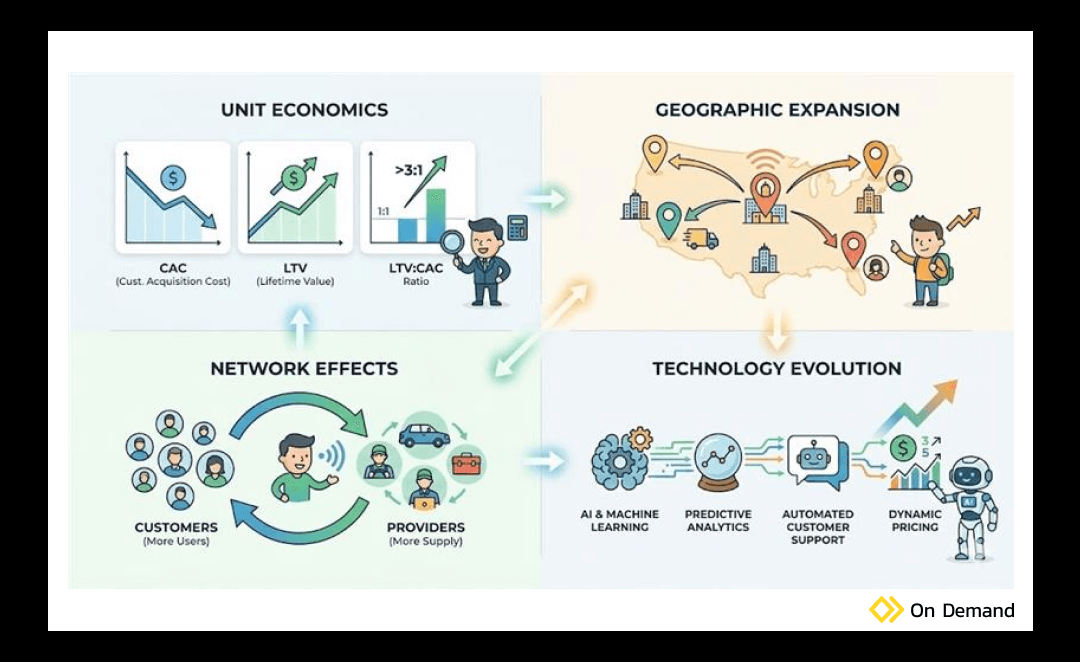
Launching successfully is just the beginning. Sustainable growth requires continuous optimization, strategic expansion, and relentless focus on unit economics.
Optimizing Unit Economics
Customer Acquisition Cost (CAC): Track what you spend to acquire each customer across all channels.
Customer Lifetime Value (LTV): Estimate the total revenue a customer generates over their entire relationship with your platform.
LTV: CAC Ratio: This critical metric reveals business health. Ratios below 3:1 indicate unsustainable unit economics. Ratios above 5:1 suggest you're under-investing in growth.
Geographic Expansion Strategy
Once you've proven product-market fit in your initial market, strategic expansion accelerates growth. Choose expansion markets based on similar demographics, comparable competitive landscapes, regulatory environments you understand, and market size justifying expansion investment.
Develop a repeatable launch playbook documenting everything that worked in your initial market: provider recruitment tactics, marketing channels, partnership strategies, and operational processes.
Building Network Effects
Network effects create defensible moats that protect your business from competition. More customers attract more providers seeking access to demand. More providers enable faster service, broader availability, and better pricing—attracting more customers.
Geographic density amplifies network effects. In ridesharing, 10 drivers in one neighborhood deliver better service than 100 drivers spread across a city.
According to NFX research, companies with strong network effects achieve 70% higher revenue growth and 240% higher market capitalizations compared to peers without network effects.
Technology Evolution
Implement AI-driven features that improve with scale: dynamic pricing algorithms, predictive analytics, forecasting demand patterns, personalized recommendations improving conversion rates by 15-30%, and automated customer support.
Stay current with emerging technologies and consumer expectations by regularly reviewing technology trends and future-proofing strategies .
Verticals with Proven Success
The on-demand economy spans dozens of verticals, but 21 specific categories demonstrate exceptional growth trajectories and profitability potential, representing a combined market opportunity exceeding $935 billion.
Food and Grocery Delivery: This $246 billion combined market includes restaurant delivery, grocery delivery, and meal kit services.
Home Services: Professional cleaning, repairs, maintenance, and handyman services represent $150+ billion in annual spending. Average customer LTV exceeds $2,500 according to HomeAdvisor data.
Healthcare and Wellness: Telemedicine, prescription delivery, mental health services, and fitness coaching have exploded to $86 billion annually.
Beauty and Personal Care: On-demand salon services, makeup artists, massage therapy, and personal training generate $128 billion globally.
Transportation and Logistics: Beyond ridesharing's $218 billion market, opportunities exist in specialized transport like medical transportation, luxury vehicles, and courier delivery.

Conclusion
Launching an on-demand app in 90 days is ambitious but entirely achievable with the right approach, tools, and execution discipline. The entrepreneurs who succeed follow a proven playbook:
They validate market demand before investing significant resources. They choose technology approaches aligned with their timeline and budget constraints—often leveraging white-label solutions and MVP development services to accelerate time-to-market while minimizing risk. They focus relentlessly on unit economics, understanding that growth without profitability creates unsustainable businesses.
The on-demand economy continues expanding as consumers increasingly value convenience and instant access. Whether you're targeting food delivery, home services, healthcare, or any other vertical, opportunity exists for well-executed platforms that solve genuine problems for specific customer segments.
Your 90-day journey begins with a single decision: commit to taking action. The difference between entrepreneurs who launch successful platforms and those who perpetually plan isn't talent, resources, or luck—it's consistent execution toward a clear goal.
The roadmap is clear. The tools are available. The market opportunity is massive. What happens in the next 90 days depends entirely on what you do today.
Explore More On-Demand Success Strategies
Ready to dive deeper into building your on-demand empire? Discover comprehensive insights on choosing the right platform approach, understanding market dynamics, and implementing proven growth strategies.
Learn how successful entrepreneurs are leveraging innovative development approaches to launch faster, spend less, and achieve profitability sooner.
Discover 21+ Proven On-Demand Business Models With $935B+ Market Opportunity →
FAQs:
1. How much does it cost to build an on-demand app in 2025?
Most founders want to know the real development budget before starting. On-demand app cost varies based on custom development vs. white-label solutions. Custom apps range from $150,000–$500,000, while white-label setups cost $5,000–$30,000 and help founders launch within 90 days. Your blog explains both cost models, hidden expenses, and first-year budget expectations.
2. Is it realistic to launch a full-on-demand app in just 90 days?
Yes, if you follow the correct roadmap. Your blog shows how 90-day launches are possible using MVP development, white-label SaaS platforms, rapid market validation, and a structured 4-phase plan (Days 1-15, 16-45, 46-70, and 71-90). Founders often ask this question because traditional development takes 12–18 months.
3. What features should an MVP on-demand app include at launch?
This is one of the most searched questions in the on-demand space. Your blog lists core MVP features like user onboarding, booking, provider dashboard, real-time tracking, payments, notifications, and ratings. Users want to know the minimum features needed to start generating revenue without overspending.
4. How can I reduce my on-demand app development time and cost?
A common question from first-time founders. Your blog clearly explains how entrepreneurs can cut costs by 70–80% by choosing white-label app solutions, pre-built SaaS systems, and structured MVP development instead of full custom builds. This FAQ reinforces your blog’s value and deep insights into timelines, costs, and monetization.