
Posted At: Dec 31, 2025 - 305 Views
10 minutes to read

Quick Summary
User retention is the biggest growth challenge in on-demand services. This blog breaks down five must-have features: on-demand loyalty programs, AI personalization, seamless UI/UX, real-time communication, and flexible payments, that keep users engaged, loyal, and spending more. Backed by data and real-world insights, it’s a practical guide for building high-retention on-demand platforms.
Introduction
The on-demand economy is booming, but there's a harsh reality that most businesses face: acquiring users is expensive, but keeping them is even harder. According to recent industry data, acquiring a new customer costs 5-25 times more than retaining an existing one. Even more alarming, the average mobile app loses 77% of its daily active users within the first three days after installation, and 90% within the first month (Statista, 2024).
For entrepreneurs wondering how to start an on-demand business that thrives long-term, the answer isn't just about getting downloads—it's about building features that keep users coming back. Whether you're running a food delivery service, ride-sharing platform, or home services marketplace, user retention is the difference between sustainable growth and constant struggle.
The benefits of on-demand apps for retention go far beyond just financial metrics. Repeat customers spend 67% more than new customers on average, and loyal customers are five times more likely to repurchase and four times more likely to refer others (Bain & Company, 2023). This compounding effect is what separates successful platforms from those that burn through marketing budgets without building lasting value.
This comprehensive guide explores five essential features that have proven to drive user retention and loyalty in on-demand services. These aren't theoretical concepts; they're battle-tested strategies backed by data and implemented by the industry's most successful platforms.
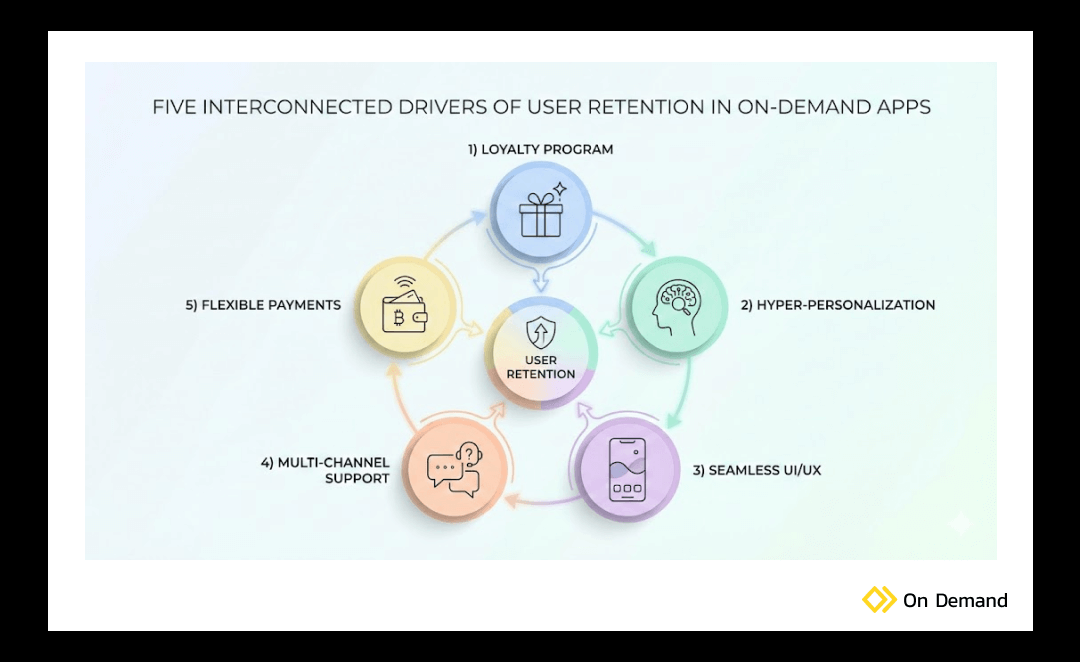
Feature 1: Intelligent On-Demand Loyalty Program
Building an effective on-demand loyalty program is one of the most powerful retention strategies available to platform owners. Research shows that 75% of consumers say they favor companies that offer rewards programs, and loyalty program members generate 12-18% more revenue annually than non-members (Bond Brand Loyalty, 2024).
The key is understanding that modern loyalty programs go far beyond simple point accumulation. They create emotional connections between users and platforms while providing tangible value at every interaction. Think about it from a user's perspective: when you've accumulated points or achieved a certain status on a platform, you're less likely to switch to a competitor, even if they offer a similar service. This psychological lock-in, combined with real benefits, creates a powerful retention mechanism.
Designing a Multi-Tiered Reward Structure
The most successful on-demand platforms implement tiered loyalty systems that incentivize increased engagement. A well-designed tier structure typically includes three to four levels, each offering progressively better benefits. For example, a Bronze tier for new users might offer basic rewards like 5% discounts, while a Silver tier for regular users could include priority customer support. Gold-tier loyal advocates might enjoy perks such as free deliveries and exclusive access to new features, while Platinum VIP members receive personalized experiences and maximum rewards.
According to a 2024 McKinsey study, tiered loyalty programs increase customer retention rates by 30-40% compared to single-tier systems. The psychology behind this is fascinating: users are motivated not just by the rewards they're currently receiving, but by the aspiration to reach the next level. This gamification element keeps them engaged and actively using your platform.
The Power of Strategic Point Mechanics
The way users earn and redeem points can make or break your loyalty program. Successful platforms reward various user actions beyond just making purchases. First-order completions might earn 100 points, encouraging users to overcome the initial hesitation. Daily app opens could earn 5 points, building a habit of engagement. Successful referrals might earn 250 points, turning your users into brand advocates. Review submissions could earn 50 points, building social proof while rewarding participation.
A 2024 benchmark study of on-demand services found that users who engage with loyalty programs show a 42% increase in order frequency, 38% higher average order value, and 65% reduction in churn rates compared to non-members. These aren't marginal improvements; they're transformative business metrics.
For businesses serious about implementing an effective loyalty program, the investment in proper design and execution pays dividends far beyond the initial development costs. The key is making the program feel rewarding from the first interaction, ensuring users can achieve meaningful rewards within their first few uses rather than requiring months of engagement to see any benefit.
Feature 2: Hyper-Personalized User Experiences
In 2024, generic experiences no longer suffice. Research from Accenture shows that 91% of consumers are more likely to shop with brands that provide personalized offers and recommendations. For on-demand services, personalization transforms generic interactions into tailored experiences that make users feel understood and valued.
The difference between basic customization and true personalization is significant. Basic customization might remember your name and past orders. True personalization utilizes artificial intelligence and machine learning to predict your needs before you even search for them, presents options based on your preferences and context, and adapts the entire interface to match your usage patterns.
Implementing AI-Powered Recommendation Engines
Modern recommendation systems go far beyond simple "you might also like" suggestions. They analyze behavioral patterns, tracking browsing history, order frequency, and search queries to understand user intent. They consider contextual factors like time of day, location, weather, and even day of the week. Advanced systems use collaborative filtering to identify patterns among similar users, then apply those insights to enhance individual experiences.
According to Epsilon research from 2024, 80% of consumers are more likely to purchase when brands offer personalized experiences, leading to 10-15% revenue increases. More importantly for retention, personalized experiences create an emotional bond between the user and the platform. When an app consistently anticipates your needs and presents relevant options, it becomes indispensable rather than just convenient.
The Art of Dynamic Content Customization
Personalization should extend to every touchpoint in your application. Your homepage should showcase services and providers based on individual user preferences and past behavior. Push notifications should be timed and worded based on when each user is most likely to engage. Email campaigns should reflect actual interests rather than generic promotions. In-app messaging should provide contextual prompts that feel helpful rather than intrusive.
The impact of comprehensive personalization on retention is substantial. Platforms with personalized product recommendations see 28% higher retention rates. Those using personalized push notifications experience 45% increases in user engagement. Even personalized homepage content drives 33% better retention compared to generic layouts (Segment Personalization Report, 2024).
Businesses seeking custom mobile app development services should prioritize personalization capabilities from the beginning. Retrofitting sophisticated personalization into an existing platform is significantly more expensive and complex than building it into your foundation. The same principle applies to white-label beauty app features and other specialized on-demand solutions.
Privacy-First Personalization Builds Long-Term Trust
As personalization deepens, transparency becomes essential. Users are far more likely to engage with data-driven experiences when they understand how their information is used and feel in control of personalization settings.
Best practices include:
- Clear explanations of why recommendations or offers appear
- Easy-to-manage personalization and notification preferences
- Opt-in controls for AI-driven and data-based features
- Compliance with GDPR, CCPA, and regional data protection laws
A 2024 PwC Digital Trust Survey found that 87% of users are more loyal to brands they trust with their data, even when personalization is highly advanced. Privacy-first personalization builds confidence, reduces opt-outs, and strengthens long-term retention.
Businesses seeking custom mobile app development services should prioritize personalization capabilities from the earliest stages of product design. Retrofitting advanced personalization into an existing on-demand platform is significantly more complex and costly than embedding it into the core architecture. The same principle applies to white-label beauty app features and other specialized on-demand solutions, where personalized experiences increasingly define competitive advantage.
Feature 3: Seamless and Intuitive User Interface
User experience isn't just about making things look pretty—it's a direct driver of retention and revenue. Research from Forrester in 2024 demonstrates that a well-designed user interface can raise conversion rates by up to 200%, while improved UX design can yield conversion rates up to 400%. More critically, 86% of users delete apps due to a poor first-time experience
The challenge for on-demand platforms is balancing feature richness with simplicity. Your app needs to handle complex operations like real-time matching, payment processing, and GPS tracking, but users shouldn't feel that complexity. The best interfaces make complicated processes feel effortless.
Mastering Frictionless Onboarding
The first 30 seconds determine whether users will give your platform a real chance or abandon it forever. Successful onboarding follows the principle of progressive disclosure—showing features gradually rather than overwhelming new users with everything at once. Social sign-in options can reduce registration friction by 60%, removing a major barrier to entry. Smart onboarding flows allow users to skip non-essential steps and explore the platform before committing personal information.
Most importantly, effective onboarding demonstrates value within those crucial first 30 seconds. Show users exactly what they can accomplish, how easy it is, and what makes your platform special. Statistics show that smooth onboarding can improve first-week retention by 50%, which compounds over time into dramatically better long-term retention.
The Critical Role of Performance Optimization
In the on-demand economy, speed isn't just a nice-to-have feature—it's a fundamental requirement. Users expect instant responses, and they won't tolerate waiting. Research shows that 53% of mobile users abandon apps that take longer than three seconds to load (Google, 2024). Even more striking, every one-second delay in page load time costs approximately 7% in conversions according to Amazon's research.
Key Considerations for Optimized Performance:
- Fast Load Times: Ensure app launch and page load times stay under two seconds consistently to prevent user drop-off.
- Smooth Transitions: Maintain 60fps animations across all interactions to create a responsive and fluid experience.
- Efficient Image Handling: Use modern formats like WebP, implement lazy loading, and compress images without sacrificing quality to minimize data usage.
- Offline Accessibility: Enable core features, such as past orders or saved preferences, to function without internet connectivity.
- Consistent Branding: Visual consistency increases brand recognition by 40% and loyalty by 25%, reinforcing user trust.
- Thoughtful Use of White Space: Improves readability by 32% and user engagement by 20%, reducing cognitive load.
- Color Psychology: Strategic use of colors strengthens emotional connections with users by 45%.
- Micro-Interactions: Small animations, feedback moments, and interactive cues increase user satisfaction by 35% and make the app feel more intuitive.
By focusing on these elements, performance optimization becomes not just a technical necessity but a strategic driver of retention, engagement, and perceived quality.
For platforms committed to excellence, partnering with custom UI/UX design services ensures every design decision serves a strategic purpose. The investment in proper design pays back through improved retention, higher conversion rates, and reduced customer support costs as users find the interface intuitive enough to navigate without assistance.
Feature 4: Multi-Channel Communication and Support
Being available when users need you isn't optional—it's essential for retention. HubSpot's 2024 research reveals that 90% of customers rate an immediate response as important or very important when they have a customer service question. In on-demand services where timing is everything, responsive communication can make the difference between a loyal user and a churned one.
The most effective communication strategies combine proactive outreach with responsive support channels. Rather than waiting for users to encounter problems and reach out, successful platforms anticipate needs and communicate at key moments throughout the service journey.
Building Comprehensive Real-Time Support
Modern users expect support to be instantaneous and available through their preferred channels. In-app live chat with human agents should handle complex queries with average resolution times of three to five minutes. AI-powered chatbots can manage 60-70% of common questions instantly, providing immediate answers for straightforward issues while escalating complex problems to human agents. Technical troubleshooting, video call support, and screen sharing capabilities can resolve issues that would take dozens of text messages to explain.
Companies with strong omnichannel support retain 89% of their customers compared to just 33% for those with weak support capabilities. This dramatic difference underscores how critical communication infrastructure is to retention strategy. When users know they can get help quickly whenever they need it, they're far more likely to stick with your platform through occasional hiccups rather than immediately switching to a competitor.
The Power of Proactive Communication
The best on-demand platforms don't wait for users to wonder what's happening—they communicate proactively at every stage. Before service delivery, users should receive order confirmation with estimated times, service provider details, ratings, real-time tracking updates, and preparation reminders when relevant. After service completion, immediate follow-up with confirmation, rating requests within two hours, personalized thank-you messages, and issue resolution inquiries show users you care about their experience.
Push notifications deserve special attention because they're powerful but dangerous. When done right, they keep users engaged and informed. When done wrong, they drive uninstalls. Research from Localytics shows that order status updates have a 78% open rate and are critical for user satisfaction. Promotional offers sent at optimal times (11 am-1 pm or 6 pm-8 pm) achieve 42% open rates and drive 15% increases in orders. Re-engagement notifications sent seven days after inactivity have 35% open rates and recover 22% of potentially churned users.
However, there's a fine line between helpful and annoying. Sending more than five push notifications per week increases uninstall rates by 19%. The solution is giving users control over their notification preferences and using data to understand optimal frequency for each individual user rather than applying a one-size-fits-all approach.
Creating Meaningful Feedback Loops
Users who feel heard are users who stay. Platforms that actively solicit feedback and demonstrably act on it see 10-15% higher retention rates within six months. The key is creating closed-loop feedback systems where users can see their input actually influencing the platform. In-app rating prompts after positive experiences, detailed feedback forms for service improvements, dedicated feature request channels, and, most importantly, follow-up contact with users who left negative reviews all contribute to building trust and loyalty.

Feature 5: Flexible Payment and Transparent Pricing
Payment friction is one of the fastest ways to lose users. Research from the Baymard Institute shows that payment-related issues account for 28% of cart abandonments in mobile apps. For on-demand services where transactions happen frequently and often spontaneously, seamless payment experiences aren't just convenient—they're absolutely essential for retention.
The challenge is that different users have strong preferences for different payment methods. What feels secure and convenient to one demographic might feel cumbersome or unfamiliar to another. The solution is offering comprehensive payment options while making each one feel native and trustworthy.
Implementing Payment Flexibility
Successful on-demand platforms typically offer at least three payment categories. Digital wallets like Apple Pay and Google Pay now account for 40% of mobile transactions and are particularly popular with younger users who value speed and security. PayPal and Venmo remain preferred by millennials for their social features and buyer protection. Platform-specific wallets with stored balances can reduce transaction friction and increase spending.
Traditional methods still matter significantly. Credit and debit cards with proper tokenization for security remain the most universal payment option. Bank transfers work well for larger transactions where interchange fees would otherwise be prohibitive. Surprisingly, cash on delivery remains relevant in many emerging markets and for certain user demographics who prefer it.
Payment Methods and Retention Impact
| Payment Method | Popularity (Global %) | Key Benefits | Estimated Retention Impact* |
|---|---|---|---|
| Digital Wallets | 40% | Fast, secure, mobile-friendly | 0.15 |
| PayPal / Venmo | 25% | Buyer protection, social payment integration | 0.12 |
| Credit / Debit Cards | 60% | Universal acceptance, secure tokenization | 0.1 |
| Bank Transfer | 10% | Good for large transactions, minimal fees | 0.05 |
| Cash on Delivery | 15% | Trust for users without digital payment access | 0.08 |
| Buy-Now-Pay-Later | 5% | Higher-ticket affordability, flexible payment | 0.18 |
| Subscription / Prepay | 8% | Predictable revenue enhances loyalty | 0.2 |
Data from Stripe's 2024 report confirms that offering three or more payment methods increases conversion rates by 30%. The business logic is straightforward: every user you lose to payment friction is revenue walking away. The technical implementation might require partnering with white-label e-commerce solutions or with grocery delivery app development specialists who understand the complexities of payment integration.
The Trust Factor of Transparent Pricing
Hidden fees are trust killers. PwC's 2024 Consumer Survey found that 86% of consumers want to know the full price before checkout, and hidden fees increase cart abandonment by 55%. The solution is radical transparency at every pricing touchpoint.
Effective transparent pricing displays the base service cost with clear itemization, explains any dynamic pricing with surge indicators and reasons, breaks down all fees separately (platform fees, delivery charges, service charges), calculates taxes in real-time so users see the exact total, clearly shows applied discounts with visible savings amounts, and prominently displays the final total before requiring commitment.
Additional strategies to strengthen pricing trust:
- Price comparison tools: Show users savings versus competitors to reinforce perceived value.
- Dynamic discounts: Offer targeted discounts for first-time users or loyalty members to create positive surprises.
- Bundle deals: Package multiple services with visible savings to encourage higher spend.
- Price lock guarantees: During high-demand periods, lock in prices to reduce anxiety about surge pricing.
- Surge pricing transparency: When surge pricing is necessary, provide clear explanations with estimated times until normal rates resume.
- Personalized pricing notifications: Inform users of relevant offers or discounts based on their usage patterns to enhance loyalty.
- Refund and adjustment clarity: Clearly outline policies for partial refunds or adjustments if service issues arise, which reinforces fairness.
Beyond basic transparency, these smart pricing features can improve perceived value, increase conversion, and deepen user trust—turning pricing from a potential friction point into a loyalty-building tool.
The Subscription Model Advantage
For many on-demand services, subscription models create the ultimate retention mechanism. They transform transactional relationships into ongoing commitments while providing genuine value that justifies the monthly fee. According to Zuora's 2024 Subscription Economy Index, subscription members show three to five times higher retention rates and 40% higher lifetime value compared to transactional users.
A typical subscription structure might include a free basic tier with standard features serving as the entry point, a premium tier at $9.99 monthly offering benefits like free delivery and 10% off all services, and an elite tier at $19.99 monthly, including all premium benefits plus priority support and exclusive access to new features. Users who subscribe aren't just paying for services; they're psychologically committed to the platform in a way that casual users aren't.
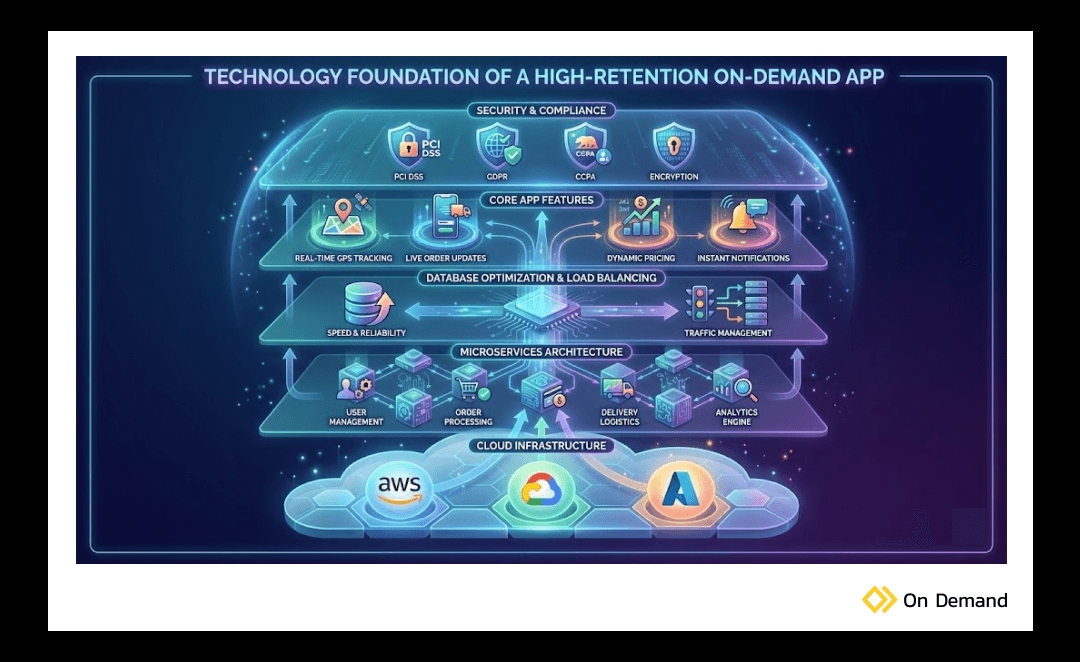
The Foundation: Technology That Enables Retention Features
While features drive user engagement, the underlying technology stack determines whether your platform can actually deliver on its promises. Poor technical infrastructure leads to app crashes (which cause 62% of users to uninstall after just one or two crashes, according to Apteligent 2024 research), slow load times (causing 40% abandonment after three-second delays), security vulnerabilities that destroy trust instantly, and integration failures that break payments or notifications.
Discover the Ultimate Technology Stack for On-Demand Apps that supports the seamless user experiences users expect. The right technical foundation enables real-time GPS tracking and mapping, live order status updates, dynamic pricing calculations, instant notification delivery, and seamless integration of all the retention features discussed above.
Modern on-demand platforms require scalable cloud-based infrastructure through providers like AWS, Google Cloud, or Azure. Microservices architecture allows individual features to be developed, deployed, and scaled independently. Load balancing ensures performance during traffic spikes. Database optimization maintains fast query times even as your user base grows.
Security and compliance can't be afterthoughts. PCI DSS compliance is mandatory for payment processing. GDPR and CCPA compliance protect user data and your business from legal risk. End-to-end encryption secures sensitive information. Regular security audits catch vulnerabilities before they become breaches.
Measuring Success: The Metrics That Matter
Implementing retention features without measurement is guesswork. The most critical metric to track is retention rate across different time horizons. Day 1 retention (the percentage of users returning the next day) should target 40% or higher, though industry averages fall between 25-35%. Day 7 retention (users active after one week) should exceed 30%, with industry benchmarks at 15-25%. Day 30 retention (users active after one month) should aim for above 20%, though typical performance ranges from 8-15% (Mixpanel Mobile Benchmarks, 2024).
Customer lifetime value is perhaps the most important long-term metric. It should be at least three times your customer acquisition cost for sustainable unit economics. Churn rate (the percentage of users who stop using your platform) should stay below 3% monthly, though industry averages run 5-7%. Each of these metrics tells a story about how well your retention features are actually working.
Feature-specific metrics provide deeper insights. For loyalty programs, track enrollment rates (targeting above 50%), active member ratios (aiming for 70%+), points redemption rates (60-80% is healthy), and tier progression velocity. For personalization, measure recommendation click-through rates (targeting 15%+) and compare conversion rates between personalized and generic experiences. For support, monitor first response times (under 30 seconds ideal), resolution rates (above 90%), and customer satisfaction scores (targeting 4.5+ out of 5).
Balancing Monetization with Retention
Understanding effective app monetization strategies requires balancing revenue generation with user experience. The best monetization approaches enhance rather than detract from retention. Commission-based models, where the platform takes 15-30% of each transaction, align platform success with vendor success while remaining transparent to users. Subscription revenue provides predictable monthly income while increasing user commitment. Service fees like delivery charges or booking fees must provide clear value propositions. Advertising can work if done carefully with native ads that match the user experience, limited frequency to avoid annoyance, and highly targeted content to maintain relevance.
However, aggressive monetization destroys retention. Studies show that intrusive ads increase app abandonment by 44% (eMarketer, 2024). The key is finding the sweet spot where monetization feels fair and valuable rather than exploitative. Users don't mind paying for genuine value—they resent feeling nickel-and-dimed or manipulated.
Conclusion: Building for Long-Term Success
Creating a successful on-demand service platform requires strategic focus on retention from day one. The five must-have features explored in this guide—intelligent loyalty programs, hyper-personalized experiences, seamless UI/UX, multi-channel communication, and flexible payments—work together to create compelling user experiences that drive loyalty.
The statistics are clear: increasing customer retention rates by just 5% can boost profits by 25-95%. Repeat customers spend 67% more than new customers. Loyal customers are five times more likely to repurchase and four times more likely to refer others. These aren't marginal improvements; they're the difference between businesses that struggle to survive and those that thrive.
Implementation doesn't happen overnight. Start with foundation features that provide immediate user value, then layer in advanced capabilities as you learn from user behavior and feedback. The platforms that win in the on-demand economy are those that never stop optimizing the user experience based on data and insights.
The technology and strategies exist to build world-class retention into your platform. The real question is whether you're ready to prioritize retention as a core business strategy rather than an afterthought. For those ready to take the next step in understanding how to start an on-demand business built for sustainable growth, the path forward is clear: focus relentlessly on creating value that keeps users coming back.
Continue Learning: Essential Next Steps
Want to dive deeper into building a successful on-demand business from the ground up?
Your retention strategy is only as strong as the foundation it's built on. Explore our comprehensive guide on how to start an on-demand business that covers market validation, technology stack selection, go-to-market strategies, scaling best practices, and financial planning insights. Understanding the complete journey from concept to scale ensures you build retention capabilities into your platform's DNA from the very beginning rather than trying to retrofit them later.
Read the Complete Guide:- How to Start an On-Demand Business
FAQs:-
1. What is an on-demand loyalty program, and how does it help retain users?
An on-demand loyalty program rewards users for repeat engagement, referrals, and other meaningful actions. By offering points, tiered rewards, and exclusive perks, it encourages users to keep coming back, increasing retention and lifetime value.
2. How can personalization improve user retention in my on-demand app?
Hyper-personalized experiences use AI and user behavior data to recommend services, tailor content, and send timely notifications. Personalized interactions make users feel understood and valued, boosting engagement, repeat usage, and loyalty.
3. Which payment options are essential for keeping users satisfied and loyal?
Offering multiple payment methods, digital wallets, credit/debit cards, cash-on-delivery, and subscriptions reduces friction and builds trust. Transparent pricing and flexible payment options also help prevent user churn.
4. How do multi-channel communication and support impact user loyalty?
Users expect quick and reliable support across channels like live chat, chatbots, in-app messaging, and email. Proactive updates, real-time notifications, and effective feedback systems improve satisfaction and keep users engaged with the platform.
5. How can an on-demand website help me increase user retention and loyalty?
An on-demand website provides a platform to implement key retention features like loyalty programs, personalized experiences, seamless UI/UX, multi-channel support, and flexible payments. By leveraging these tools, businesses can engage users effectively, encourage repeat usage, and build long-term loyalty.