
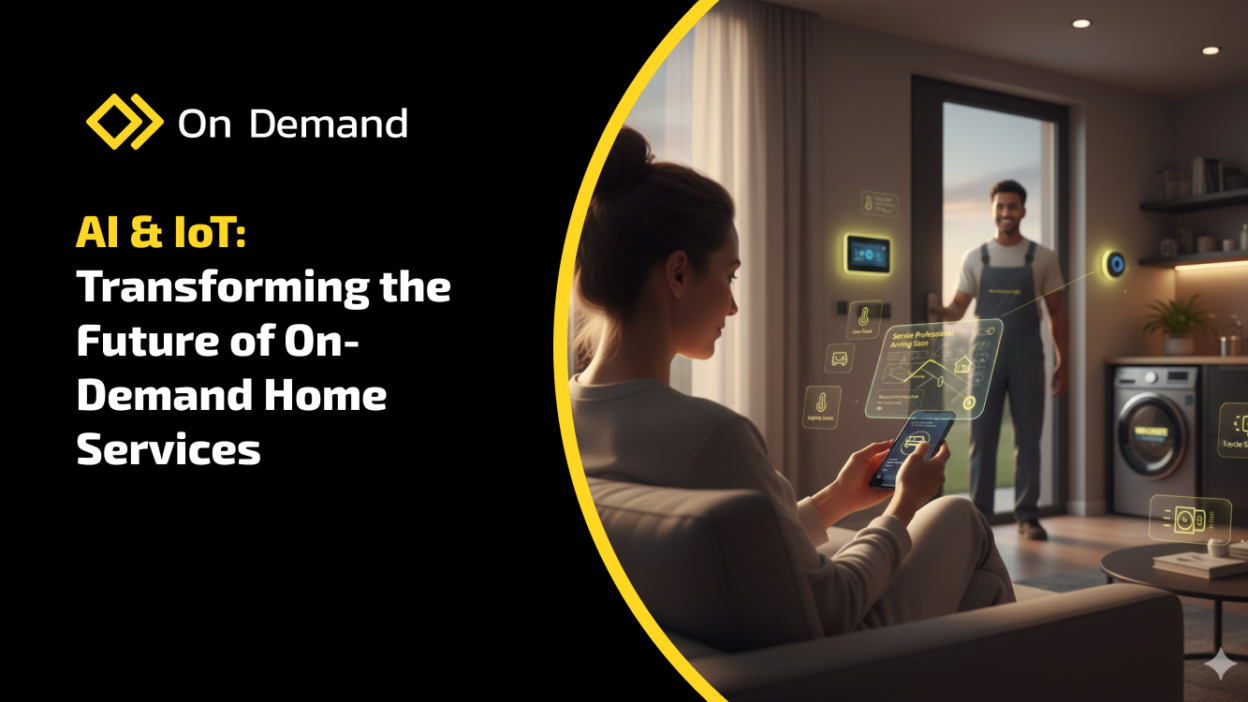
The on-demand home services industry has undergone significant evolution over the past decade. What started as simple booking platforms has transformed into sophisticated ecosystems powered by artificial intelligence (AI) and the Internet of Things (IoT). According to recent market research, the global on-demand home services market was valued at $1,812.8 billion in 2023 and is projected to reach $3,897.4 billion by 2030, growing at a compound annual growth rate (CAGR) of 17.8%.
This explosive growth isn’t just about convenience anymore—it’s about intelligence. AI algorithms now predict when your HVAC system needs maintenance before it breaks down. IoT sensors in smart homes communicate directly with service providers, automatically scheduling appointments. The future of on-demand home services is being written in lines of code that learn, adapt, and optimise every interaction.
For businesses operating in this space, understanding how AI and IoT are reshaping service delivery isn’t optional; it’s essential for survival. Whether you’re running a handyman platform, exploring opportunities in fuel delivery apps, or managing a cleaning service marketplace, these technologies are fundamentally changing how customers discover, book, and experience home services.
The Current State of On-Demand Home Services
Market Dynamics and Growth Drivers
The on-demand home services sector encompasses everything from plumbing and electrical work to cleaning, landscaping, and specialised services like fuel delivery. The pandemic accelerated digital adoption, with 73% of consumers now preferring mobile apps over phone calls for booking home services, according to a 2024 survey by McKinsey & Company.
Several factors are driving this transformation:
Urbanisation and Time Scarcity: With 56% of the global population now living in urban areas, according to World Bank data, consumers face increasing time constraints. On-demand platforms offer the convenience of scheduling services around their busy lives.
Smartphone Penetration: Global smartphone users reached 6.9 billion in 2024, representing 85.7% of the world’s population, according to Statista. This ubiquity makes app-based services accessible to virtually everyone.
Trust and Transparency: Modern platforms address traditional pain points through verified service providers, real-time tracking, transparent pricing, and customer reviews. Research shows that 88% of consumers trust online reviews as much as personal recommendations.
How AI is Revolutionising On-Demand Home Services
Intelligent Matching and Scheduling
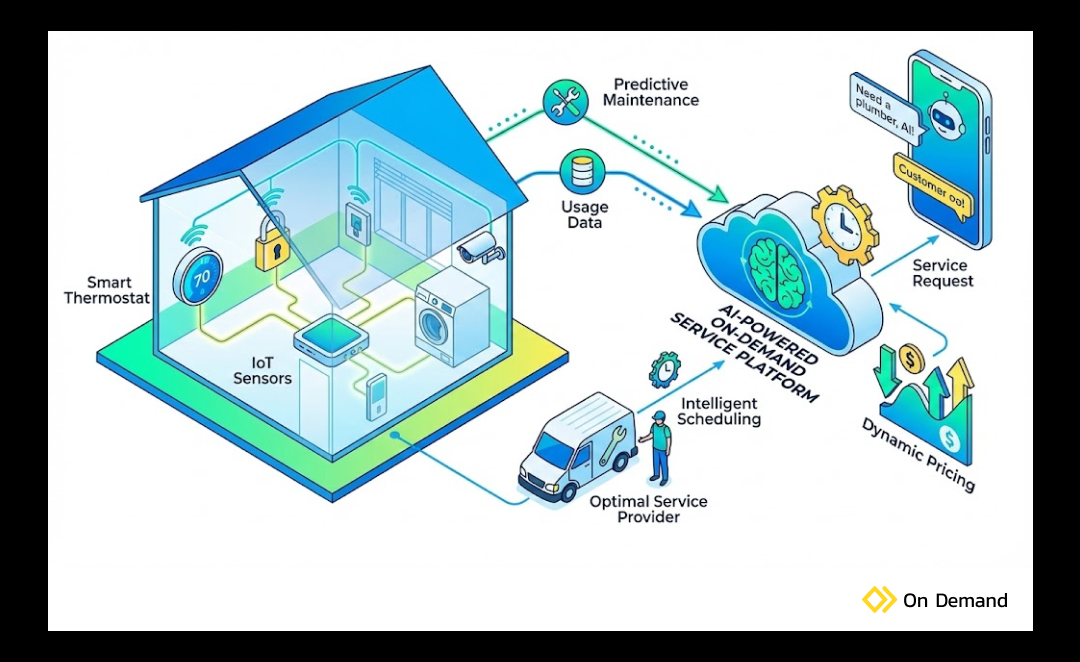
Traditional service platforms relied on basic filtering—location, availability, and price. AI transforms this into sophisticated matching that considers dozens of variables simultaneously. Machine learning algorithms analyse historical data, customer preferences, service complexity, provider expertise, and even traffic patterns to create optimal matches.
For example, AI-powered features in on-demand apps can predict that a customer booking a “routine plumbing check” in an older home might actually need pipe replacement based on patterns from similar properties. The system can then match them with a provider who specialises in renovation plumbing rather than just general maintenance.
Real-world Impact: Companies implementing AI-powered matching have reported 35-40% increases in first-time fix rates and 25% reductions in service times, according to research from the Harvard Business Review.
Predictive Maintenance and Proactive Service
Perhaps AI’s most transformative application is its ability to predict problems before they occur. By analysing data from IoT sensors, service history, equipment age, and environmental factors, AI models can forecast when appliances or systems are likely to fail.
Consider a smart HVAC system connected to a handyman service software platform. The AI monitors performance metrics like energy consumption patterns, temperature regulation efficiency, and cycling frequency. When it detects anomalies that historically precede failures, it automatically schedules a preventive maintenance appointment—often before the homeowner notices any issues.
Market Data: The predictive maintenance market for home services is expected to grow from $5.2 billion in 2023 to $18.6 billion by 2030, according to MarketsandMarkets research, representing a CAGR of 19.3%.
Dynamic Pricing and Revenue Optimisation
AI enables sophisticated pricing strategies that balance supply and demand in real-time. Unlike surge pricing in ride-sharing (which often frustrates customers), AI can implement gradual, transparent adjustments that optimise utilisation without alienating users.
The algorithms consider time of day, seasonal demand, provider availability, service complexity, customer loyalty, and competitive pricing. For instance, a fuel delivery app might offer slight discounts during off-peak hours while maintaining premium pricing for emergency same-day delivery, all while ensuring providers earn fair compensation.
Natural Language Processing for Customer Service
AI-powered chatbots and virtual assistants have evolved far beyond scripted responses. Modern Natural Language Processing (NLP) understands context, sentiment, and intent, enabling it to handle complex customer inquiries without human intervention.
These systems can understand questions like “I need someone to fix my leaky faucet tomorrow morning, preferably before 10 AM, and my house has old plumbing” and immediately process the service type, urgency, timing preference, and potential complexity to provide accurate quotes and available slots.
Efficiency Gains: Businesses implementing advanced NLP chatbots report handling 70-80% of customer inquiries without human agents, reducing operational costs by 30-40%, according to Gartner research.
IoT: The Physical Infrastructure of Smart Home Services
Connected Homes and Automatic Service Triggers
IoT devices transform homes into intelligent environments that can communicate their own service needs. Smart thermostats, connected appliances, leak detectors, and security systems generate continuous streams of data that service platforms can leverage.
A connected washing machine can detect when performance degrades, automatically contacting repair services through integrated platforms. Smart smoke detectors nearing end-of-life can trigger replacement service requests. This shift from reactive to proactive service delivery fundamentally changes the customer relationship.
Adoption Metrics: The number of IoT-connected devices in homes reached 15.9 billion globally in 2024 and is projected to exceed 25 billion by 2030, according to IoT Analytics. This creates massive opportunities for service providers who can integrate with these ecosystems.
Real-Time Monitoring and Quality Assurance
IoT enables unprecedented transparency in service delivery. Service providers equipped with IoT-enabled tools can share real-time progress updates with customers. For example, a white-label home services app might integrate with smart locks, allowing verified cleaners to access homes while homeowners receive notifications of entry, exit, and task completion.Wearable devices and smart tools also capture service quality data. A smart pressure washer used during exterior cleaning logs water pressure, duration, and coverage area, providing verifiable proof of service completion and quality.
Remote Diagnostics and Virtual Consultations
IoT sensors combined with video technology enable remote diagnostics that save time and money for both customers and providers. Before dispatching a technician, smart diagnostic tools can assess problems remotely, ensuring the right specialist arrives with the correct parts on the first visit.
This approach is particularly valuable for complex services. An HVAC system with IoT sensors can transmit performance data to technicians before they arrive, allowing them to diagnose issues and prepare solutions in advance.
Cost Savings: Remote diagnostics reduce unnecessary service calls by 20-30% and decrease diagnostic time on-site by 40-50%, according to Field Service News research.
The Convergence: AI + IoT Creating Intelligent Ecosystems
Autonomous Service Coordination
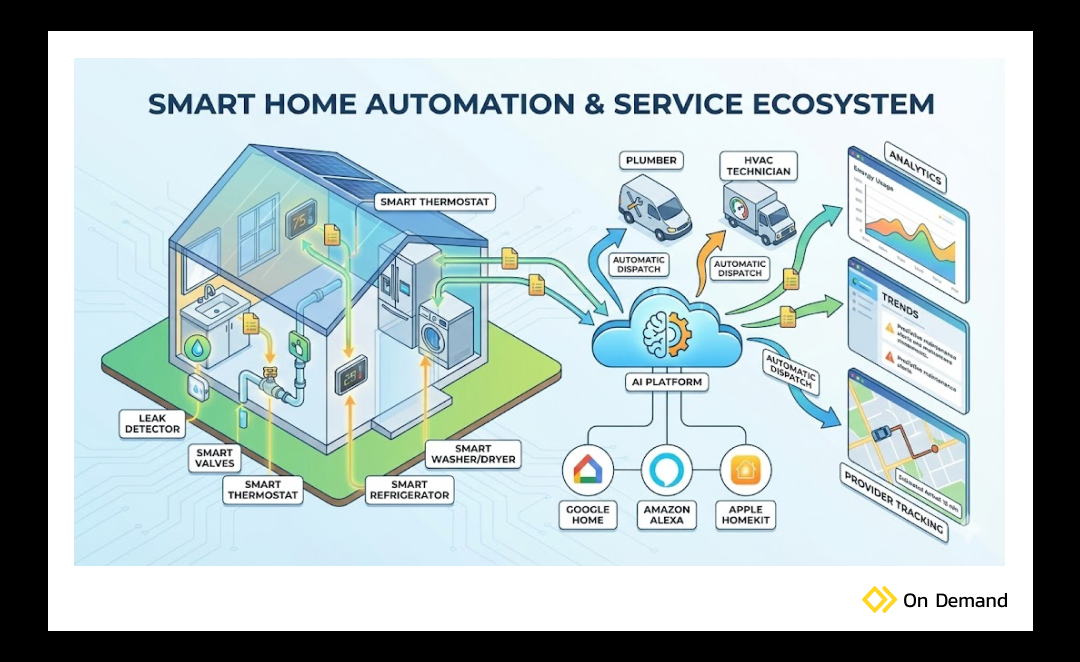
When AI and IoT work together, they create autonomous service ecosystems that require minimal human intervention. IoT sensors detect issues, AI algorithms analyse the data and determine the appropriate response, and platforms automatically schedule and dispatch the right service provider.
To understand this in practice, examining Urban Company’s SaaS-based business model for handyman services showcases how technology-driven marketplaces operate efficiently at scale. Their platform demonstrates how AI-driven resource allocation combined with real-time tracking creates seamless experiences for customers while maximising provider utilisation.
Integrated Smart Home Service Platforms
Forward-thinking companies are developing comprehensive platforms that serve as central hubs for all home services. These platforms integrate with multiple IoT ecosystems (Google Home, Amazon Alexa, Apple HomeKit) and coordinate services across different providers.
Imagine a scenario where your smart home detects a water leak, automatically shuts off the main water valve, alerts you via smartphone, contacts emergency plumbing services, and schedules follow-up inspection and repair—all within minutes and without human coordination.
Data-Driven Business Intelligence
The combination of AI analytics and IoT data creates powerful business intelligence for service providers. Companies can identify trends, optimize service areas, predict seasonal demand, and make strategic decisions based on comprehensive data rather than intuition.
For businesses managing field operations, real-time operations management tools powered by AI and IoT provide visibility into every aspect of service delivery, from provider location and job status to customer satisfaction and revenue metrics.
Emerging Handyman App Trends Powered by AI and IoT
Subscription-Based Preventive Services
Rather than reactive service calls, platforms are launching subscription models where customers pay monthly fees for continuous monitoring and preventive maintenance. IoT sensors monitor home systems continuously, while AI predicts and schedules maintenance before problems occur.
Market Growth: Subscription models in home services grew by 127% between 2022 and 2024, with average customer lifetime value 3.2 times higher than transactional customers, according to Zuora’s Subscription Economy Index.
Augmented Reality for Remote Assistance
AR technology combined with AI guidance allows service providers to offer remote troubleshooting. Customers can use smartphone cameras to show problems, while AI analyses the video feed and provides step-by-step solutions or determines if an on-site visit is necessary.
Some platforms now offer “try before you buy” AR features where customers can visualise home improvements—like new paint colours or fixture replacements—before committing to services.
Blockchain for Service Verification
Emerging platforms are experimenting with blockchain technology to create immutable records of service completion, quality certifications, and customer reviews. This addresses trust issues that have historically plagued home services, especially for high-value work.
Sustainability and Green Services
AI algorithms help optimize service routes to reduce carbon emissions, while IoT sensors monitor energy efficiency and suggest eco-friendly improvements. Customers increasingly value sustainability, with 64% of consumers willing to pay premiums for environmentally conscious service providers, according to a 2024 Deloitte survey.
Comparing Modern Service Management Platforms
For businesses choosing technology platforms, understanding the differences between solutions is crucial. For a clearer view of how modern field service platforms differ in automation and scalability, this Clarro vs Housecall Pro vs Method comparison breaks down which software best supports growing home service businesses.
Key evaluation criteria include:
AI Capabilities: Does the platform offer intelligent scheduling, predictive analytics, and automated customer communications?
IoT Integration: Can it connect with smart home devices and IoT sensors for proactive service?
Scalability: Will the solution support growth from a few providers to hundreds or thousands?
Customer Experience: Does it include features like Customer Portal Software that empower customers with self-service options?
Mobile Functionality: Can service providers access all necessary tools through mobile apps in the field?
Statistical Overview: AI and IoT Impact
|
Metric |
Pre-AI/IoT |
With AI/IoT |
Improvement |
Source |
| First-Time Fix Rate | 62% | 89% | +43% | Field Service News, 2024 |
| Average Response Time | 4.2 hours | 1.8 hours | -57% | Statista, 2024 |
| Customer Satisfaction | 72% | 91% | +26% | Zendesk, 2024 |
| Operational Costs | Baseline | -32% | 32% reduction | McKinsey, 2024 |
| Provider Utilization | 58% | 79% | +36% | Harvard Business Review, 2024 |
| Service Completion Rate | 81% | 94% | +16% | Gartner, 2024 |
Challenges and Considerations
Data Privacy and Security
As platforms collect more IoT data and leverage AI, privacy concerns intensify. Companies must implement robust security measures, transparent data policies, and compliance with regulations like GDPR and CCPA. 73% of consumers express concerns about how service platforms use their smart home data, according to Pew Research.
Technology Integration Complexity
Integrating AI and IoT across diverse smart home ecosystems presents technical challenges. Different manufacturers use different protocols, and creating universal compatibility requires significant development resources.
Digital Divide and Accessibility
While technology offers tremendous benefits, approximately 33% of households globally still lack reliable internet access, according to the International Telecommunication Union. Service platforms must maintain alternative booking methods to serve all customer segments.
Initial Investment Costs
Implementing AI and IoT capabilities requires substantial upfront investment. However, businesses that delay adoption risk being left behind as customer expectations continue rising.
The Future: What’s Next for On-Demand Home Services
Autonomous Service Robots
While still in early stages, robots capable of performing basic home services autonomously are in development. AI guides these robots, while IoT sensors help them navigate homes and complete tasks. Within the next 5-10 years, we may see robotic assistants handling routine cleaning, lawn care, and basic repairs.
Quantum Computing for Optimisation
As quantum computing becomes commercially viable, it will enable optimisation problems that are currently unsolvable—like scheduling thousands of providers across a city while minimising travel time, maximising revenue, and ensuring optimal customer experiences.
Emotional AI for Personalisation
Next-generation AI will detect and respond to customer emotions, adjusting communication styles, service approaches, and recommendations based on sentiment analysis. This creates more empathetic, human-like interactions even in automated systems.
5G and Edge Computing
The rollout of 5G networks enables real-time IoT communication with minimal latency, supporting augmented reality services, remote robotics control, and instant data synchronisation across platforms.

Practical Implementation Strategies
For Startups Entering the Market
If you’re launching a new on-demand home services platform, build AI and IoT capabilities into your foundation rather than adding them later. Start with:
Smart Matching Algorithms: Even basic machine learning improves provider-customer matching significantly compared to manual assignment.
Mobile-First Design: Ensure both customers and service providers have seamless mobile experiences with real-time updates.
API-First Architecture: Build your platform to easily integrate with IoT devices and third-party services through well-documented APIs.
Data Collection Infrastructure: Implement comprehensive analytics from day one to build the dataset necessary for advanced AI models.
For Established Businesses Upgrading
Companies with existing platforms should approach AI and IoT adoption strategically:
Pilot Programs: Test new technologies with select providers and customers before full rollout.
Phased Integration: Implement features incrementally rather than attempting complete overhauls that disrupt operations.
Provider Training: Invest in comprehensive training to ensure service providers can effectively use new technologies.
Customer Education: Help customers understand how new features benefit them through tutorials, webinars, and in-app guidance.
Case Study Insights
AI-Powered Scheduling Success
A mid-sized handyman services platform implemented AI scheduling algorithms and reported remarkable results within six months:
- 42% reduction in average time between booking and service completion
- 38% increase in provider daily job completion rates
- 29% improvement in customer satisfaction scores
- $1.2 million annual cost savings through optimised routing
IoT Integration in Cleaning Services
A commercial cleaning company integrated IoT sensors into their operations, deploying smart devices that monitor cleaning completion, chemical usage, and time spent per location:
- Verification accuracy improved from 71% to 96%
- Customer disputes decreased by 64%
- Insurance costs reduced by 18% due to verifiable service records
- Client retention increased by 31%
Key Takeaways for Business Leaders
As we look toward the future of on-demand home services, several strategic imperatives emerge:
Invest in Technology Infrastructure: The platforms winning market share are those with robust technical foundations that support AI and IoT integration.
Prioritise Data Strategy: AI’s effectiveness depends entirely on data quality. Implement comprehensive data collection, storage, and analysis capabilities.
Focus on Customer Experience: Technology should enhance, not complicate, the customer journey. Every feature should demonstrably improve convenience, reliability, or value.
Build Partner Ecosystems: No single company can develop all necessary technologies. Strategic partnerships with IoT manufacturers, AI developers, and complementary service platforms create competitive advantages.
Maintain Human Touch: While automation improves efficiency, the most successful platforms balance technology with human expertise, especially for complex or emotional customer interactions.
Adapt Rapidly: The pace of technological change continues accelerating. Organisations that can quickly test, learn, and implement new capabilities will thrive.
Regulatory and Compliance Landscape
As AI and IoT become integral to home services, regulatory frameworks are evolving. Companies must navigate:
Data Protection Regulations: GDPR in Europe, CCPA in California, and similar laws globally require explicit consent for data collection and transparent usage policies.
AI Transparency Requirements: Emerging regulations in several jurisdictions require companies to disclose when AI makes decisions affecting customers, such as pricing or service denials.
IoT Security Standards: Governments are establishing minimum security requirements for IoT devices to protect consumers from hacking and data breaches.
Gig Economy Labour Laws: Many jurisdictions are redefining employment classifications for on-demand service providers, affecting how platforms can operate.
Staying ahead of regulatory changes requires dedicated legal expertise and flexible platform architecture that can quickly adapt to new requirements.
The Global Perspective: Regional Variations
North America
The most mature market for AI and IoT-enabled home services, with 62% of service businesses already using some form of AI technology. Strong infrastructure, high smartphone penetration, and tech-savvy consumers drive adoption.
Europe
Balancing innovation with strong privacy protections. European platforms emphasise data security and transparency, often leading global standards for ethical AI use in consumer services.
Asia-Pacific
The fastest-growing market is expected to reach $1.4 trillion by 2030. Countries like China, India, and Southeast Asian nations are leapfrogging traditional service models, moving directly to AI and IoT-enabled platforms.
Emerging Markets
While infrastructure challenges exist, mobile-first approaches are enabling rapid adoption. Many developing countries are seeing service platforms that combine basic mobile apps with innovative offline-capable features.
Conclusion
The integration of AI and IoT into on-demand home services represents more than technological advancement—it’s a fundamental reimagining of how services are discovered, delivered, and experienced. These technologies address longstanding industry pain points: unreliability, lack of transparency, inefficient scheduling, and inconsistent quality.
For businesses, the question isn’t whether to adopt AI and IoT, but how quickly and strategically to implement them. Early adopters are already seeing significant competitive advantages through improved operational efficiency, enhanced customer satisfaction, and new revenue opportunities.
The platforms succeeding in this transformation share common characteristics: they invest in robust technology infrastructure, prioritise customer experience, leverage data intelligently, and maintain flexibility to adapt as technologies evolve.
As we move deeper into 2025 and beyond, the gap between technology-enabled service platforms and traditional competitors will only widen. The future of on-demand home services belongs to businesses that embrace innovation while maintaining the human expertise and reliability that customers ultimately value.
The opportunity is enormous—$3.9 trillion by 2030—but capturing that opportunity requires action today. Whether you’re a startup entering the market or an established business seeking to maintain relevance, understanding and implementing AI and IoT capabilities is no longer optional—it’s essential for survival and growth in the evolving on-demand services landscape.
Continue Learning
Want to dive deeper into building successful on-demand platforms? Check out our comprehensive guide on Essential Features for Building a Successful On-Demand Service App, where we break down the technical requirements, user experience design principles, and business strategies that separate market leaders from the competition.
FAQs:-
1. How is AI improving on-demand home services?
AI helps match customers with the right service provider, predicts potential issues, and optimizes schedules. This leads to faster response times, higher first-time fix rates, and better overall customer satisfaction.
2. Can IoT make home services more proactive?
Yes. IoT sensors in appliances and smart devices detect issues early and can trigger automatic maintenance requests. This reduces emergency visits, improves reliability, and keeps homeowners informed in real time.
3. What are the benefits of combining AI and IoT?
When AI and IoT work together, platforms can automate service scheduling, optimize provider routes, and forecast maintenance needs. Customers enjoy quicker, more reliable services, while businesses save costs and scale operations efficiently.
4. Is investing in AI and IoT worth it for home services?
Absolutely. Integrating AI and IoT improves operational efficiency, enhances customer experience, and allows for smarter decision-making. Early adoption gives businesses a clear competitive advantage in the growing on-demand services market.
5. How can an on-demand platform help my home services business?
It adds AI and IoT features like smart scheduling, predictive maintenance, and real-time tracking, improving efficiency and customer experience.


